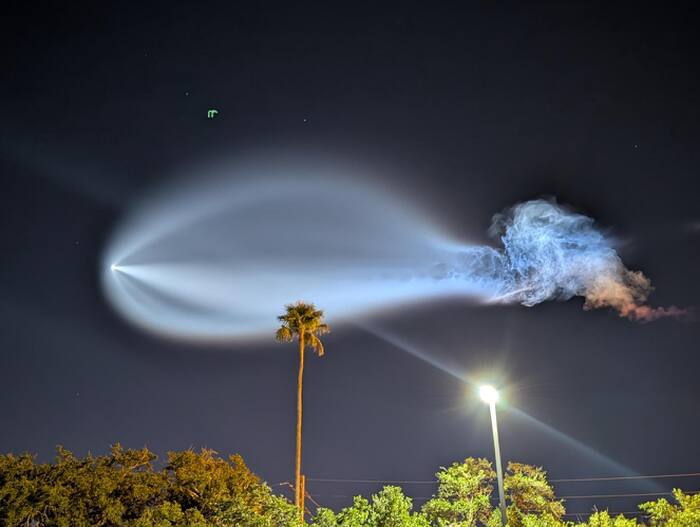
SpaceX Falcon 9 Launch Creates Stunning Space Jellyfish Cloud Over Southeast US
A SpaceX Falcon 9 rocket launched from Cape Canaveral Space Force Station at 6:33:44 a.m. EDT on Tuesday, Oct. 13, 2026, creating a visible “jellyfish-shaped” cloud over Northeast Florida, Southeast Georgia, and parts of the Southeast U.S. The mission, designated CRS-35, is transporting over 6,300 pounds of supplies to the International Space Station.
The science behind the atmospheric display
The jellyfish effect observed by residents across multiple states is a byproduct of rocket exhaust expanding in the upper atmosphere. According to WJXT News4JAX, the launch occurred during the pre-dawn hours, a critical window for visual phenomena. When a rocket ascends shortly before sunrise or after sunset, the exhaust plumes reach high altitudes where they are still illuminated by the sun, even while the ground remains in darkness.
Severe Weather Team 2 Chief Meteorologist Brad Nitz explained that as the rocket’s exhaust moves into the thin upper atmosphere, it rapidly expands. This expansion, combined with the angle of the rising sun, creates the glowing, bulbous shape with wispy trails often likened to jellyfish tentacles. WSB-TV reported that the effect was visible as far north as metro Atlanta, where it was captured by station meteorologists.

Mission details for the SpaceX CRS-35 flight
The Falcon 9 rocket lifted off from Space Launch Complex 40 carrying a Dragon spacecraft. This mission marks the fourth flight for the specific Cargo Dragon spacecraft, identified as C211, and the eighth flight for the Falcon 9 first-stage booster. NASA’s Commercial Resupply Services program oversees the transport of scientific research and equipment essential for station operations.
The spacecraft is currently on a trajectory to reach the International Space Station on Thursday, Oct. 15, 2026. Upon arrival, it is scheduled to dock at the zenith port of the station’s Harmony module. These resupply missions are standard practice for maintaining the orbital laboratory, though the visual impact of the morning launch drew significant public attention across the regional flight path.
Geographic reach of the visual phenomenon
Reports of the glowing plume were widespread, extending well beyond the immediate vicinity of the Cape Canaveral launch site. In addition to observations in Florida and Georgia, the phenomenon was spotted in Roanoke, Virginia, as documented by News 6’s sister station, WSLS-TV.
The event shows how aerospace logistics and local environmental conditions intersect. For organizations involved in aerospace engineering, site management, or large-scale logistical coordination, the complexity of these operations highlights the necessity of maintaining strict NASA Commercial Resupply protocols.
Space Force manages CRS-35 mission risks
While the visual display is a routine result of high-altitude physics, the underlying mission represents a critical link in the supply chain for the International Space Station.

As space travel becomes more frequent, the need for clear communication between launch providers and the public remains essential. Whether managing the atmospheric impact of a launch or the physical logistics of cargo delivery, stakeholders must rely on experienced Space Force operations and aerospace planning experts to mitigate risks and manage public expectations. The successful launch of the CRS-35 mission proves the reliability of the Falcon 9 platform, even as it creates unique visual markers in the morning sky.
Beyond the spectacle, the mission remains focused on the primary objective of delivering science and supplies to the orbiting crew. As the Dragon spacecraft continues its transit, the focus shifts to the docking procedure scheduled for later this week, marking the next phase of the CRS-35 mission profile.
Related reading
- UTA Golf Tied For Eighth After Opening Day At Tall City Collegiate
- Prosecutors Drop Most Impeachment Charges Against Philippine VP Sara Duterte
- Software engineer Brandon Thomas has built AI-assisted replacements for Adobe Creative Cloud and (newsy-today.com)
- Up to 7 MHz Twice: What SpaceX's Reported $8 Billion Actually Buys (daybreakwire.com)