South Korea Hypertension Control Rate Drops to 40% Under New 130/80 Target
Hypertension control rates in South Korea fall to about 40% under the new 130/80 mmHg target set by the International Society of Hypertension, compared with more than 70% under the previous standard, 메디칼업저버 reported.
The gap reflects a large population of patients with systolic blood pressure between 130 and 139 mmHg who need additional reduction to reach goal, said Lee Hae-young of Seoul National University Hospital at a symposium chaired by Kim Young-dae of Dong-A University Hospital during the Korean Society of Hypertension academic conference in November.
SPRINT and ESPRIT trials showed adding one antihypertensive agent to patients on an average of 1.8 drugs lowered systolic pressure by about 10 mmHg and improved clinical outcomes. Doubling calcium channel blocker doses increases efficacy by about 1.4-fold while raising peripheral edema rates from about 8% to 15%, and diuretic dose escalation lifts adverse event rates from about 9% to 18%, Lee said.
S-amlodipine, the active S-enantiomer, provides blood pressure reduction comparable to amlodipine 10 mg at a 5 mg dose with peripheral edema rates below 1%, and switching patients with amlodipine-induced edema to S-amlodipine reduced swelling in about 90% of cases, according to clinical data presented. A 2026 study in the Journal of Cardiovascular Pharmacology found no significant difference in major adverse cardiovascular events between S-amlodipine and amlodipine.
Valsartan 160 mg demonstrated blood pressure lowering, organ protection, and favorable metabolic and renal profiles in studies including the 2002 Circulation and 2010 New England Journal of Medicine studies.
Indapamide, a thiazide-like diuretic, acts on vascular smooth muscle to promote vasodilation in addition to renal diuresis. About 5% is excreted renally versus about 90% for hydrochlorothiazide and about 70% for chlorthalidone. At 1.25 mg, cholesterol, glucose, potassium, and sodium levels remained similar to placebo at eight weeks. Indapamide lowered blood pressure about 5 mmHg more than thiazides and reduced left ventricular mass more effectively.
In elderly patients, indapamide-based therapy cut heart failure risk by 64% in the 2008 New England Journal of Medicine study. Stroke recurrence fell about 30% with indapamide-containing regimens, and a 2009 Hypertension Research meta-analysis found roughly 20% mortality reduction.
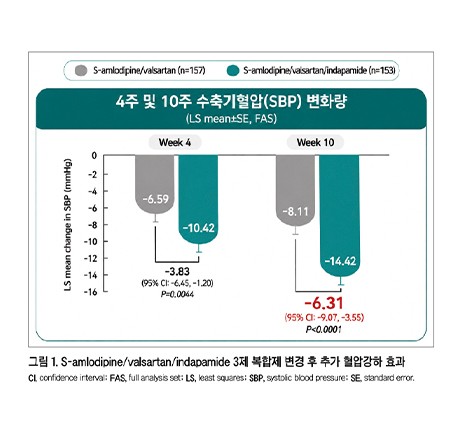
A clinical trial evaluated adding indapamide 1.25 mg to S-amlodipine/valsartan 2.5/80 mg versus continuing the two-drug combination for four weeks, then uptitrating valsartan to 160 mg in both arms through week 10.
At week 10, the triple combination lowered systolic pressure about 6 mmHg more than the dual regimen, with greater diastolic reduction, higher normalization rates, and better response rates. No dizziness or other discomfort-related adverse events were reported with the switch.