South Korea Education Ministry to Issue School AI Guidelines Next Month
Students in South Korea will soon face stricter rules for using generative artificial intelligence in the classroom.
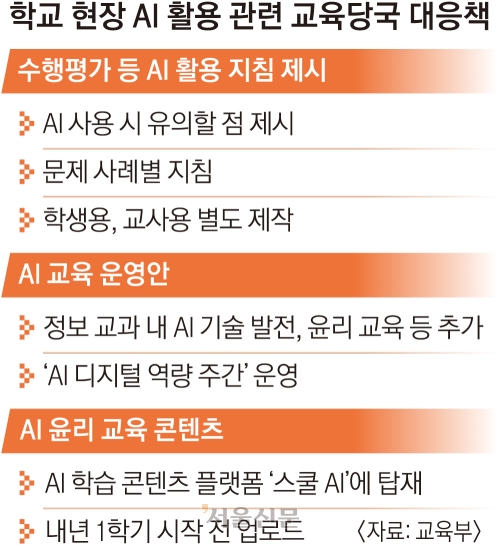
The Ministry of Education plans to distribute new regulatory guidelines next month, according to a report by Seoul Shinmun on Thursday. The policy mandates that students disclose any use of AI tools in their assignments and personally verify the accuracy of the generated results.
The ministry will issue three versions of the “School Generative AI Utilization Guide,” specifically tailored for elementary, middle, and high school students, alongside a version for teachers. These documents aim to eliminate classroom confusion by providing concrete examples of permitted and prohibited AI use.
Performance assessments, which typically account for 30% to 40% of a student’s internal grade, fall under the new restrictions, according to 서울신문. While the ministry permits AI for research purposes, it explicitly bans the submission of AI-generated material as original work. The ministry confirmed that performance assessments will be held to the same disciplinary standards as written examinations.
“If an AI result is submitted as one’s own creative work, it constitutes an act of academic dishonesty,” an official from the Ministry of Education said.
The upcoming guidelines follow earlier, less effective measures. The 2022 “AI Ethics Principles for Education” and a December 2025 announcement prohibiting AI-generated text were widely criticized for being too vague to deter misuse. Current enforcement remains difficult, as many educators and students argue that AI-assisted work is often undetectable unless a student copies a response in its entirety.
“Teachers tell us not to use AI, but unless you copy and paste the entire answer for a performance assessment, it is hard to get caught,” a 17-year-old high school student in Seoul said.
A 47-year-old high school teacher in Seoul said that students often use AI to generate answers for public performance assessment prompts, undermining the goal of fostering critical thinking.
The Ministry of Education, as the central administrative body, oversees national school education policies, including AI guidelines, with the Minister serving as the Deputy Prime Minister for Social Affairs. In 1991, the Local Education Autonomy Act decentralized authority, delegating enforcement to 17 directly elected Metropolitan and Provincial Offices of Education, each with Governors serving 4-year terms responsible for local educational administration.
To prepare for the rollout, the ministry intends to upload ethics-focused educational content to the “School AI” platform before the next semester begins.