South Dakota Voters Reject Sales Tax for Property Tax Relief in Two Counties, Option 0-for-4 at Ballot Box
Voters in Clay and Charles Mix counties on Tuesday rejected half-cent sales tax proposals for homeowner property tax relief, making the option 0-for-4 when it goes to a vote in South Dakota counties.
Nearly 58% opposed it in Clay County; 50.2% opposed the tax in Charles Mix County.
The two defeats leave the county sales tax option winless at the ballot box. At least seven other counties have adopted the tax without a public vote, meaning it takes effect in January in places such as Custer, Hughes, Lawrence, Lincoln, Meade, Pennington and Fall River.
The votes matter because this year the South Dakota Legislature and Gov. Larry Rhoden gave counties the authority during this year’s legislative session to implement their own half-percent sales tax for the first time in state history, with proceeds lowering homeowners’ property taxes.
Lawmakers and the governor also decided to use proceeds from next year’s state sales tax increase — from 4.2% to 4.5% — toward property tax relief statewide. Voters in Brown and Codington counties had already rejected the local option at the Nov. 3 general election.
“My plan to cut property taxes empowers South Dakotans to choose what works best for their county,” Rhoden said. “And people in different counties will make different choices — that’s why we left all options open to refer and initiate these measures.”
Rhoden sent that statement to South Dakota Searchlight after the Nov. 3 rejections. He had told South Dakota Public Broadcasting earlier this year that the approach was deliberately local: “We left as many options available to the local governments as possible,” he said, adding that it was “totally up to individual counties whether it’s a good fit for them or not, and whether the citizenry agrees with them or not.”
Seven votes apart in Charles Mix
Charles Mix County, whose seat is Lake Andes, came within a whisker of passing the tax. Unofficial returns showed 656 votes against and 649 in favor, a margin of seven votes. Seven provisional ballots were part of the count, South Dakota Public Broadcasting reported.
The Charles Mix County commission is scheduled to canvass the election results at its meeting Friday at 11:30 local time. As of press time, the auditor had yet to respond to an inquiry from South Dakota Searchlight about whether a recount might be possible.
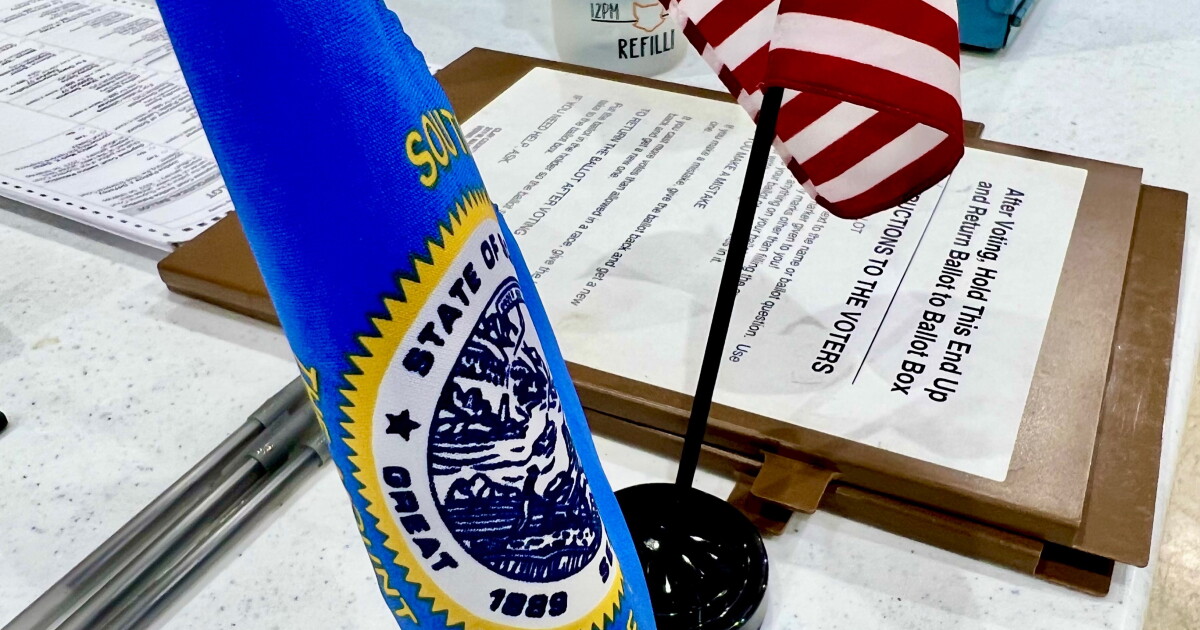
Clay County, home to Vermillion, saw a clearer verdict: over 57% opposed the ordinance, South Dakota Public Broadcasting reported, close to the nearly 58% figure News From The States gave. Turnout was 27.5% in Clay and 22.5% in Charles Mix, per the counties’ auditors.
| County | Vote on sales tax | Turnout | When |
|---|---|---|---|
| Clay | Nearly 58% opposed | 27.5% | Tuesday |
| Charles Mix | 656 against, 649 for | 22.5% | Tuesday |
| Brown | Rejected | — | Nov. 3 |
| Codington | Rejected | — | Nov. 3 |
Why the vote came a week late
Both referendums landed on Tuesday rather than Nov. 3 because general election ballots were already printed when petitioners turned in the signatures needed to force the votes. In Clay County, commissioners had adopted the ordinance directly; opponents gathered signatures to refer it to the ballot.
Among them was Julia Kleinschmit, a social worker who helped lead the petition drive in Clay County.
Julia Kleinschmit told South Dakota Public Broadcasting that she got mad about the situation.

She pointed to the burden a sales tax places on people already stretched thin. “Gas is so high. Groceries are so high. We have a record number of people using our Feeding Vermilion pantry,” she said. “And that the county commissioners would pass on a higher sales tax on those same people.”
Kleinschmit said homeowners themselves pushed back on the fairness of the arrangement. “What I heard over and over again is ‘That is not fair to people who don’t own homes,’” she told the broadcaster, noting that 48% of Clay County residents rent. “And they, the folks who were homeowners said, ‘Somebody else shouldn’t be paying my property taxes.’”
The regressive-tax argument
The debate at the state level ran along the same lines. Two major pieces of legislation this year tied sales taxes to property tax relief. One measure, championed by Gov. Larry Rhoden, gave the county half-cent sales tax option. Another bill, designated SB 245, redirected a state sales tax increase already on the schedule so that its proceeds would go toward property taxes.
Opponents called the approach regressive, South Dakota Public Broadcasting reported: everyone pays sales taxes, including renters and non-homeowners, while the relief goes to homeowners. Kleinschmit argued the state had shifted the fight downward. “There should be more leadership at the state,” she said.
“I think that Gov. Rhoden and other legislators punted this to the counties and created this fight at our level, instead of being responsible at the state level to really take a systematic view of property tax reform.”
The underlying pressure is real. Rising property taxes across the state drove the legislative package in the first place, and homeowners in counties that rejected the tax will look to the statewide relief funded by the state rate increase instead.
What the split means for 66 counties
The state now has two tracks running at once. In seven counties, commissioners adopted the tax without a referendum — Custer, Hughes, Lawrence, Lincoln, Meade, Pennington and Fall River — and it takes effect in January, South Dakota Public Broadcasting reported. In the four counties where voters weighed in, the answer has been no every time.
That leaves 55 counties that have done neither, and the 0-for-4 record at the ballot box gives their commissioners a clear signal about how such a tax might fare if petitioners refer it.
The Legislature’s bill pages for the county sales tax option and Senate Bill 245 document the statutory framework behind both tracks.
Rhoden, born in 1959, took office as South Dakota’s 34th governor in January 2025 after Kristi Noem resigned to become United States Secretary of Homeland Security. Before that, he served as the state’s 39th lieutenant governor from 2019 to 2025, following more than a decade and a half in the Legislature: four terms in the House, where he spent four years as majority leader, and two stints in the Senate.
His path to the governor’s office included an earlier run for higher office — a 2014 U.S. Senate campaign that ended in the Republican primary, where he lost to former governor Mike Rounds. In November, he announced his candidacy for the 2026 gubernatorial election.
For Charles Mix County, the next number is the one that comes out of Friday’s canvass. The unofficial margin stands at seven votes, and the county’s posted election results remain unofficial until the commissioners certify them.