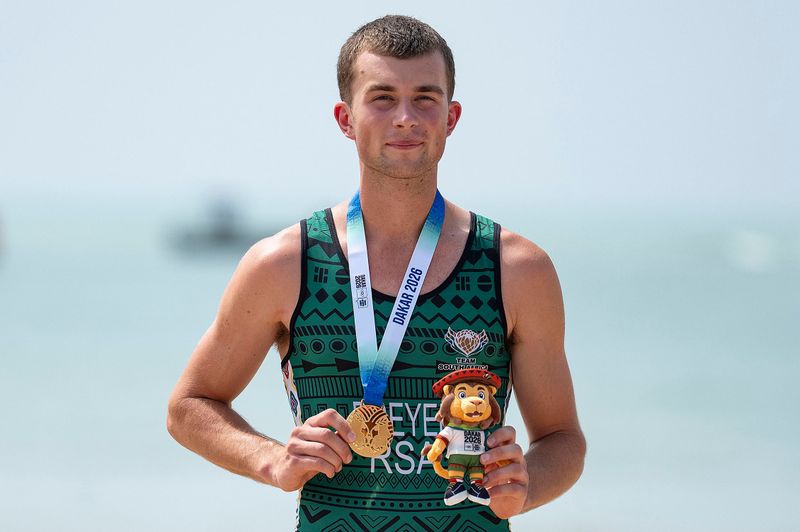
South African Rower Callum Dreyer Wins Inaugural Gold in Coastal Beach Sprints at Youth Olympic Games
South African rower Callum Dreyer won the inaugural men’s solo coastal beach sprints title at the Dakar 2026 Youth Olympic Games on 3 November, clocking an event-best 2:15.65 in the final just 15 months after first picking up an oar.
The 16-year-old from KwaZulu-Natal, competing unranked and internationally for the first time, won three knockout races in 50 minutes on Saly Beach to claim the country’s first gold medal in the discipline.
Dreyer entered the Games having learnt coastal beach sprints only five months earlier, according to coach Avlyn Gallwey, who serves as his manager, coach and female boat handler.
“In the back of our minds, we believed that Callum had the talent and the ability, but having never actually stood on any kind of stage to do a knockout race, other than in training, we didn’t want to put too much pressure on him,” Gallwey told Daily Maverick. The initial target was simply to progress past the time trials into the last 16.
Dreyer placed fourth in the time trials, then recorded the fastest time of the last-16 round to reach the quarter-finals. On finals day he edged Czechia’s Ondrej Zizka by 0.14 seconds in the quarter-final, dominated Hungary’s Adam Moor in the semi-final, and defeated Spain’s Diego Molina Martinez by nearly 30 seconds in the final.
“I couldn’t believe it. It was surreal,” Gallwey said. “He was completely unranked. We had no idea how he would fare against this international competition. We knew he had the talent and the determination and the ability, but to see him just grow as the competition went on was an absolute privilege.”
Because beach sprints make their Olympic programme debut at these Youth Games, Dreyer’s 2:15.65 stands as the first Olympic record in the event. “Although unranked, Callum completely dominated the men’s solo coastal beach sprints competition, defeating Spain’s Diego Molina Martinez in the final on Saly Beach with an absolute event-best time of 2:15.65,” Gallwey told The Citizen.
“Because this is the first time beach sprints have ever featured in an Olympic event, Callum is officially the first-ever Olympic record holder, setting the absolute fastest time of the entire regatta during his final golden run.”
Gallwey described Dreyer as possessing “quiet determination, calmness under extreme pressure and a maturity far beyond his years.” She credited flat-water head coach Ernie Steenkamp at Hilton College for foundational technical work on Midmar Dam, and thanked the South African Sports Confederation and Olympic Committee, RowSA, Team SA management, medical staff, chef de mission Sizwe, male boat handler Martin Dreyer, the Organising Committee for the Olympic Games and the Senegalese hosts.
“It has been an absolute privilege to witness a local KZN athlete who only took up beach sprint rowing five months ago blow the global competition away,” Gallwey said. “Callum has done his country, his school, KZN Beach Sprints and our entire local community so proud.”

Coastal beach sprints, added to the Olympic programme in 2023 ahead of a Los Angeles 2028 debut, begin with a 50-60 m beach sprint to the boat, a slalom around two buoys, a 250 m turn and a return through surf to a beach finish.
“It’s a mad dash,” Gallwey said. “It’s a combination of sprinting, rowing, being able to read the surf or the waves and it’s just action and dynamic and exciting.”