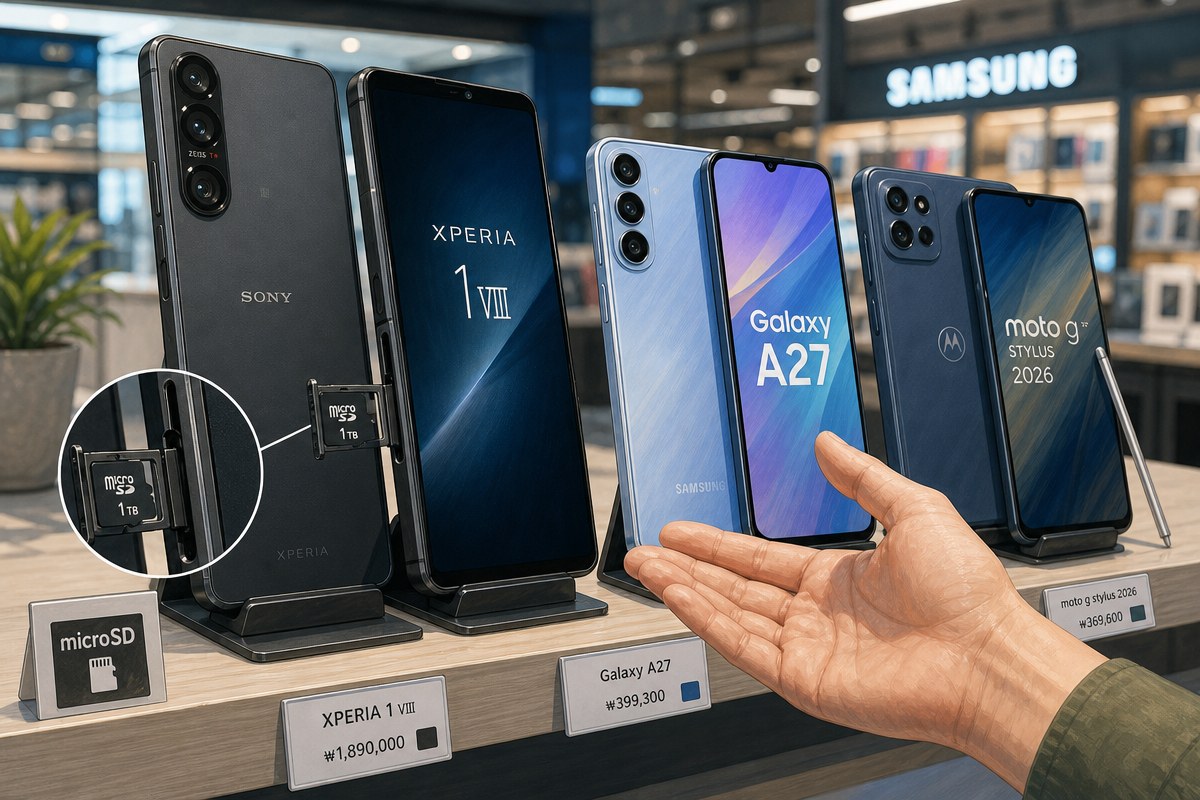
Sony Xperia 1 VIII Is the Only 2026 Android Flagship with Expandable Storage
As the smartphone industry absorbs the structural shock of the 2026 memory market—widely termed ‘RAMageddon’—expandable storage has vanished from nearly all tier-one handsets, leaving the Sony Xperia 1 VIII as the sole remaining mainstream flagship equipped with a physical microSD card slot. According to technical reports from Android Authority and How-To Geek, escalating memory and storage silicon prices have forced original equipment manufacturers to strip out local expansion ports, shifting the financial burden of high-capacity configurations directly onto enterprise and consumer buyers. While Samsung effectively purged expandable storage from its flagship lineup when the Galaxy S series abandoned the feature with the Galaxy S20 generation, structural memory inflation has now pushed expansion slots out of upper-tier mid-range devices like the Galaxy A56 as well.
The Tech TL;DR:
- The Hardware Reality: Driven by 2026 ‘RAMageddon’ memory price spikes, the Sony Xperia 1 VIII stands as the lone Android flagship offering a microSD card slot.
- Mid-Range Holdouts: Devices like the Samsung Galaxy A27 and Moto G Power retain expansion capabilities, though performance is restricted by mid-tier SoCs like the Snapdragon 6 Gen 3 and MediaTek Dimensity 6300.
- Deployment Friction: Enterprise and consumer buyers eyeing the Xperia 1 VIII face severe import hurdles, limited regional availability, and complex 5G network compatibility configurations in North America.
Architectural Pressures: Why Flagship Expandable Storage Collapsed
The systematic removal of microSD slots from high-end mobile hardware is not merely a design preference for unibody waterproofing or internal thermal management; it is an economic triage necessitated by volatile flash memory pricing. According to analysis published by Android Authority, manufacturers are no longer able to absorb escalating DRAM and NAND component costs internally. Consequently, high-capacity internal storage tiers carry aggressive retail premiums. For power users, local media creators, and field engineers dealing with massive datasets, external flash memory via SDXC cards historically served as a low-cost performance bypass. Today, that escape hatch is restricted almost exclusively to entry-level and select mid-tier hardware classes.
For organizations deploying mobile hardware at scale, managing local device storage without hardware expansion requires tight control over containerization, edge caching, and cloud offloading.
The 2026 Flagship Landscape: Sony Xperia 1 VIII vs. The Industry
Pinpointing an enterprise-grade or consumer handset that combines current-generation processing power with physical storage expansion reveals a stark market vacuum. Per historical tracking by How-To Geek, Samsung’s Galaxy S20 series marked the final iteration of the S-line to feature a microSD slot, a design choice replicated across competing tier-one ecosystems. In 2026, the Sony Xperia 1 VIII occupies an isolated position as the only high-end flagship retaining the feature.
| Device Model | Processor (SoC) | Max Base RAM/Storage | microSD Support | Primary Market / Availability |
|---|---|---|---|---|
| Sony Xperia 1 VIII | Qualcomm Snapdragon 8 Elite Gen5 | High-Tier Flagship Specs | Yes (Dedicated/Hybrid Slot) | Global / Limited North American Support |
| Samsung Galaxy A27 | Qualcomm Snapdragon 6 Gen3 | 6GB RAM / Standard Storage | Yes | International Mid-Range |
| Moto G Power (2025/2026) | MediaTek Dimensity 6300 | 8GB RAM / 128GB Storage | Yes | Global Entry/Mid-Range |
Under the hood, the Sony Xperia 1 VIII packs Qualcomm’s Snapdragon 8 Elite Gen5 silicon, matching top-tier computational performance with physical media flexibility, dual front-facing speakers, and a legacy 3.5mm headphone jack. However, structural supply-chain hurdles accompany the hardware. According to How-To Geek, the device lacks official tier-one distribution in the United States. Importers must navigate complex carrier provisioning, and every subsequent over-the-air software update risks breaking 5G radio band functionality, demanding manual reconfiguration of APN profiles and network protocols.
Evaluating Mid-Range Alternatives and Expansion Constraints
For buyers unwilling to import unsupported hardware, expandable storage is confined to lower-tier silicon architectures. Samsung’s Galaxy A56 dropped the microSD slot found in its predecessor, but the Galaxy A27 preserves the feature, pairing a Qualcomm Snapdragon 6 Gen3 chip with 6GB of RAM and a 6.7-inch 120Hz AMOLED panel. According to hardware breakdowns, the device is slated for six years of major software support running atop Android 16.
Similarly, the Galaxy A55 5G—available via online channels like Amazon for roughly $430—utilizes a hybrid SIM tray that accepts up to a 1TB microSD card in its secondary slot. Driven by an Exynos 1480 processor, a 5000mAh battery, and an IP67 rating, it provides a resilient physical build despite omitting native Galaxy AI processing suites. Motorola adopts a parallel strategy, restricting expansion to its Moto G catalog. The Moto G Power offers IP68/IP69 ingress protection and MIL-STD-810H ruggedization at an accessible price point, though its MediaTek Dimensity 6300 chipset limits execution speeds for intensive, concurrent background processes.
When hardware failures strike older, non-expandable enterprise fleets or rare import flagships, businesses cannot afford prolonged operational downtime.
Technical Implementation: Managing Storage Limits via CLI
When physical expansion slots are unavailable on modern flagships, developers and system administrators must script automated cleanup routines to manage local cache saturation and prevent I/O bottlenecks.
# Connect to target Android device via ADB and inspect internal storage allocation
adb shell df -h /data

# List top 10 largest application data directories to identify storage hogs
adb shell du -h --max-depth=1 /data/data | sort -hr | head -n 10

# Clear application cache for a specific target package to reclaim local blocks
adb shell pm clear com.example.heavyapp
Deploying scripts of this nature across a corporate device deployment requires rigorous adherence to security baselines.
The Editorial Kicker: The Trajectory of Mobile Storage Flexibility
The retreat of expandable storage from flagship hardware underscores a permanent shift in mobile systems architecture, where manufacturers prioritize internal proprietary silicon margins over user-accessible modularity. While the Sony Xperia 1 VIII proves that high-end performance and microSD slots are technically reconcilable, its restricted geographic availability and import friction relegate true local storage freedom to a niche pursuit. As memory pricing volatility persists, enterprise IT planners must architect infrastructure around cloud-first data synchronization rather than hardware-level expansion, accepting that the era of the expandable flagship has effectively drawn to a close.

Disclaimer: The technical analyses and security protocols detailed in this article are for informational purposes only. Always consult with certified IT and cybersecurity professionals before altering enterprise networks or handling sensitive data.