
Solar Energy Breakthrough: Molecular Vibrations Speed Up Electron Transfer
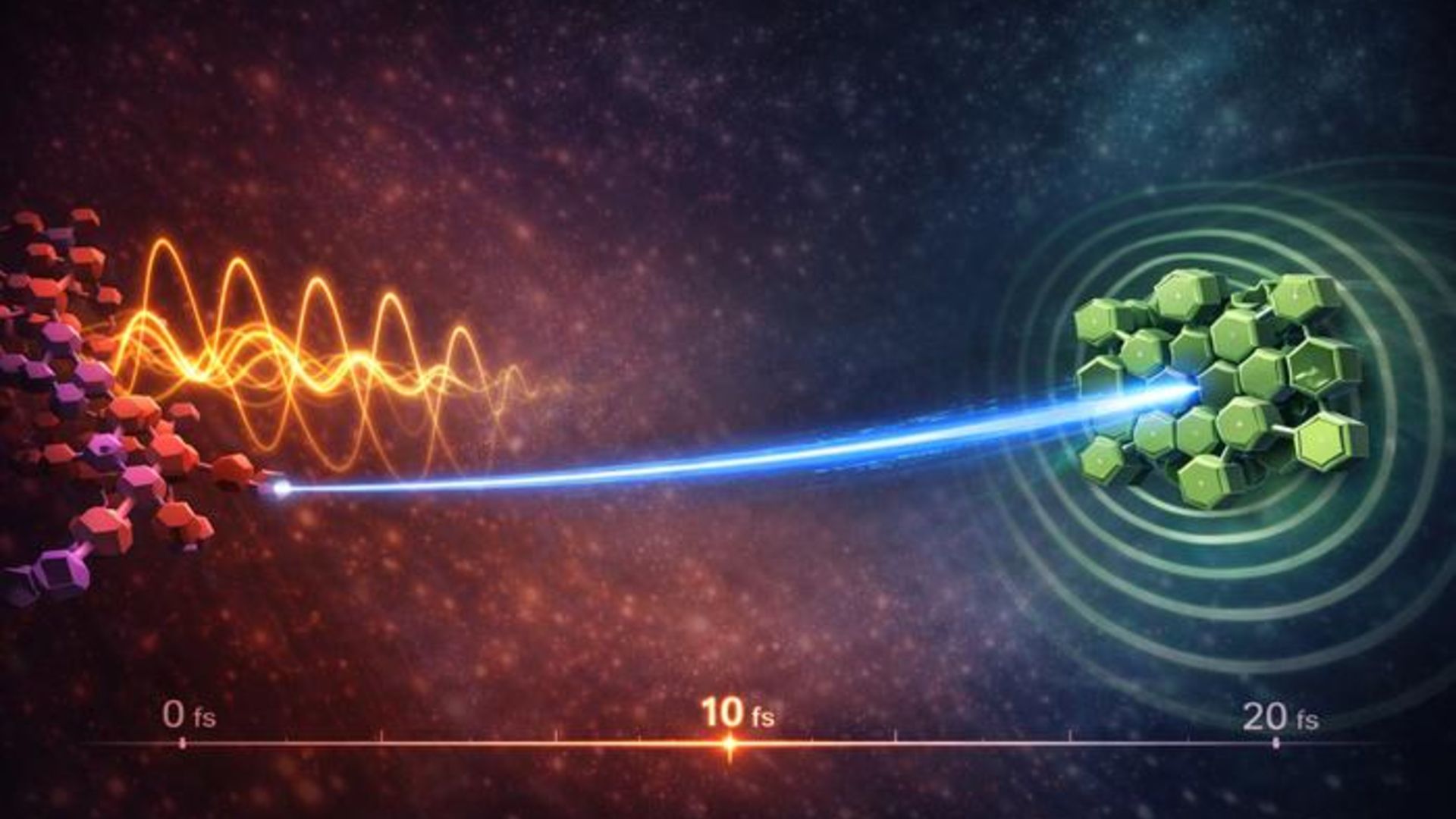
Electrons can traverse materials used in solar cells with unprecedented speed – in as little as 18 femtoseconds, roughly the time it takes for a molecule to vibrate – according to a new study published March 5 in the journal Nature Communications. The discovery, made by researchers at the University of Cambridge, could pave the way for significantly more efficient organic solar cells.
The research centers on understanding how electrons move within organic solar cells, which utilize carbon-based molecules to convert sunlight into electricity. While theoretically cheaper to produce than traditional silicon-based cells, organic solar cells have historically suffered from lower efficiency. A key challenge lies in optimizing the transfer of electrons from the light-absorbing material (the donor) to the material that carries the current (the acceptor).
“We’re effectively watching electrons migrate on the same clock as the atoms themselves,” said Pratyush Ghosh, a researcher at the University of Cambridge and co-author of the study. The team employed a sophisticated technique involving short laser pulses to excite electrons in a polymer donor material, TS-P3, and then used a second laser to track the subsequent charge transfer process.
Conventional understanding dictates that efficient charge transfer requires strong “electronic coupling” between the donor and acceptor molecules, allowing electrons to move easily. However, this often comes at the cost of lower voltage output. The Cambridge team observed remarkably fast charge transfer without relying on this traditional requirement. Instead, they found that molecular vibrations within the donor material acted as a catalyst, effectively “catapulting” electrons across the interface to the acceptor molecule.
“Instead of drifting randomly, the electron is launched in one coherent burst,” Ghosh explained. “The vibration acts like a molecular catapult. The vibrations don’t just accompany the process, they actively drive it.” When the electron reached the acceptor molecule, it triggered corresponding vibrations, further accelerating the transfer.
This process occurs on an extraordinarily fast timescale. While some systems exhibit charge transfer over 100 to 200 femtoseconds, the Cambridge team’s experiments revealed transfer happening in just 18 femtoseconds – comparable to the speed of molecular vibrations themselves.
Akshay Rao, a physicist at Cambridge and co-author of the study, emphasized the potential implications for materials design. “Instead of trying to suppress molecular motion, we can now design materials that use it – turning vibrations from a limitation into a tool,” Rao stated. The researchers believe their findings provide a new framework for developing organic solar cells that are both more efficient and cost-effective.
The study, titled “Vibronically assisted sub-cycle charge transfer at a non-fullerene acceptor heterojunction,” details the experimental setup and findings. (Ghosh, P., Royakkers, J., Londi, G., Giannini, S., Arul, R., Gillett, A. J., Keene, S. T., Zelewski, S. J., Beljonne, D., Bronstein, H., & Rao, A. (2026). Nature Communications, 17(1).) Further research is planned to explore the application of this principle to a wider range of materials and device architectures.