
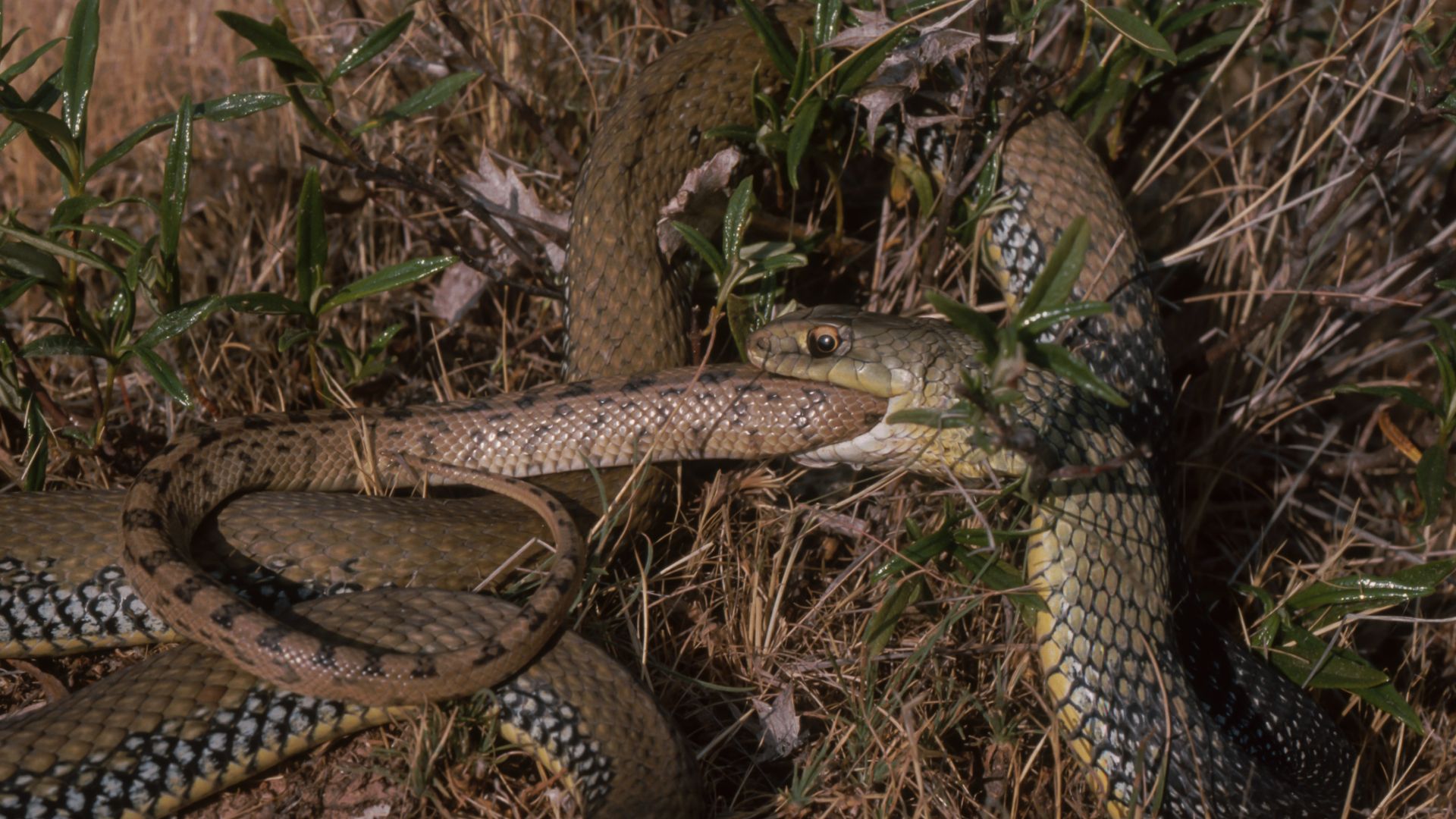
Snakes are evolving to eat one another with surprising frequency, a behavior scientists say is driven by environmental stressors and offering a strategic advantage for survival. A comprehensive review of existing reports, encompassing 503 documented cases across at least 207 snake species, reveals that cannibalism has arisen independently at least 11 times throughout snake evolutionary history.
The research, published November 2, 2025, in the journal Biological Reviews, challenges previous assumptions that cannibalism is a maladaptive trait. Instead, researchers found the behavior provides ecological benefits, particularly when resources are scarce. “For us humans, we don’t consider of cannibalism as something common – it’s something weird and disgusting,” said Bruna Falcão, lead author of the study and a graduate student in biology at the University of São Paulo. “But for snakes, it’s good for them; it’s good for their ecological fitness. … It’s strategic.”
While cannibalism is observed across the animal kingdom – including spiders and praying mantises – the prevalence in snakes was unexpected. The study team gathered reports from across all continents inhabited by snakes, encompassing both wild and captive populations. “None of us expected that … snakes could be so cannibalistic, and no one was talking about it,” Falcão stated.
The most frequently reported instances of cannibalism occurred within the Colubridae family, accounting for 29% of all cases. Yet, researchers noted that this family isn’t typically known for preying on other snakes, suggesting that food scarcity is a primary driver of the behavior in this group. Viperidae (vipers) accounted for 21% of reports, but these were largely observed in captivity, potentially linked to stressors associated with confinement and limited food availability. Elapidae (cobras) represented approximately 19% of cases, consistent with the known predatory behavior of cobras, which regularly consume other snakes in the wild.
Dietary flexibility appears to play a role, with almost half of the snake species exhibiting cannibalistic behavior also classified as having generalist diets. This suggests that snakes capable of consuming a wide range of prey are more likely to turn to cannibalism when other food sources are limited. However, biologist Xavier Glaudas, a National Geographic Explorer not involved in the study, cautioned that the data supporting this connection could be stronger, noting that only 47.7% of the cannibalistic snake species were definitively classified as generalists.
A physical prerequisite for cannibalism is the ability to consume another snake, which is directly related to jaw structure. No instances of cannibalism were reported in snake species lacking the jaw flexibility to swallow a conspecific.
The study builds on previous, often isolated, reports of cannibalistic behavior. For example, research by Glaudas’ team documented male Montpellier snakes in France consuming females, a behavior believed to be linked to limited food resources outside of the mating season. Eating females during the mating season would be counterproductive, reducing opportunities for reproduction.
Falcão acknowledged that the review likely doesn’t encompass all instances of cannibalism in snakes, as many reports remain in older, less accessible publications. Further research is needed to fully understand the scope and drivers of this widespread behavior. The study team is continuing to analyze existing data and solicit new reports to build a more comprehensive picture of cannibalism in snakes.
