
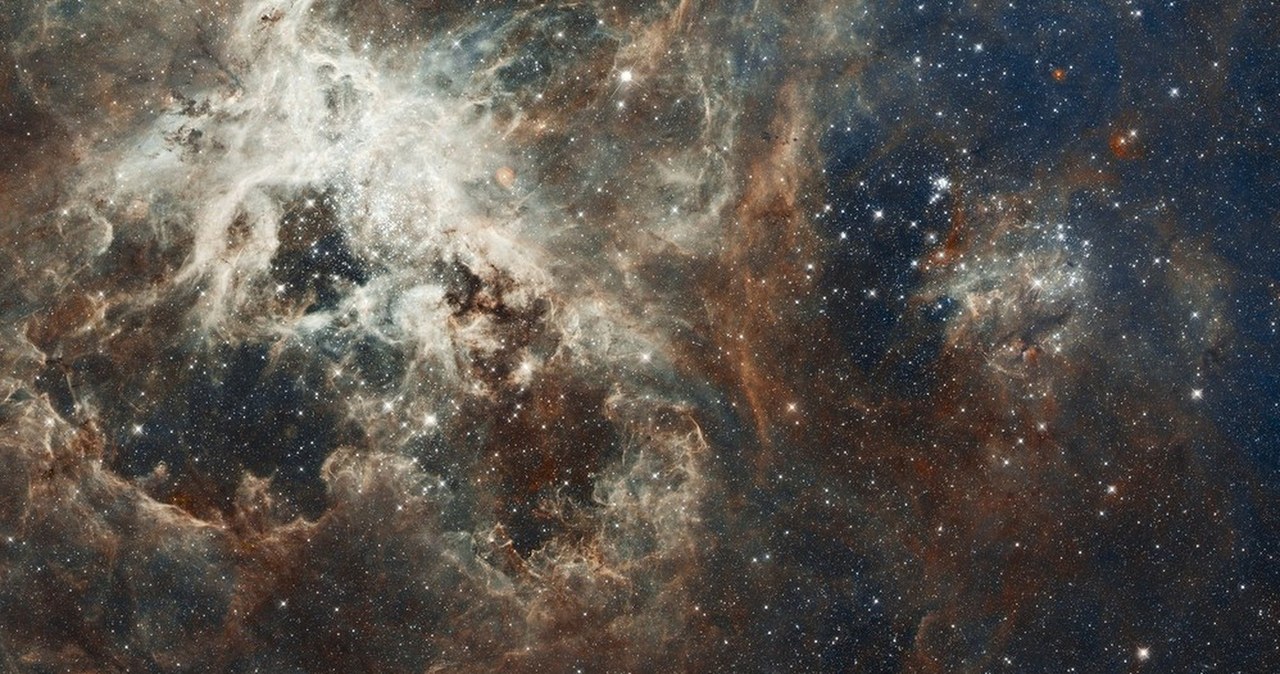
Small Magellanic Cloud Is Breaking Apart: What Is Causing the Catastrophe?
The Magellanic Clouds—two of the Milky Way’s closest galactic neighbors—have long been cosmic constants, their faint glow visible to the naked eye in the Southern Hemisphere’s night sky. But astronomers now confirm what telescopes have begun to reveal in stark detail: the Small Magellanic Cloud (SMC), the smaller of the pair, is unraveling before our eyes. New observations from the European Southern Observatory’s Very Large Telescope (VLT) and NASA’s Hubble Space Telescope show the SMC’s outer regions being stripped away by gravitational forces, its stars and gas dispersing into the void at a rate that defies typical galactic evolution. The process, described in a study published this week in Nature Astronomy, is not a gradual fade but an accelerating disintegration—one that may reshape our understanding of how dwarf galaxies survive in the universe’s harsh gravitational tug-of-war.
The discovery hinges on two critical findings. First, the SMC’s stellar halo, a diffuse outer layer of ancient stars, is being torn apart by the Milky Way’s gravity. Second, the galaxy’s neutral hydrogen gas—the raw material for future star formation—is spilling into intergalactic space at an unprecedented rate. “We’re witnessing a galaxy in the throes of death,” said Dr. Elena D’Onghia, an astrophysicist at the University of Wisconsin-Madison and lead author of the study. “The SMC isn’t just fading—it’s being actively dismantled by tidal forces, and the process is happening faster than models predicted.”
Why is this happening now?
The SMC’s demise is the result of a cosmic collision it never saw coming. For billions of years, the Magellanic Clouds orbited the Milky Way in a delicate balance, their combined gravity binding them together. But about 250 million years ago, the Large Magellanic Cloud (LMC)—the SMC’s larger sibling—underwent a close encounter with the Milky Way. That interaction sent shockwaves through the system, destabilizing the SMC’s orbit and exposing it to the Milky Way’s relentless pull. The LMC, now 120,000 light-years away from the Milky Way’s center, acts as a gravitational anchor, but its own distorted path has left the SMC stranded in a highly elliptical orbit, where tidal forces stretch and tear at its structure.
Data from the VLT’s MUSE instrument reveals that the SMC’s outer regions are being stripped at a rate of approximately 10,000 solar masses per year—equivalent to the mass of a small globular cluster dissolving into space. Meanwhile, Hubble’s ultraviolet observations show that the galaxy’s star formation rate has plummeted by 30% over the past 50 million years, a direct consequence of gas loss. “The SMC is losing its ability to form new stars,” said Dr. David Nidever, an astronomer at Montana State University and co-author of the study. “Without gas, it’s essentially running out of fuel.”
What happens next for the SMC?
The SMC’s fate is now inextricably linked to the Milky Way’s future. Astronomers project that within the next 500 million years, the galaxy will either be completely absorbed by the Milky Way or reduced to a sparse stellar stream—a ghostly trail of stars and gas marking its former path. The LMC, too, is on a collision course with our galaxy, though its larger mass means it may survive longer as a distinct structure before merging. “The Magellanic Clouds are the last major satellites of the Milky Way,” said D’Onghia. “Their destruction will leave our galaxy without its most prominent companions—a cosmic milestone.”
The implications extend beyond the SMC’s immediate demise. Dwarf galaxies like the Magellanic Clouds are laboratories for understanding galaxy formation. Their relatively simple structures and proximity allow astronomers to study processes that are obscured in more distant, complex galaxies. The SMC’s disintegration offers a rare opportunity to observe tidal stripping in real time, a phenomenon that likely played a role in shaping the early universe. “This is like watching a car crash in slow motion,” said Nidever. “We’re seeing the mechanics of galaxy interactions play out in a way we’ve only theorized about before.”
Yet the SMC’s story is not just one of loss. Its remnants will contribute to the Milky Way’s halo of stars and gas, enriching our galaxy with heavy elements forged in the SMC’s stars. Some of the gas stripped from the SMC may even trigger new star formation in the Milky Way’s outer regions. “In a cosmic sense, the SMC’s destruction is a creative force,” said D’Onghia. “It’s recycling material that will become part of something new.”
The European Southern Observatory and NASA have prioritized further observations of the SMC using the upcoming James Webb Space Telescope, which will probe the galaxy’s molecular gas clouds and young star clusters in unprecedented detail. Meanwhile, simulations at the Max Planck Institute for Astronomy are refining models of the Magellanic Clouds’ orbits to predict exactly when—and how—their final merger with the Milky Way will occur.
For now, the SMC remains visible to stargazers in the Southern Hemisphere, its faint glow a reminder of the universe’s relentless cycle of creation and destruction. But telescopes are capturing its last gasps—a galaxy being torn apart, not by an external force, but by the inexorable laws of gravity that govern the cosmos.