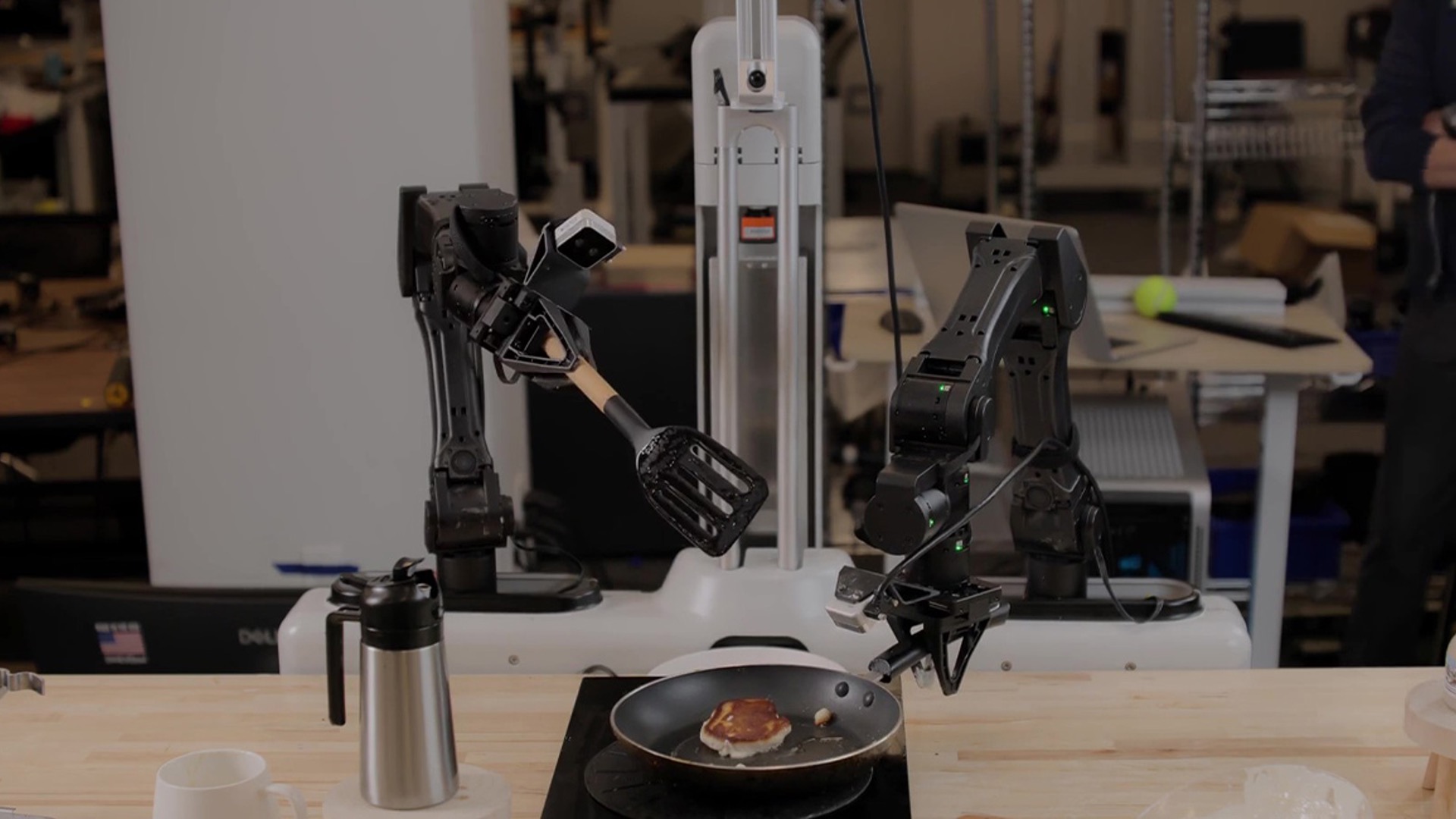
Skild AI S1 Robot Learns New Tasks From a Single Video Using NVIDIA AI
Skild AI Taps NVIDIA AI to Teach Robots New Tasks From a Single Video
Skild AI released its S1 robot foundation model, an infrastructure update designed to learn complex, long-horizon tasks from a single video demonstration without requiring task-specific fine-tuning or weight updates. Launched following development on NVIDIA AI infrastructure, the model relies on in-context learning to interpret video prompts, mapping human actions directly into executable actions for industrial robotic hardware.
The Tech TL;DR:
- Core Tech: Skild AI S1 robot foundation model utilizing in-context learning from video prompts.
- Performance: Executes unfamiliar, multi-step tasks lasting up to 10 minutes with roughly 66% single-step success rates in early vendor-reported tests, compared to 9% for comparable systems cited by Skild AI.
- Infrastructure: Developed using NVIDIA Isaac Lab, NVIDIA Cosmos open world foundation models, and Omniverse simulation libraries.
Architectural Mechanics of S1 In-Context Learning
Traditional industrial automation requires extensive dataset collection, manual teleoperation, and repetitive task-specific retraining whenever factory layouts change or new product lines arrive. According to Skild AI, the S1 model bypasses this pipeline by treating a video demonstration as the immediate program. An operator records a short video of an unseen task, and the model interprets the visual sequence, objects, and intent to map out robotic actions instantly.
This capability addresses traditional IT and robotics bottlenecks where deployment cycles stall due to high data-gathering overhead. Per technical specifications highlighted in reporting from August 2026, a single short video demonstration can replace roughly 380 hands-on training examples, eliminating 50 to 100 hours of manual data collection per skill.
Infrastructure and Training Pipelines via NVIDIA Ecosystem
Skild built and researched S1 across NVIDIA accelerated computing infrastructure, integrating several core simulation and training layers. According to Skild AI, the company leverages NVIDIA Cosmos open world foundation models to convert raw video data into structured descriptions, while Cosmos Curator handles large-scale dataset filtering and annotation. To minimize the simulation-to-reality gap, engineering teams utilize NVIDIA Isaac Sim and Omniverse libraries alongside the Newton physics engine inside Isaac Lab for reinforcement learning.
Developers targeting similar physical AI deployments can review foundational implementation standards through official developer portals like the NVIDIA Omniverse GitHub Repositories or examine edge optimization techniques via the NVIDIA TensorRT Documentation.
Implementation Example: Inference Optimization with TensorRT
Deploying foundation models on edge robotics hardware requires minimizing latency during multi-step manipulation tasks.
# Example CLI configuration for optimizing an ONNX robotic policy model with TensorRT
trtexec --onnx=skild_s1_policy.onnx
        --saveEngine=skild_s1_policy.trt
        --fp16
        --workspace=4096
        --verbose
As noted in the primary rollout details, Skild AI, NVIDIA, and Foxconn are actively deploying the Skild Brain on dual-arm manipulators for high-precision assembly of NVIDIA Blackwell systems. This collaboration tests the model against real-world manufacturing disturbances, including fastener insertion, busbar installation, and sequence tracking.
Commercial Scaling and Deployment Realities
The S1 release coincides with rapid commercial growth for Skild AI, which reached a $100 million annual revenue run rate 10 months after its initial commercial deployment, according to company statements. The firm has established over 60 deployment partnerships spanning manufacturing, logistics, inspection, security, and food preparation. Deepak Pathak, cofounder and CEO of Skild AI, stated that learning by experience rather than preprogramming marks a fundamental shift in robotics.

Despite these benchmarks, deployment teams must exercise evaluation skepticism. Industry analysts emphasize that early completion rates between 60% and 80% require rigorous testing against specific enterprise hardware, lighting conditions, and end-effector payloads.
Disclaimer: The technical analyses and security protocols detailed in this article are for informational purposes only. Always consult with certified IT and cybersecurity professionals before altering enterprise networks or handling sensitive data.