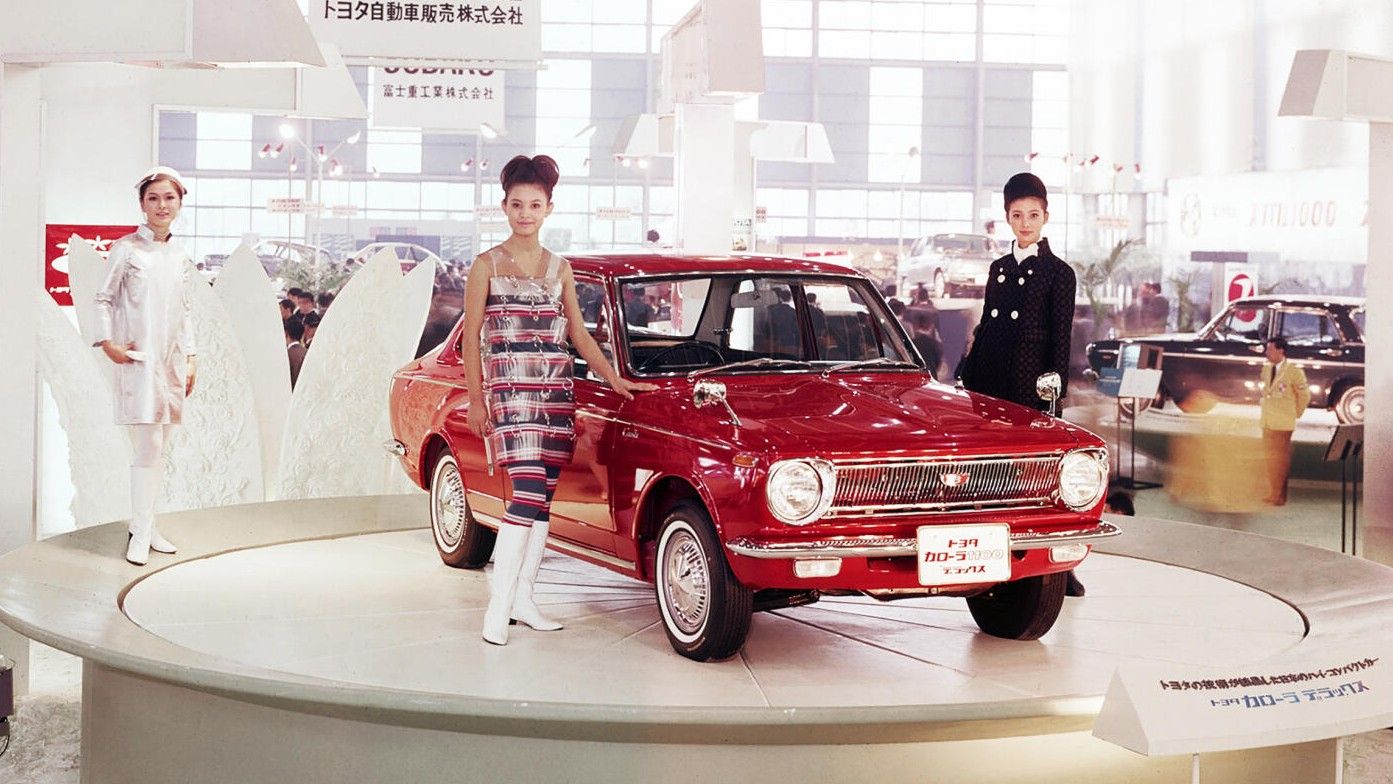
Sixty Years After Its Debut, the Toyota Corolla Has Logged More Than 57 Million Sales Worldwide
Sixty years after its debut, the Toyota Corolla has logged more than 57 million sales worldwide, making it the best-selling nameplate in automotive history, Blick reported, according to Toyota Media.
The milestone arrives as Toyota prepares a 13th generation for an unspecified launch date, extending a lineage that began in November 1966 when the first Corolla rolled out of the new Takaoka plant with a 1,077 cc engine — roughly 100 cc larger than the rival Datsun Sunny 1000, according to Blick.
The 80-point mandate
Chief engineer Tatsuo Hasegawa set a development target he called “80 points plus Alpha”: every core attribute — price, running costs, comfort, performance — had to score at least 80 out of 100, with the “Alpha” providing the differentiating edge. For the launch model, that edge was the larger displacement and a sportier stance designed to capture Japan’s rising middle class, which had rejected the spartan Publica introduced five years earlier.
“In all important properties the Corolla should achieve at least 80 out of 100 points. At the price and maintenance, but also at the comfort and driving performance. The ‘plus Alpha’ should be the icing on the cake.”
said Hasegawa, whose philosophy has guided twelve generations.
Swiss foothold
Importer Emil Frey launched the Corolla in Switzerland in 1967 at 6,975 francs. Within five years Toyota held 8.6 percent of the Swiss market, ranking fourth behind Opel, Fiat, and Volkswagen. Nearly 300,000 Corollas have been registered in Switzerland since, and the model still accounts for roughly one in three Toyotas sold there.
From oil crisis to hybrid pivot
The 1973 oil shock tested the formula. Production was cut, but the Corolla’s frugality matched the moment and volumes rebounded quickly. By 1997 cumulative deliveries passed 22 million, overtaking the Volkswagen Beetle for the all-time lead. Toyota’s German media office notes that the current tally exceeds 57 million units including derivatives such as the Corolla Cross SUV.
Europe saw a branding detour: between 2007 and 2019 hatchbacks and wagons carried the Auris badge while only the sedan kept the Corolla name. The 2009 tightening of EU emissions rules prompted Toyota to transplant the Prius’ full-hybrid system into the Auris/Corolla a year later, a move that cemented the model’s efficiency credentials in the region.
Concept signals next chapter
At the 2025 Japan Mobility Show Toyota displayed a Corolla Concept with a low, angular silhouette, hinting at the design direction for the 13th generation. Powertrain details and launch timing remain undisclosed. The only certainty, inherited from Hasegawa’s original brief, is that the next iteration will again be measured by how much car it delivers for the money.
Before joining Toyota in 1946, Hasegawa served as chief designer on the Tachikawa Ki-94, a high-altitude interceptor intended to counter B-29 bombers. He developed the “TH airfoil” for the aircraft, a theory later found to closely resemble the supercritical airfoil NASA would advance in the 1960s.
At Toyota he led first-generation development of the Publica, Sports 800, Corolla, Celica and Carina, and introduced the shusa product-manager system adapted from wartime fighter programs. He was inducted into the Japan Automotive Hall of Fame in 2004 for applying aerodynamic theory to automobile design.
As the model enters its seventh decade, the continuity of its engineering brief — value, reliability, adaptability — remains the benchmark against which every mass-market competitor is judged.