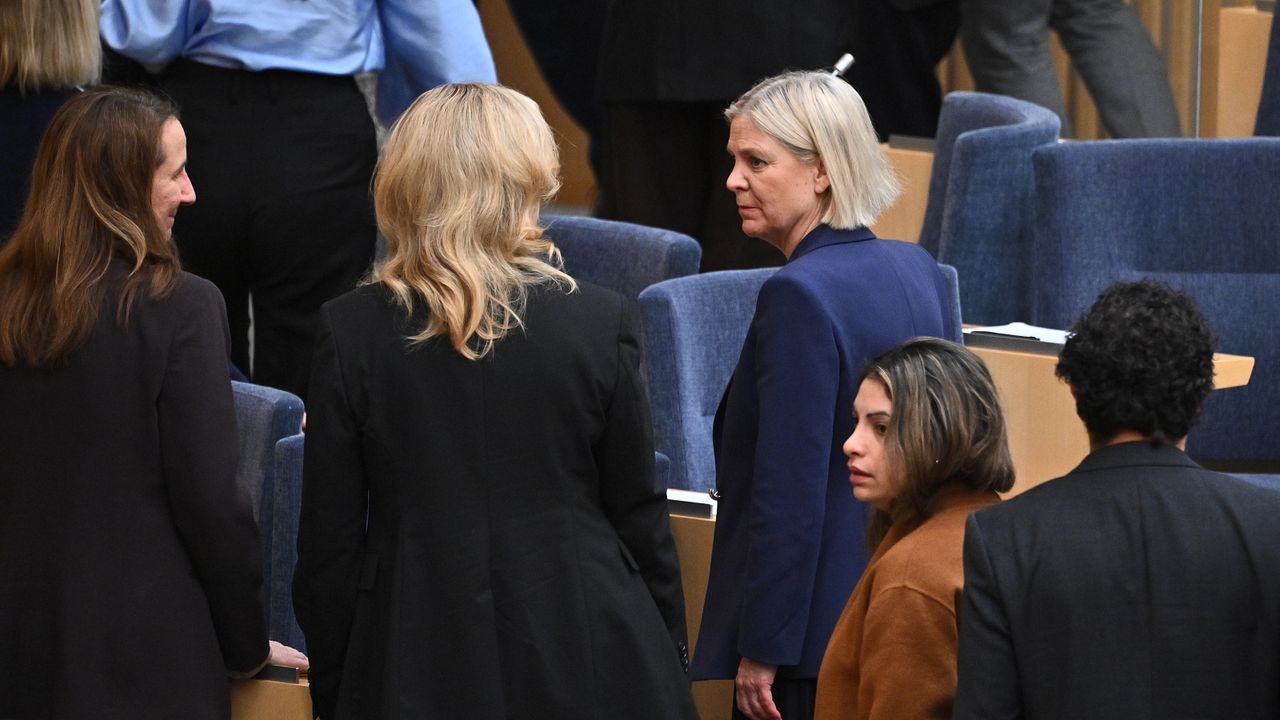
Sixty-Eight Days After Sweden’s September 13 Election
Sixty-eight days after Sweden’s September 13 election, Social Democrat leader Magdalena Andersson has failed to present a government agreement, leaving the red-green bloc deadlocked over the Left Party’s demand for cabinet seats and the Centre Party’s refusal to accept them.
The impasse centers on a parliamentary equation that should favor Andersson. Her bloc holds a numerical edge over the Tidö parties, yet internal contradictions have stalled talks since Centre Party leader Muharrem Demirok accepted Andersson’s “total package” proposal in early November. Sources with insight into the negotiations tell TV4 Nyheterna that discussions have intensified but remain stuck on red lines regarding government formation and policy specifics.
Vänsterpartiet demands cabinet seats
Vänsterpartiet leader Nooshi Dadgostar insists her party must sit in government after years of supporting Social Democrat-led administrations from the outside, according to Aftonbladet. “It cannot always be the Left Party that is expected to give up something so that others can agree,” Dadgostar said during a red-green meeting. The Centre Party, however, maintains that a government including the Left Party would lack parliamentary stability and alienate centre-right voters.
Negotiators for the Social Democrats have attempted to bridge the gap by offering policy concessions to the Left Party — on welfare, schools, and labor market reforms — while keeping them out of the cabinet.
A person close to the talks described these offers to TV4 Nyheterna as “rena skambud” — mere token gestures — because the Centre Party refuses to implement the very policies meant to buy Left Party support. “The idea is that the Left Party should be bought off, but the Centre Party does not go along with any of the buy-offs,” the source said.

Internal pressure mounts on Andersson
Frustration is spreading within Social Democrat ranks. Party debater Linn Svansbo criticized the leadership’s strategy of avoiding conflict with the Centre Party to secure a governing arrangement. “That strategy needs to be re-evaluated if a red-green government formation fails,” Svansbo told DN, as reported by OMNI.
Former Riksdag member Veronica Palm, now political editor at Norrländska Socialdemokraten, warned it would be “uselt” — miserable — if the Social Democrats fail to take power despite favorable parliamentary arithmetic. SVT reported that party insiders fear a leadership crisis if Andersson cannot deliver a government.
Speaker sets next deadline
Speaker Andreas Norlén will conduct a new round of talks with party leaders on Tuesday. Ulf Kristersson, leader of the Moderates, is expected to deliver his final report on the centre-right’s ability to form a government. Norlén must then decide whether to hold a third prime ministerial vote — the fourth and final attempt under the constitution — or call an extraordinary election.
Kristersson has maintained a low-key, statesmanlike posture throughout the process, Aftonbladet noted, contrasting with what the paper described as Andersson’s “increasingly desperate” tactical shifts. The Moderate leader has already secured parliamentary support from the Sweden Democrats, Christian Democrats, and Liberals for a Tidö government, though formal negotiations on policy remain.

Alakil proposes 2030 agreement
In Dagens Arena, SSU activist Weiam Alakil argued the Social Democrats should have clarified their governing intentions before the election. “Voters must know which political direction they are voting for and which parties are prepared to take joint responsibility,” Alakil wrote.
The solution, Alakil proposes, is a long-term written agreement with the Left Party on government participation after the 2030 election, guaranteeing ministerial posts if the red-green bloc wins and parliamentary conditions allow. Such a commitment would build trust now and create better conditions for compromise, Alakil argued, while acknowledging that Centre Party objections must be taken seriously through negotiation and clear rules.
Opinion polls show eroding Social Democrat lead
The deadlock carries electoral risk. Aftonbladet reported that the latest opinion poll shows the Moderates overtaking the Social Democrats for the first time since the election. If the red-green bloc collapses without forming a government, the alternative could be a Tidö administration or an extraordinary election — either outcome likely strengthening the right.
Magdalena Andersson, born 1967, was Sweden’s first female prime minister, serving briefly in November 2021 before resigning hours later when the Green Party quit her coalition over a budget defeat. She returned to the post on 30 November 2021 and held it until October 2022, when Ulf Kristersson succeeded her after the election.
A career economist, she was Minister for Finance from 2014 to 2021 and chaired the International Monetary and Financial Committee from 2020 to 2022, the first European and first woman in that role in over a decade.
Andersson’s parliamentary mathematics still hold. But the clock is ticking toward the speaker’s decision, and with it, the fate of Sweden’s next government.