Single Nuclear Blast in Space Could Disable 98% of Low Earth Orbit Satellites Within a Week, Study Finds
A single nuclear explosion in space could disable nearly all satellites in low Earth orbit within a week by creating an artificial radiation belt, according to a new study by researchers at the University of Wisconsin-Madison and Princeton University.
A detonation of one megaton at 500 kilometers altitude would trap fission electrons in Earth’s magnetic field, forming a persistent radiation belt that satellites would cross repeatedly, according to the study reported by Phys.org.
The initial X-ray pulse would knock out roughly 3 percent of the modeled fleet of more than 13,000 active satellites, but the trapped radiation would drive the failure rate to 25 percent within 24 hours, 78 percent after three days and 98 percent within seven days, Phys.org reported, according to Epe.
How the radiation belt forms
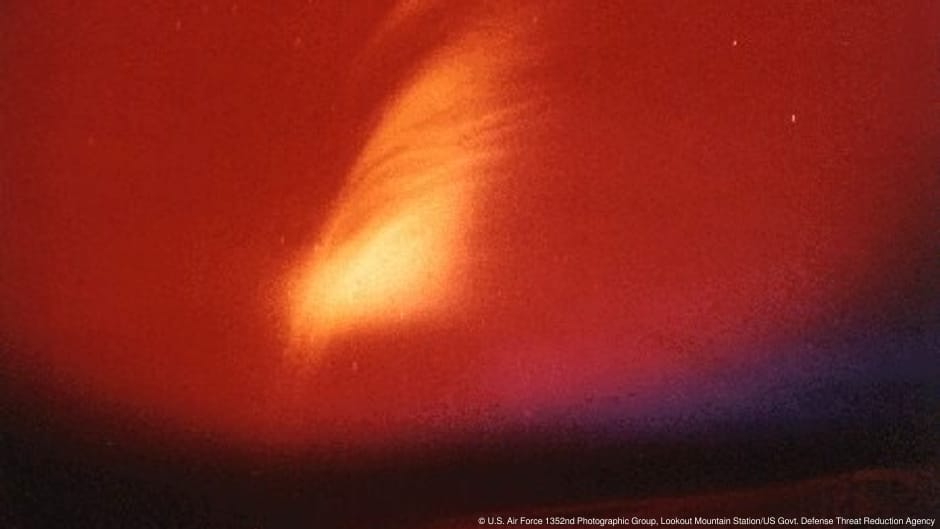
The blast itself produces no destructive shock wave in the near-vacuum of space. Instead, charged particles excite the upper atmosphere, creating an artificial aurora, while the magnetic field captures high-energy electrons released by the explosion. Satellites receive a fresh dose of radiation each time they pass through this new belt, degrading electronics and solar panels over time.
What history shows
The 1962 U.S. “Starfish Prime” test, detonated at about 400 kilometers over the Pacific, demonstrated the delayed effect. The glow over Honolulu faded in minutes, but satellites stopped functioning months later as they crossed the radiation belt created by the test.
Which satellites are at risk
Low Earth orbit hosts satellites essential for communications, weather forecasting, Earth observation and emergency beacons, Phys.org reported.
Collisions increase following satellite detonations
Disabled satellites would remain in orbit without maneuvering capability, raising collision risks. The model estimates about 20 collisions in the two years after a detonation and 26 in a decade, compared with 12 in a baseline scenario without a blast, Phys.org reported.
Treaties prohibit space nuclear weapons despite verification gaps
The 1967 Outer Space Treaty prohibits placing nuclear weapons in orbit, and the 1963 Partial Nuclear Test Ban Treaty bans nuclear explosions in space. The Outer Space Treaty lacks a verification system for spacecraft payloads, but a detonation would be readily detected by U.S. satellite sensors designed to spot the characteristic signatures.
Shielding and backup systems mitigate radiation risks
Shielding can harden satellite electronics and backup systems can preserve some services. Radioactive fallout reaching the surface would be dispersed and unlikely to deliver concentrated doses comparable to a ground-level explosion.
- New Comic “Surveillance Isn’t Safety” Chronicles Grassroots Fight Against Flock Safety ALPRs
- Josh Allen Produces Documentary on 2022 Buffalo Blizzard
- Leana Wen: RFK Jr. Vaccine Policies Could Spike Liver Cancer (newsy-today.com)
- Systematic Review Finds Narcolepsy Cost-Effectiveness Models Omit Indirect Costs, Comorbidities (archyde.com)