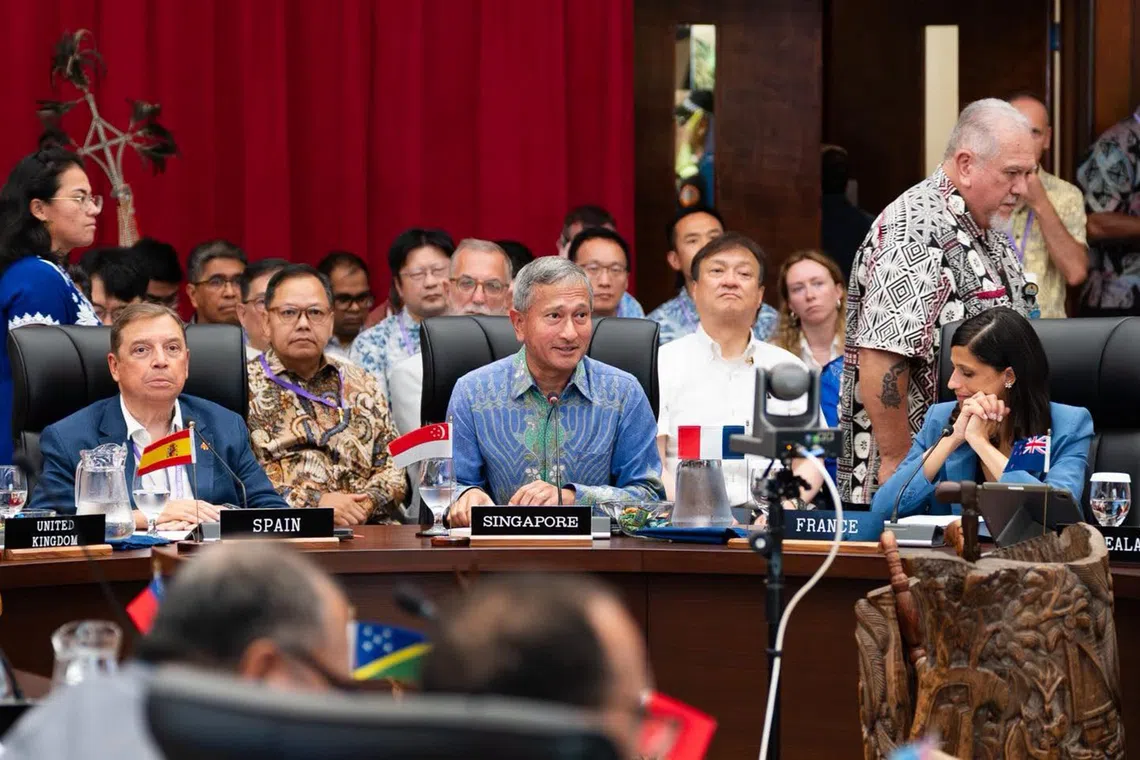
Singapore Renews Training Programmes for Pacific Island Officials
On Sept 1, Foreign Minister Vivian Balakrishnan announced that Singapore has rolled out a pair of capacity-building packages designed to assist Pacific island nations in reinforcing their governing bodies and institutions.
The initiative aims to support mid-to-senior level officials across the region through targeted training in governance, artificial intelligence, and public service transformation. According to the Ministry of Foreign Affairs, nearly 10,000 Pacific officials have participated in the Singapore Cooperation Programme and related training efforts since 1992.
SPARKS and SIDS of Change Training Programmes
The first renewed initiative, named the Singapore-Pacific Resilience and Knowledge Sharing programme, will operate from January 2027 to December 2029. According to the Ministry of Foreign Affairs, SPARKS focuses on mid-to-senior level Pacific officials, offering instruction in leadership, governance, financial management, and macroeconomic fundamentals. Singapore originally launched SPARKS in 2023 during its first attendance as a dialogue partner at the Pacific Islands Forum Leaders Meeting.
The second package, designated SIDS of Change, is scheduled to run from April 2027 to March 2029. This programme delivers customized courses covering artificial intelligence for governance, public service transformation, civil aviation, and maritime fellowships. Small Island Developing States, or SIDS, comprise a United Nations bloc of 39 countries and 18 associate members that face distinct challenges due to their limited geographic scale, geographic isolation, and severe vulnerability to economic and environmental disruptions. Pacific island nations form one of three primary regional SIDS groupings, alongside the Caribbean and the Atlantic, Indian Ocean and South China Sea regions. Singapore introduced SIDS of Change in 2024 at the Fourth International Conference on Small Island Developing States. Both packages align with priority areas identified in the 2050 Strategy for the Blue Pacific Continent.
Regional Architecture and Strategic Independence
Speaking at the 55th Pacific Islands Forum Leaders Meeting with Dialogue Partners in Palau, Balakrishnan stated that Singapore supports a strong, Pacific-led regional architecture and opposes turning the Pacific into an arena for proxy contests.
Drawing comparisons to Southeast Asia, Balakrishnan emphasized the lessons learned from regional integration.
“Our experience in Southeast Asia has shown the value of ASEAN Centrality: by building a strong regional core, we can engage major powers while retaining our agency, retaining strategic choice and options, and shaping our own regional agenda,” Balakrishnan said.
The foreign minister noted that cooperation between ASEAN and the Pacific region remains vital for advancing shared priorities, including climate change, connectivity, sustainable development, and economic resilience. Singapore expects to draw the two regional groupings closer together when it assumes the ASEAN chairmanship in 2027.
Addressing the limitations often ascribed to geographic size, Balakrishnan argued that smaller nations maintain agency through institutional strength and adherence to international law.
“We cannot choose the world we live in, but we can strengthen our internal resilience nationally, we can extend our hands to partnerships across our boundaries, and we must insist that we have collective agency,” Balakrishnan said.