Severe Bleeding After Nephrostomy Tube Removal: A Case Report
A 76-year-old man experienced a severe renal hemorrhage immediately following the removal of a percutaneous nephrostomy tube, according to a case report. The patient suffered a substantial blood loss totaling approximately 300 g of bloody output containing blood clots through his ileal conduit after the catheter was pulled on postoperative day five.
-
Key Clinical Takeaways:
- The 76-year-old male patient underwent right-sided percutaneous nephrostomy using an 8.3-Fr JINRO™ nephrostomy catheter from Boston Scientific prior to radical cystectomy and ileal conduit urinary diversion.
- The nephrostomy tube removal triggered bleeding from both the nephrostomy tract and the ileal conduit, causing his hemoglobin to drop from 10.4 to 9.4 g/dL despite his remaining hemodynamically stable.
- Clinicians managed the acute hemorrhage using external compression, temporary Foley catheter balloon occlusion within the ileal conduit, and a transfusion of four units of packed red blood cells without requiring transcatheter arterial embolization.
Clinical Presentation of Muscle-Invasive Bladder Cancer and Hydronephrosis
The patient initially presented to clinicians with asymptomatic gross hematuria. Magnetic resonance imaging indicated cT3a bladder cancer, while computed tomography revealed cN0M0 disease accompanied by bilateral hydronephrosis. His baseline serum creatinine sat at 1.41 mg/dL alongside a hemoglobin level of 12.7 g/dL. Following transurethral resection of the bladder tumor, pathological examination confirmed grade 3 urothelial carcinoma under the 1973 World Health Organization grading system, with muscularis propria invasion reaching at least pT2 classification.
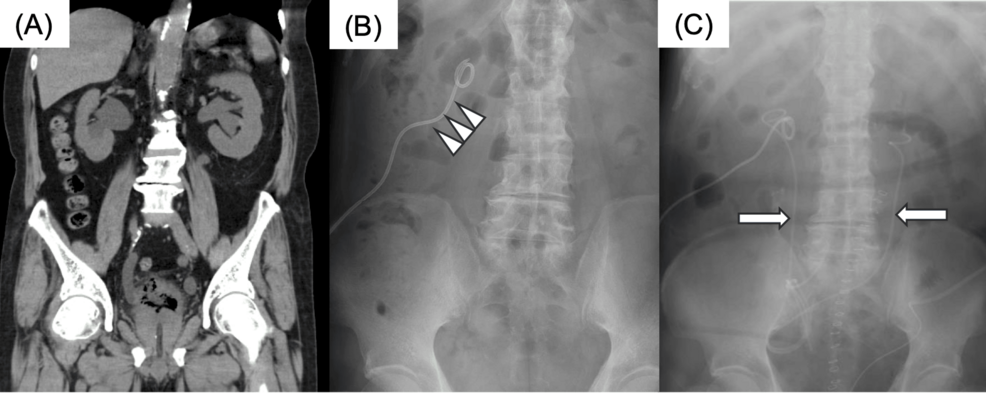
The clinical picture shifted when the patient developed right obstructive pyelonephritis. To address this complication, medical staff performed a right percutaneous nephrostomy utilizing an 8.3-Fr JINRO™ nephrostomy catheter manufactured by Boston Scientific located in Marlborough, MA, USA. The procedure relied on ultrasound and fluoroscopic guidance without Doppler imaging. Medical personnel noted a small amount of bleeding through the puncture needle during initial access, though the team successfully inserted the catheter as planned.
Surgical Intervention and Postoperative Nephrostomy Tube Removal
Five days after the initial urinary decompression, the patient underwent radical cystectomy, pelvic lymph node dissection, and ileal conduit urinary diversion. The operation lasted 261 minutes, and the recorded estimated blood loss reached 610 mL. Final pathology reports established urothelial carcinoma staged as pT3aN0. Medical staff clamped the nephrostomy tube following the cystectomy procedure.
On postoperative day five—representing ten days after the initial percutaneous nephrostomy placement—clinicians removed the nephrostomy tube. Right before the removal, the patient maintained a blood pressure of 159/75 mmHg and a heart rate of 82 beats per minute. Immediately following the extraction, bleeding erupted directly from the nephrostomy site alongside substantial bloody output and clots passing through the ileal conduit. Concurrently, his vital signs shifted as his blood pressure dropped to 124/65 mmHg and his heart rate climbed to 96 beats per minute.
Post-Removal Hemorrhage Management and Computed Tomography Findings
Responding to the sudden bleeding, medical personnel applied external compression directly to the nephrostomy site. Simultaneously, staff temporarily inflated a Foley catheter balloon inside the ileal conduit to occlude its outlet. Contrast-enhanced computed tomography subsequently showed no active vascular extravasation but verified the presence of a hematoma situated within the right renal pelvis. The patient accumulated approximately 300 g of bloody output containing blood clots from the ileal conduit.
Faced with severe bleeding and the distinct risk of continued blood loss, medical staff administered a transfusion of four units of packed red blood cells. Hemostasis was successfully secured without the need for transcatheter arterial embolization. The authors of the report note that while hemorrhagic complications during percutaneous nephrostomy placement are widely recognized, clinically significant bleeding immediately following tube removal remains rarely documented in medical literature.
Disclaimer: The information provided in this article is for educational and scientific communication purposes only and does not constitute medical advice. Always consult with a qualified healthcare provider regarding any medical condition, diagnosis, or treatment plan.