
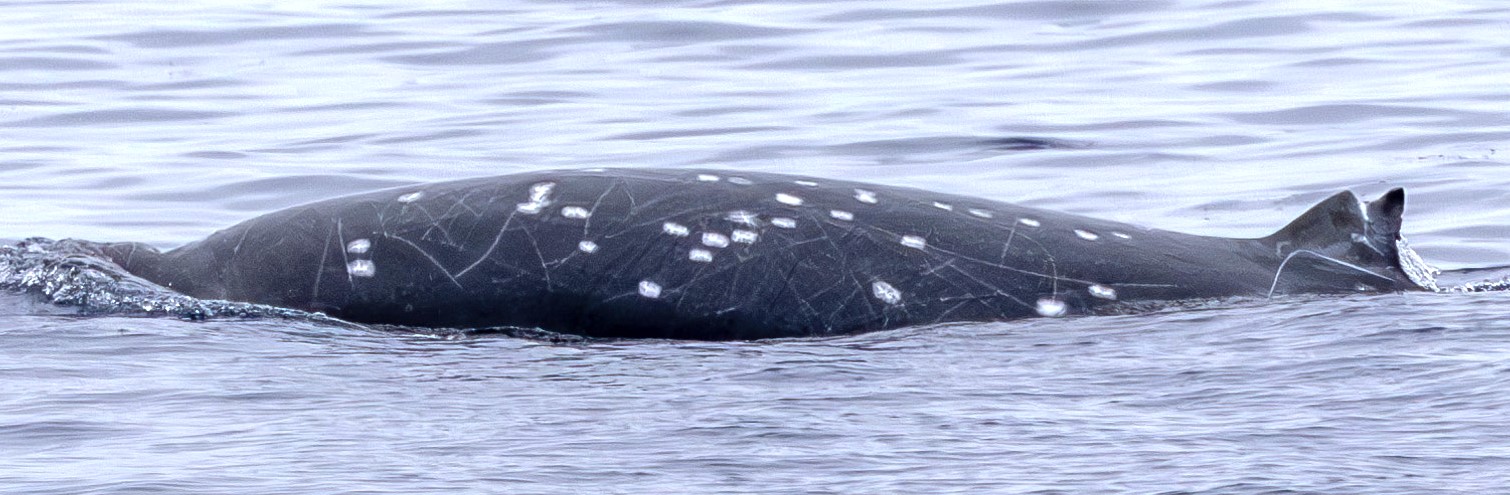
Rare Ginkgo-toothed Beaked Whale Identified Alive at Sea, Tissue Sample obtained via Crossbow Bolt
Researchers have confirmed the first-ever sighting and identification of a living Ginkgo-toothed beaked whale ( Mesoplodon ginkgodens) in the eastern Pacific Ocean.The discovery, made during a series of encounters off the coast of California, resolves a decades-long mystery surrounding the whales’ presence in the region.
The team, led by Robert Pitman and Melodie Henderson, documented the whales using binocular observations, photographs, and hydrophones. During a close encounter, one whale approached within 66 feet (20 meters) of the research vessel, prompting Pitman to deploy a 150-pound (68-kilogram) draw-weight crossbow loaded with a modified punch-tip arrow.
“The crossbow arrow (‘bolt’) extracts a tiny, pencil-eraser-sized plug of skin and blubber,” Pitman said. “We have collected thousands over the years, from dozens of whale and dolphin species.”
The tissue sample was retrieved after the arrow dislodged and sent for genetic analysis.”It took a few days to process the material and run the tests, and we were all waiting with baited breath,” Henderson said. “When we got the results back we were all a bit shocked – while thay did look like that species,this was not the expected area of their distribution so we had discounted that as a possibility – but we were also thrilled to finally have the mystery solved.”
Ginkgo-toothed beaked whale strandings are common in the western Pacific, but only two individuals have previously been recorded stranding in the eastern Pacific. The researchers initially considered the possibility of encountering Perrin’s beaked whales (Mesoplodon perrini), one of the least known marine mammals, which have only been documented from six stranded specimens off southern California.
The team now plans to search for Perrin’s beaked whales and other unidentified beaked whale species, aiming to connect their vocalizations to specific individuals.
“This is importent because once we match up the calls to all the individual species, then we can use passive acoustic monitoring (towing hydrophones behind vessels, drifter buoys, etc.) and finally learn where these whales live, how many there are, and how vulnerable they are to human disturbances, especially high-seas fisheries,” Pitman said.
