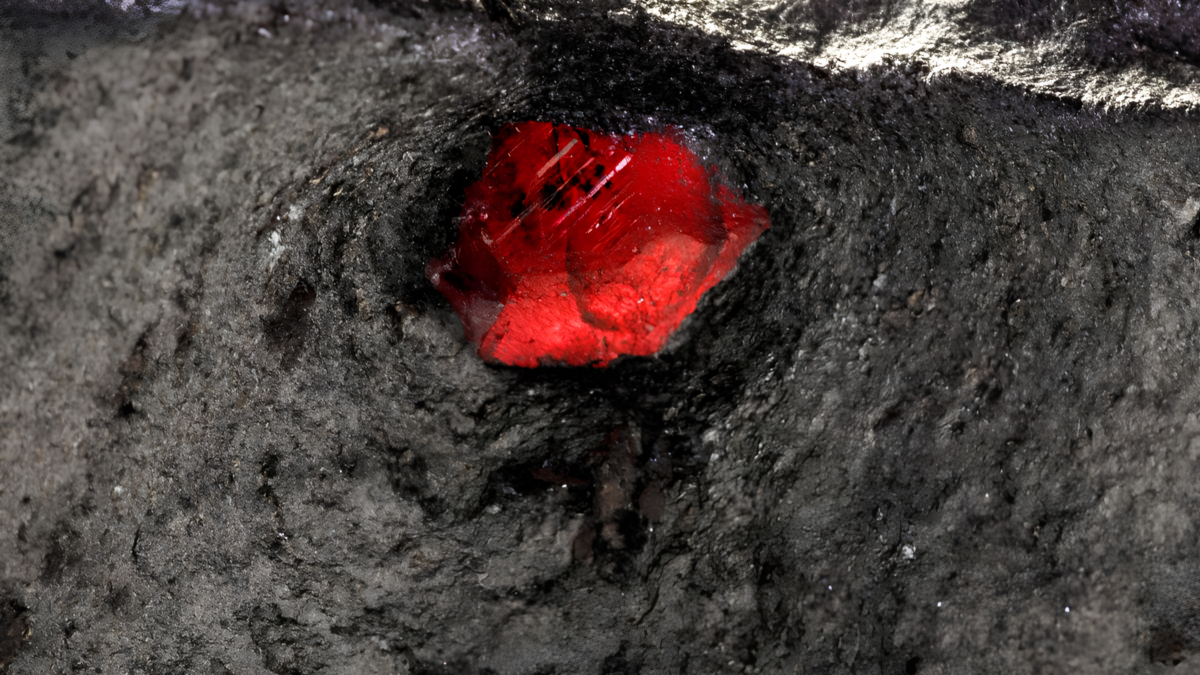
Scientists Discover Garnet in Mars Meteorite for the First Time
“This discovery is going to expand our knowledge of the geologic processes that are possible on this planet,” said Tanya Kizovski, a planetary geologist at Brock University in Canada, regarding a new meteorite finding published in Geochemical Perspectives Letters.
Scientists studying a Mars meteorite stored in the Royal Ontario Museum collection have discovered grains of garnet, a mineral never before found in any Martian sample, ScienceAlert reported. The tiny speck of iron-rich garnet known as andradite measures roughly 0.8 by 0.5 millimeters—smaller than a poppy seed—and was hidden inside a rock fragment from the meteorite fall designated as NWA 8171.
NWA 8171
The meteorite NWA 8171 consists of basaltic breccia, a geological formation where magma cools and hardens around other mineral inclusions, resembling a fruitcake. It is one of 18 fragments from the same Martian meteorite fall, sharing a lineage with the famous piece nicknamed ‘Black Beauty’ or NWA 7034.
Because garnets preserve records of past geological processes, researchers can use them to study past temperature and pressure conditions, according to ScienceAlert. Kizovski told ScienceAlert that her team initially assumed the section was pyroxene before follow-up analyses confirmed it was andradite.
“The chemistry was a bit odd,” said planetary geologist Tanya Kizovski. “This little section of the meteorite looked really interesting, and the chemistry was a bit odd,” Kizovski said.
“At first, we assumed it was a mineral called pyroxene, which is very common, but then we decided to take a second look.” “This new garnet-bearing rock type could give us clues to how Mars has changed throughout its history and new insights into the ancient environments that could have formed the garnet and related minerals,” Kizovski said.
Unexpected Mineral Appearance
When people picture garnets, they usually envision a highly prized gemstone with a deep, blood-red hue. However, planetary geologist Tanya Kizovski said that “The chemistry was a bit odd,” pointing out that minerals do not always match initial expectations.
The specific iron-rich form discovered in the meteorite displays a yellowy-greeny color closely resembling other common meteoritic minerals rather than standing out vividly. Because of this deceptive appearance and olive hue, the research team nearly overlooked the significant find entirely.
Questioning Martian Geological Origins
A closer examination inside the rock fragment revealed the hidden treasure that raises enormous questions about the red planet. On Earth, garnet frequently develops under intense heat, pressure, or chemical alteration, yet scientists have never identified those specific conditions on Mars.
This uncertainty leaves the museum-stored meteorite with some explaining to do regarding its past. Researchers are left asking if the garnet formed directly on Mars, and if so, exactly what process produced it and when.

Geological Questions
Researchers still do not know whether the garnet formed on Mars through unusual magma activity or metamorphism, or if it originated elsewhere before landing on the planet, ScienceAlert reported.
To investigate further, the team plans to examine isotope ratios in the mineral. James Darling, a planetary scientist at the University of Portsmouth in the UK, told ScienceAlert that the findings add a striking new dimension to our understanding of Martian geology.
“On Mars, the heat and pressure needed to produce garnet through metamorphism could have come from the impact of a meteorite hitting the surface of Mars, magma rising up into the Martian crust, or both,” Kizovski said.