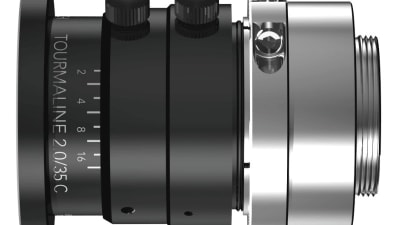
Schneider-Kreuznach Lens Powers NASA Orion Optical Navigation for Artemis Missions
Schneider-Kreuznach ruggedized lenses are flying on NASA’s Orion spacecraft, where they anchor the Optical Navigation (OpNav) camera system supporting the Artemis lunar program.
The lenses performed during Artemis I and Artemis II and will fly again on Artemis III, slated for 2027, Tech Briefs reported in a contributed article from Jos.
The OpNav system, built by Redwire in cooperation with Lockheed Martin, sits on the exterior of the Orion crew module. It captures images of Earth and the star field, and those images are processed to fix the spacecraft’s position and trajectory on the way to and from the moon. The same camera supports spacecraft monitoring and public imaging.
At the heart of the navigation chain is a monochrome 5.3-megapixel sensor paired with a customized Schneider-Kreuznach TOURMALINE 2.0/35 C lens, formerly known as the APO-Xenoplan 35. According to Tech Briefs, NASA selected the 35mm lens for three reasons: its 1.3-inch image format matched the imaging requirements, its ultra-high-resolution optical performance delivered the required image quality, and its mechanical design satisfied every environmental specification the mission imposed.
Spaceflight is unforgiving optics. Components must hold alignment and imaging performance under launch vibration, mechanical stress, thermal variation, and hard vacuum. A lens that drifts a fraction of a millimeter out of focus turns a navigation fix into noise.
The Tech TL;DR:
- Schneider-Kreuznach’s TOURMALINE 2.0/35 C lens is the imaging core of Orion’s OpNav camera, qualified for space during Artemis I and retained for Artemis II and III.
- The lens uses a near-telecentric design with a low Critical Ray Angle to maximize light through the sensor’s microlenses, plus a custom focus-locking mount to prevent focus drift.
- No outgassing compounds are used anywhere in the lens; the only bonding agent is a NASA-approved material chosen for the mission’s stringent outgassing requirements.
Why NASA picked a machine-vision lens
The TOURMALINE line is an industrial machine-vision product, not a space-qualified design at birth. What made it a candidate is a property that matters enormously for star-field navigation: a low Critical Ray Angle approaching that of a true image-side telecentric lens.
Per Tech Briefs, that characteristic minimizes image sensor shading and allows maximum light transmission through the microlenses common on modern image sensors — exactly what a navigation camera needs when its subjects are dim stars against black.
NASA also required assurance that the lens focus setting could not shift during operation. Schneider-Kreuznach developed a custom focus-locking mount to meet that requirement, one that satisfied all applicable specifications, the company stated in the Tech Briefs contribution.
Vacuum adds a second trap: outgassing. Many consumer and industrial optics use adhesives and compounds that slowly release volatile molecules in vacuum, which can condense on nearby surfaces and degrade sensors and windows. The TOURMALINE incorporates no materials or compounds that could potentially outgas, according to Tech Briefs, and the only compound securing the lens components is a NASA-approved material specifically selected for the mission’s stringent outgassing requirements.
Qualified on Artemis I, kept for the rest
The lens was originally qualified for space conditions during Artemis I, where it supported validation of Orion’s optical navigation capability. Based on that performance, the system was retained for subsequent missions, including Artemis II, Tech Briefs reported. It will continue in the OpNav system through Artemis III, which NASA is targeting for 2027.
The camera has done more than guide the spacecraft. Beyond its navigation function, the OpNav camera captured detailed images of Earth and the moon, including rarely seen views of the moon’s far side. Those images support system validation and provide additional mission data for analysis, per Tech Briefs.
What the spec sheet tells integrators
| Parameter | Value | Why it matters for OpNav |
|---|---|---|
| Sensor | Monochrome 5.3-megapixel | Monochrome maximizes quantum efficiency for star detection |
| Lens | TOURMALINE 2.0/35 C (formerly APO-Xenoplan 35) | f/2.0, 35mm fixed focal length for star-field imaging |
| Image format | 1.3-inch | Matched NASA’s imaging requirements |
| Critical Ray Angle | Low, near image-side telecentric | Minimizes sensor shading; max light through microlenses |
| Outgassing | No potentially outgassing compounds; NASA-approved bond | Prevents condensation contamination in vacuum |
The pattern is consistent with how flight programs qualify commercial optics: take an industrial lens with strong optical fundamentals, then engineer out the failure modes — focus drift, outgassing, mechanical instability — one at a time under test. Schneider-Kreuznach adapted the lens design to ensure mechanical stability of the optical elements across launch vibration, stress, thermal variation, and vacuum, Tech Briefs reported.
The bigger machine behind the lens
Jos. Schneider Optische Werke GmbH, based in Bad Kreuznach, Germany, contributed the article to Tech Briefs. The Schneider Group develops and produces high-performance lenses and optical filters for the industrial, film, and photo sectors — a portfolio that now includes flight-proven hardware on a crewed lunar spacecraft.
Redwire, the company behind the OpNav system, is itself a young assembly of older space businesses. It was formed on June 1, 2020, by the private equity firm AE Industrial Partners through the merger of Adcole Space and Deep Space Systems, and went public in January 2021.
The camera heritage traces to Deep Space Systems, the Littleton, Colorado firm incorporated in 2001 that specializes in high-definition space-qualified cameras and is a main contractor for NASA’s Commercial Lunar Payload Services program.
Weeks after its formation, Redwire acquired Made In Space, Inc., the Jacksonville, Florida company that developed three-dimensional printers for use in microgravity, adding in-orbit manufacturing to a portfolio that now spans Sun sensors, deployable solar arrays and, on Orion, optical navigation.
The next checkpoint is concrete: Artemis III, currently on NASA’s calendar for 2027, will carry the same TOURMALINE-based OpNav system to the lunar vicinity — a second flight qualification cycle for a lens line that started as machine-vision glass.