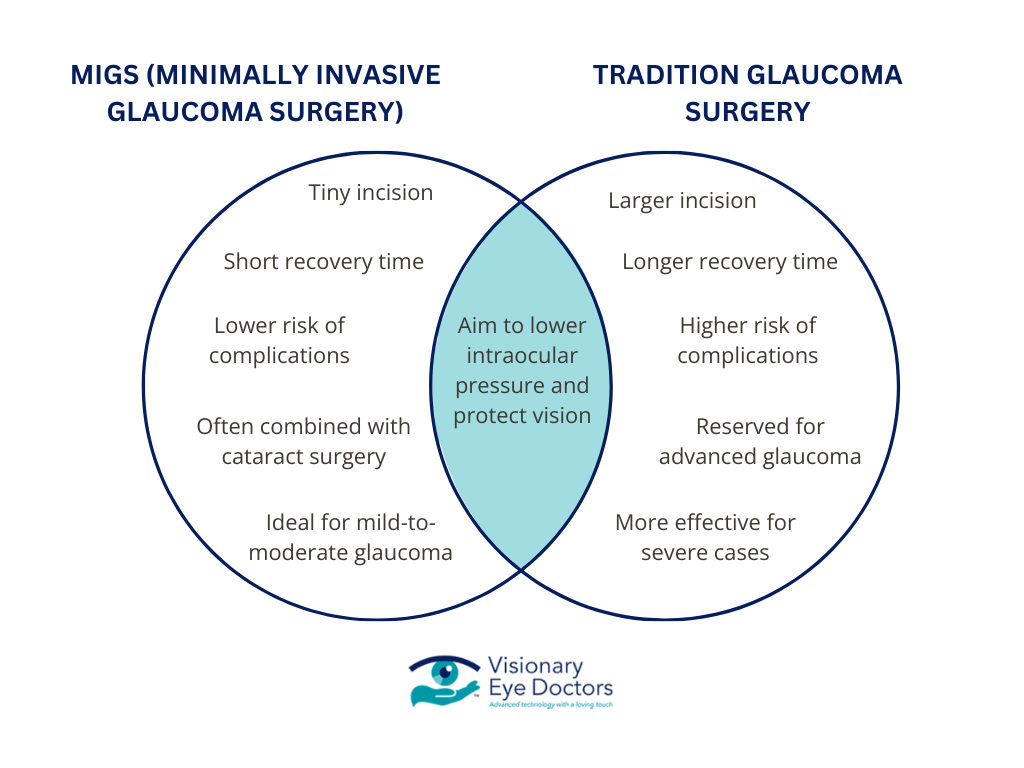
SC-MIGS vs. Conventional Glaucoma Surgery: Effectiveness and Outcomes
Minimally invasive glaucoma surgery targeting Schlemm’s canal offers comparable long-term reductions in eye drop dependency to standard procedures, according to evidence updated in October 2025. Evaluating these micro-bypass operations requires balancing modest pressure decreases against specific risks like localized bleeding.
- SC-MIGS procedures show little to no difference in long-term medication freedom when compared directly with conventional glaucoma surgeries.
- Combining SC-MIGS with cataract surgery may reduce reliance on eye drops more than cataract surgery alone, though it carries a heightened risk of bleeding.
- Clinical confidence in current data remains limited due to small sample sizes and narrow demographic representation across the evaluated studies.
Understanding Open-Angle Glaucoma and Drainage Mechanics
Open-angle glaucoma is a chronic eye condition defined by progressive damage to the optic nerve. The term open-angle indicates that the eye’s natural drainage channels remain unblocked yet fail to process fluid effectively. This inefficiency elevates intraocular pressure, gradually eroding peripheral vision. While normal pressure values generally measure between 10 mmHg and 20 mmHg, pathology can develop outside these parameters, necessitating tailored interventions.
Initial treatment protocols typically involve topical eye drops or laser procedures designed to facilitate aqueous humor outflow. When these conservative measures fail to stabilize intraocular pressure, clinicians look to surgical intervention. Standard incisional operations, such as a trabeculectomy, bypass the eye’s native drainage network entirely. While effective, conventional surgery carries risks of hypotony, severe bleeding, and the potential need for secondary procedures. These limitations drive the adoption of Schlemm’s canal-targeted minimally invasive glaucoma surgery, known as SC-MIGS, which aims to enhance natural outflow pathways with minimal tissue disruption.
Comparative Efficacy of SC-MIGS Versus Traditional Approaches
Recent syntheses examining 10 international studies involving 639 participants across Italy, Japan, India, the United States, Latin America, Poland, Canada, and China highlight distinct trade-offs between surgical methodologies. When investigators compared SC-MIGS directly with conventional glaucoma surgeries across three studies involving 99 individuals, results indicated no statistically significant difference in postoperative drop freedom, visual field stabilization, or mean pressure reduction.
Evaluations pairing SC-MIGS with cataract procedures against cataract surgery alone across two trials involving 132 patients revealed that combination therapy yielded superior pressure drops and reduced reliance on pharmacological eye drops. This benefit, however, coincided with a measurable elevation in bleeding complications. When measured against laser therapies in a single study of 30 participants, SC-MIGS achieved greater pressure reduction alongside an increased bleeding risk.

The evidence base supporting SC-MIGS is constrained by methodological limitations across existing trials. Small cohort sizes and homogeneous demographic sampling restrict the generalizability of current findings to broader, multi-ethnic patient populations. Furthermore, variations in surgical technique and postoperative follow-up intervals complicate direct comparisons between specific device iterations.
Addressing these clinical gaps demands longitudinal tracking and rigorous standardization in future trial design.
As clinical research progresses toward larger, more diverse multicenter trials, the role of Schlemm’s canal procedures within standard ophthalmic care will be more precisely defined. Until then, treatment decisions rely on careful balancing of immediate pressure-lowering efficacy against procedural morbidity.
Disclaimer: The information provided in this article is for educational and scientific communication purposes only and does not constitute medical advice. Always consult with a qualified healthcare provider regarding any medical condition, diagnosis, or treatment plan.