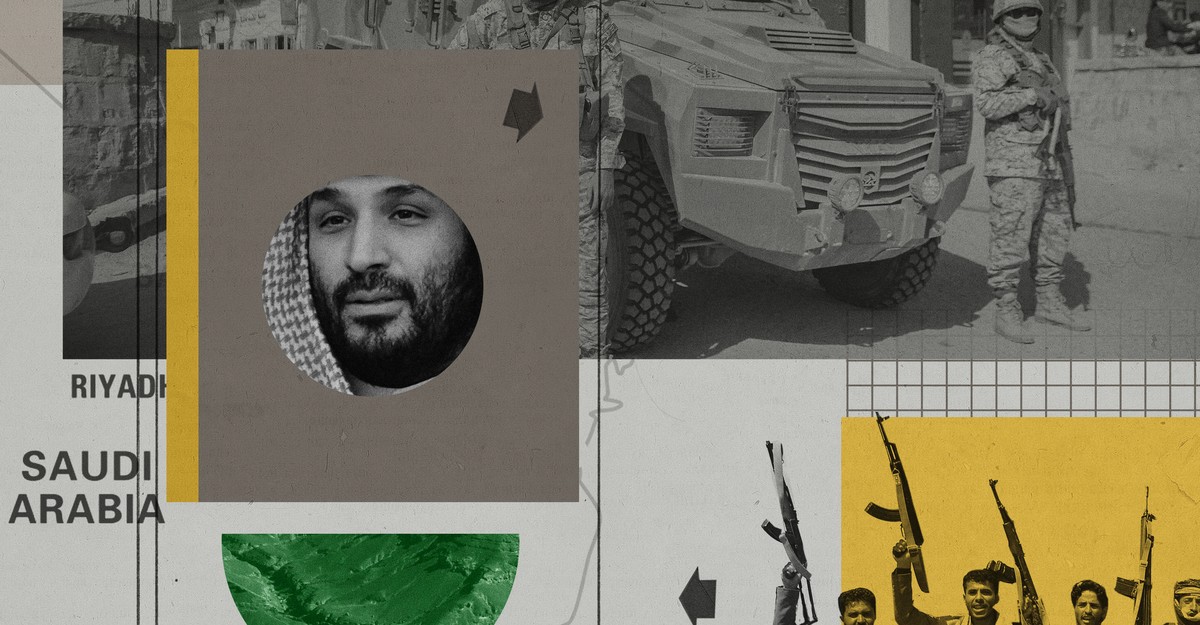
Saudi Journalist Calls Crisis ‘Most Dangerous’ Amid Houthi Missile Barrages
Missile warnings and intercepted blasts over a Riyadh shopping mall in late October shattered Saudi Arabia’s vision of a frictionless, post-oil future built on entertainment and technology.
The kingdom faces the most dangerous crisis in its history, according to Saudi journalist Abdulrahman al-Rashed, who spoke on a podcast last month as reported by The Atlantic. Recurring Houthi missile barrages have demonstrated an ability to shut down large parts of the economy, including a mid-October strike on the main airport in Riyadh that killed at least 14 people and injured hundreds.
Saudi Arabia is at war, though officials have long held firmly to the claim that the conflict is strictly intra-Yemeni. September marked the start of the current Houthi military campaign, which commenced when the group seized the Bab el-Mandeb Strait on the Red Sea. On November 15, Saudi-supported troops reported that they had been compelled to retreat from the region surrounding the strait, following some territorial advances made in October.
The conflict escalated following an offensive hatched after President Trump ordered the blockade of the Strait of Hormuz in the spring, a senior Saudi official told The Atlantic. Tehran persuaded Houthi allies to launch an offensive on the Bab el-Mandeb, with Iran agreeing to provide assistance.
A Houthi delegation attended the funeral of Ayatollah Ali Khamenei in Tehran in July. Upon their return, a Mahan Air flight carried a team of Axis military technicians and commanders—including two North Koreans, a Syrian from the Assad regime, members of the Islamic Revolutionary Guard Corps, and Lebanese Hezbollah—alongside cash, drone parts, and missile-guidance systems, according to the Saudi official.
Military Realities and Regional Alliances
Saudi commandos embedded with Yemeni government forces organized a counteroffensive, though some soldiers were killed in a Houthi strike on October 19. The near-term goal is to recapture lost territory and secure a truce, but the Saudi-backed Yemeni forces have not yet achieved that outcome.
“I don’t see a way out unless the U.S. agrees to provide direct air support,” said Nadwa al-Dawsari, an associate fellow at the Middle East Institute, told The Atlantic.
The Houthis have evolved far beyond rebel upstarts of a decade ago, operating an AI-assisted weapons industry and utilizing tools like Claude to improve guided-missile technology. They control about a third of Yemen’s territory and most of its population.
“In Hodeida, the Houthis have built a city underneath the city,” said Mohammed al-Basha, a Yemen analyst and founder of the Basha Report, told The Atlantic. “For anyone trying to capture that place, it would be like going into Gaza.”
Saudi officials remain reluctant to deploy regular troops, relying instead on thousands of soldiers brought in from Pakistan and Syria to help defend the border. Meanwhile, the Houthis continue building underground tunnels and expanding their military capabilities.
Abdulrahman al-Rashed brings a deep institutional perspective to these regional developments, having served as the general manager of the Al Arabiya news channel for a decade.
Before overseeing the network’s digital expansion and the launch of its sister channel, Al Hadath, he held the position of editor in chief at both the daily newspaper Asharq Al-Awsat and Al-Majalla magazine. In 2016, his career in journalism was recognized when he was named the Arab Media Personality of the Year at the Arab Media Forum.
Disclaimer: The views and cultural analyses presented in this article are for informational and entertainment purposes only. Information regarding legal disputes or financial data is based on available public records.