Satellite Image Shows Growing Lava Dome at Active Shiveluch Volcano in Russia
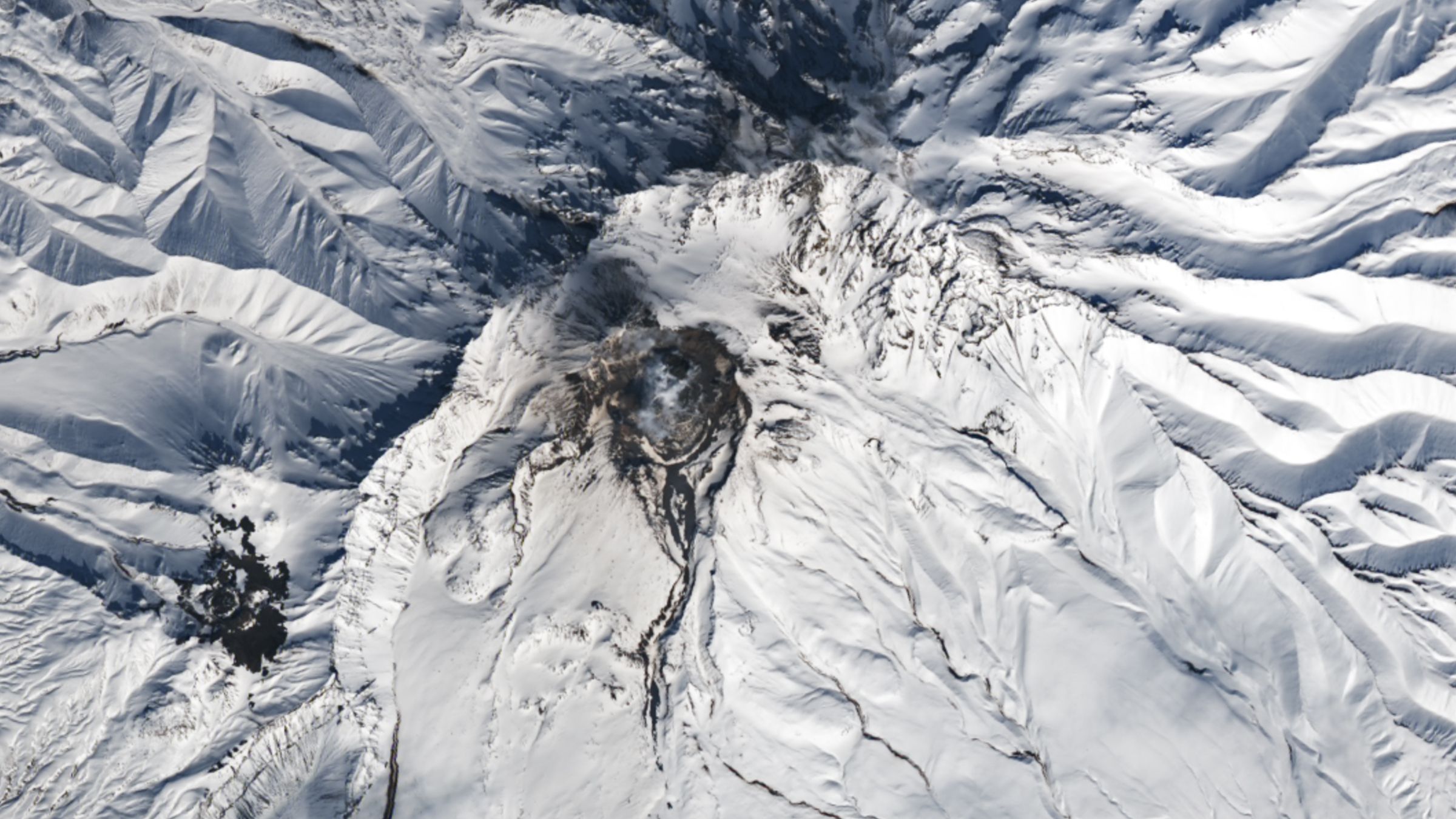
A striking Landsat 9 satellite image taken on April 23, 2026, captures a heavy blanket of snow surrounding a growing lava dome at the summit of the Shiveluch volcano on Russia’s Kamchatka Peninsula.
The 10,771-foot-tall stratovolcano — also spelled Shivelyuch or Sheveluch — is the northernmost active peak in eastern Russia’s Kamchatka Peninsula. According to NASA’s Earth Observatory (Live Science), the name Shiveluch loosely translates to “smoking mountain” in the language of the region’s Indigenous Itelmen people. The Smithsonian Institution’s Global Volcanism Program reports that the volcano has experienced at least 15 eruptions in the past 100 years, with its most recent eruption ongoing since 1999 (Live Science).
On average, the volcano spews around 530 million cubic feet of lava every year, which a 2007 study notes is enough to fill 6,000 Olympic-size swimming pools.
“On a near-daily basis, satellites detect new signs of activity within Shiveluch’s horseshoe-shaped caldera, including thermal anomalies, hot avalanches and debris flows.”
The representatives added that the volcano constantly spits out ash deposits that darken the surrounding area.
The satellite image reveals a particularly dark circle at the top of the caldera, representing a steep-sided landform that has grown rapidly in recent months.
“extruded slowly and piles up into lobed, sloped, or spine-like shapes akin to those that form when toothpaste is squeezed from a tube.”
While lava domes eventually grow so large that they give way under their own weight and cause caldera walls to collapse, the volcano quickly rebuilds itself through ongoing activity.
“Shivelyuch is an incredible volcano that has collapsed over and over again, on several scales, ranging from enormous flank collapses to more modest dome-collapse events.”
Krippner added: “It goes through cycles of collapse but then builds itself up again and again through constant volcanic activity.”
According to Harry Baker writing for Live Science, the satellite image documents ongoing dome growth at the volcano, providing a record of surface changes that scientists can track from space. The digital archive notes that this activity affects geoscientists monitoring Kamchatka volcanoes along with people living or traveling near the peninsula.
The Earth Observatory added that the summit frequently produces hot avalanches and debris flows. These phenomena constantly alter the physical appearance of the terrain when viewed from above.
Shiveluch volcano rises on Russia’s Kamchatka Peninsula, 84 kilometers (52 mi) northwest of Ust-Kamchatsk in the Kliuchevskaya volcano group, with the active Young Shiveluch reaching about 2,800 meters (9,200 ft). The stratovolcano has produced at least 60 large eruptions during the Holocene, with intense periods around 6500–6400 BC, 2250–2000 BC, and AD 50–650, and a current active period beginning around 900 BC.
Since the ongoing eruption of Young Shiveluch started on 15 August 1999, the volcano erupts around 0.015 km3 (0.0036 mi3) of magma per year, driving frequent lava dome growth and hot avalanches.
A zoomed-out version of the satellite image shows black streaks and a thick dark line emanating from the summit caldera, Space.com reported. These recent and past lava flows have retained enough heat that snow cannot settle on them. Krippner said that during previous fieldwork at Shiveluch, she could still feel heat coming from lava flows that were over 5 years old.