
Sándorfi Art Rediscovered: A Hungarian Painter’s Parisian Legacy
The Budapest art market is witnessing a resurgence of hyper-realistic figurative painting, driven by a retrospective of the late Sándorfi Imre at the Kálmán Makláry Fine Arts gallery. With a closed oeuvre creating artificial scarcity, demand from international collectors has outpaced supply, necessitating rigorous estate management and high-security logistics for the exhibition of the Horn Collection.
In the rarefied air of the global art market, scarcity is the ultimate currency. When an artist’s career is truncated by an untimely death, their body of work transforms from a creative output into a finite asset class. This is the precise economic phenomenon currently unfolding in Budapest regarding Sándorfi Imre, the Hungarian-French painter whose hyper-realistic canvases have commanded waiting lists stretching into years. The current exhibition, curated by the Erdész & Makláry Fine Arts Gallery, is not merely a cultural homage; it is a case study in posthumous brand equity and the logistical complexities of moving high-value intellectual property across borders.
The core driver of this valuation spike is the “closed oeuvre.” Unlike living contemporaries who can flood the market to meet demand, Sándorfi’s catalog is static. This creates a supply shock that drives secondary market prices upward, a trend mirrored in the performance of other hyper-realists like Gottfried Helnwein or the late Lucian Freud. According to recent auction data from major houses like Sotheby’s and Christie’s, European figurative painting from the late 20th century has seen a 14% year-over-year increase in hammer price, signaling a flight to quality among investors seeking tangible assets amidst digital volatility.
However, capitalizing on this momentum requires more than just hanging paintings on a wall. It demands a sophisticated infrastructure of trust and security. The current showcase features works from the Horn Collection, many arriving from overseas, including pieces never before seen in Hungary. Transporting assets of this magnitude—where a single canvas can represent a seven-figure valuation—transforms a gallery opening into a high-stakes logistical operation. Galleries mounting exhibitions of this caliber must engage specialized fine art logistics and climate-controlled transport firms to mitigate the risk of damage during transit. The physical security of the venue becomes paramount. High-net-worth collectors attending private viewings expect discretion and safety, prompting venues to contract with elite private security and access control specialists to manage crowd flow and protect the assets.
“The value of a deceased artist’s work is entirely dependent on the integrity of their catalogue raisonné. Without rigorous authentication protocols, the market collapses under the weight of forgeries.”
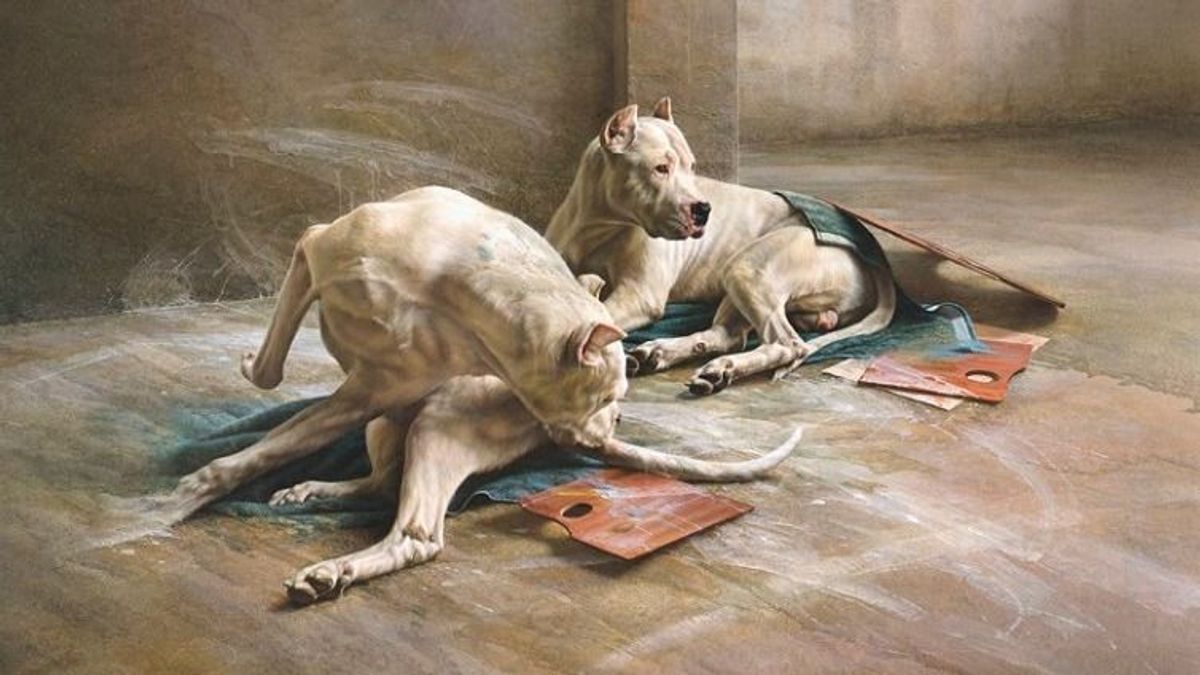
The narrative surrounding Sándorfi is also deeply intertwined with the mechanics of the art trade itself. A centerpiece of the exhibition, Motus, Motus – Hommage a la culture, serves as a meta-commentary on the industry. The painting, depicting two wounded Argentine mastiffs and a palette, is an allegory for the brutal price wars between art dealers. It was acquired by collector Péter Horn, CEO of B. Braun Hungary, who recognized the work’s significance immediately. This specific transaction highlights the role of the “blue-chip” collector in stabilizing an artist’s market. When a corporate leader or institutional buyer anchors the price floor, it provides the stability needed for the artist’s estate to plan long-term legacy projects.
Yet, the management of such an estate is fraught with legal peril. As interest grows, so does the incentive for fraud. The “Sándorfi brand” is now vulnerable to copyright infringement and the circulation of unverified works. To maintain the integrity of the pricing structure, the estate must work closely with specialized intellectual property attorneys to police the market and authenticate provenance. This legal fortification is essential to prevent the dilution of the brand, ensuring that the “long waitlist” remains a marker of exclusivity rather than a symptom of market confusion.
Beyond the gallery walls, the ripple effects of this cultural moment extend into the local economy. A high-profile exhibition of this nature acts as a magnet for cultural tourism, drawing international buyers and critics to Budapest. This influx creates immediate opportunities for the local service sector. From the moment a collector lands at Ferenc Liszt International Airport, the city’s luxury hospitality and concierge sectors stand to benefit. The synergy between high culture and high-end tourism is well-documented; art fairs and major retrospectives often drive occupancy rates in five-star districts, proving that cultural capital is a direct precursor to economic revenue.
The story of Sándorfi Imre’s resurgence is ultimately a lesson in the lifecycle of cultural IP. It begins with the artist’s vision, is amplified by the curator’s eye (in this case, Kálmán Makláry’s discovery in a Parisian bookshop), and is sustained by the collector’s conviction. But the longevity of the brand depends on the professional ecosystem surrounding it. As the exhibition draws to a close and the works return to private vaults or new public institutions, the focus shifts to preservation and legacy planning.
For stakeholders in the entertainment and culture sector, the takeaway is clear: talent is fleeting, but the business of legacy is eternal. Whether managing the estate of a painter, the catalog of a musician, or the IP of a film franchise, the principles remain the same. Success requires a triangulation of creative vision, legal protection, and logistical excellence. As the World Today News Directory continues to track these shifts, it becomes evident that the most valuable asset in the modern media landscape is not the content itself, but the professional infrastructure built to protect and monetize it.