
Samsung Unveils Sharper Stretchable Micro LED Display for Vehicles
The industry has a long history of “stretchable” prototypes that serve as little more than expensive mood boards for VCs. However, the latest iteration of Samsung Display’s Micro LED project, unveiled at SID Display Week 2026 in Los Angeles, suggests a shift from aesthetic curiosity to actual hardware viability. By hitting a 200 PPI threshold, Samsung is finally moving the needle toward standard automotive legibility.
The Tech TL;DR:
- Resolution Jump: Pixel density increased to 200 PPI, a 67 percent improvement over the previous 120 PPI iteration.
- Architectural Shift: New “bridge structure” allows for electrical continuity and higher pixel density during physical deformation.
- Deployment Target: Specifically optimized for Software Defined Vehicle (SDV) dashboards to dynamically adjust UI based on driving telemetry.
For the average consumer, a screen that stretches sounds like a gimmick. For a systems architect, it’s a nightmare of signal integrity and substrate fatigue. The core problem with stretchable displays has always been the trade-off between elasticity and resolution. When you stretch a traditional substrate, you distort the pixel pitch, leading to blurring or, worse, complete circuit failure. Samsung’s approach targets the “bridge structure”—the connective tissue between the fixed LED islands. By doubling the pixel density within these bridges, they’ve managed to maintain electrical performance without sacrificing the sharpness required for high-speed automotive environments.
Hardware Spec Breakdown: The Leap to 200 PPI
To understand why 200 PPI is the magic number, you have to look at the environment. An automotive instrument cluster isn’t a smartphone held six inches from the face; it’s a critical interface that must remain readable under varying light conditions and high-vibration environments. The previous 120 PPI model was a proof-of-concept, but it lacked the density to render crisp text at a glance. The 2026 model aligns more closely with existing automotive display standards.
| Metric | 2025 Prototype | 2026 SDV Model | Delta / Impact |
|---|---|---|---|
| Pixel Density | 120 PPI | 200 PPI | +67% Sharpness |
| Substrate Tech | Stretchable Micro LED | Enhanced Bridge Structure | Increased Electrical Stability |
| Primary Use Case | General Concept | Automotive Instrument Cluster | Context-Aware UI |
| Integration | Standalone Demo | SDV Environment | Dynamic Shape Adjustment |
This increase in density isn’t just about aesthetics; it’s about the cognitive load of the driver. In an SDV environment, the display is expected to morph based on the vehicle’s state—expanding to show navigation cues during a turn or contracting to prioritize speed and warnings during high-velocity maneuvers. Implementing this requires a tight integration between the vehicle’s CAN bus and the display driver IC (DDIC). Companies struggling with this level of hardware-software synchronization often rely on specialized [automotive software integration firms] to bridge the gap between raw hardware capabilities and usable UX.
The “Bridge Structure” and SDV Logic
The technical achievement here lies in the pixel layout. According to a Samsung Display official, the development of a new pixel structure allowed for more pixels to be integrated within the bridge structure, which connects the fixed regions where the LEDs reside. This is essentially an exercise in materials science—creating a conductor that can handle tensile stress without altering the resistance to a degree that degrades signal quality.
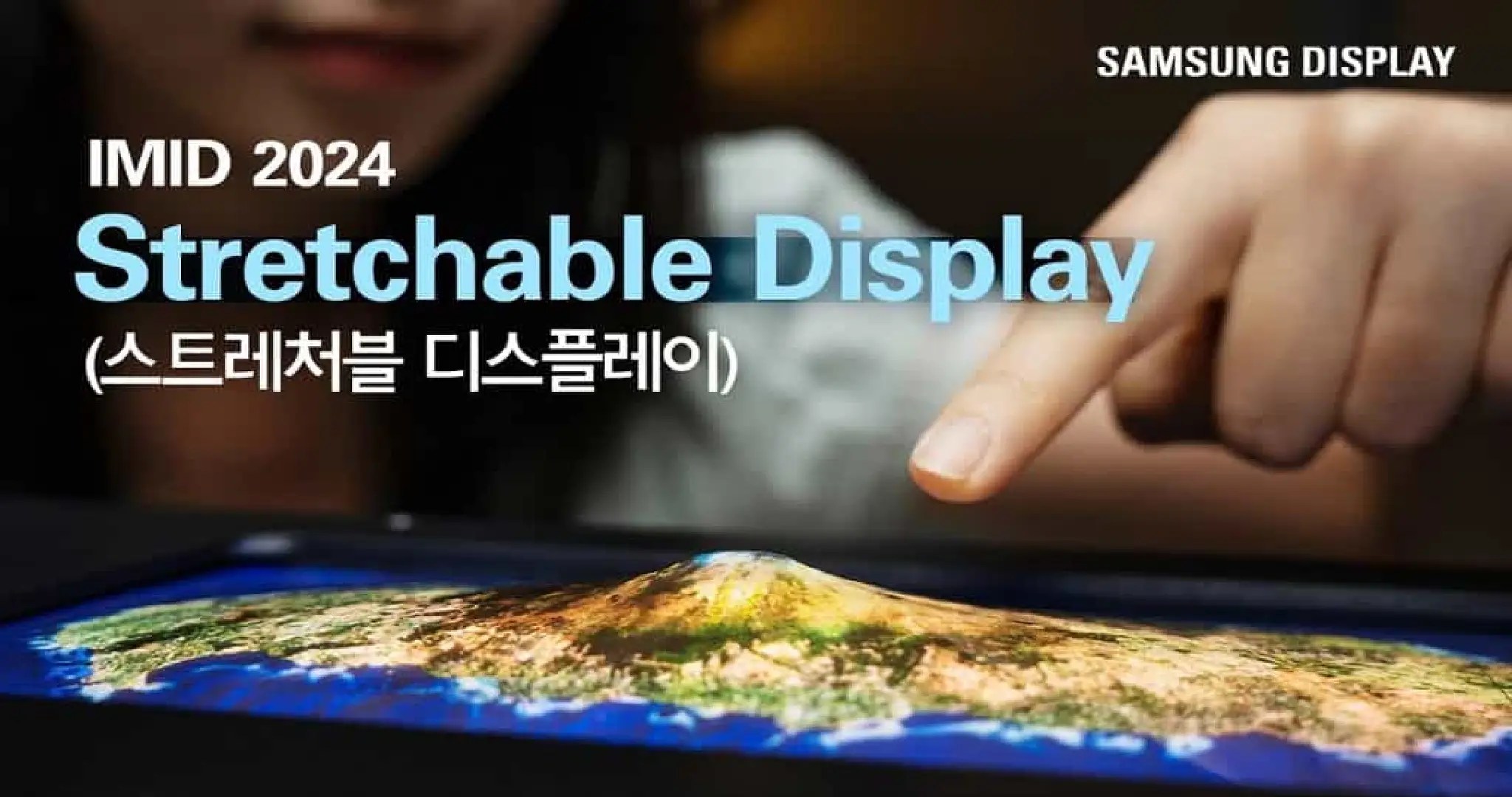
From a software perspective, this transforms the display from a static grid into a dynamic canvas. Instead of a fixed X/Y coordinate system for UI elements, the OS must handle a fluid coordinate system that updates in real-time as the panel stretches. This introduces potential latency in the rendering pipeline, especially if the NPU (Neural Processing Unit) is calculating the deformation in real-time to avoid image warping.
For developers looking to implement similar dynamic scaling in a simulated environment, the logic typically follows a transformation matrix that maps the logical UI coordinates to the physical stretched state of the panel. A conceptual API request to trigger a “dashboard expansion” event might look like this:
{ "event": "DISPLAY_MORPH", "target_zone": "speedometer_cluster", "state": { "stretch_factor": 1.25, "axis": "horizontal", "transition_ms": 300, "interpolation": "linear" }, "ui_payload": { "active_widgets": ["nav_detailed", "speed_digital"], "priority": "high" } } Maintaining this level of fluidity requires a robust tech stack, often involving custom kernels and low-level drivers. For enterprises attempting to prototype these interfaces, partnering with [hardware prototyping labs] is critical to ensure that the thermal output of the Micro LED array doesn’t compromise the elasticity of the bridge structure over thousands of cycles.
The Reality Check: Vaporware or Viable?
While the 200 PPI milestone is significant, the road to mass production is littered with “world-leading” prototypes. The primary bottleneck remains the yield rate of Micro LED transfer processes and the long-term durability of the stretchable substrate. If the bridge structure develops micro-fractures after 10,000 stretch cycles, the display becomes a liability rather than a feature.

“The transition from rigid to stretchable displays isn’t just a hardware swap; it’s a total rethink of the display driver architecture. We are moving away from static buffers toward a fluid geometry that must be synchronized with the vehicle’s physical state in milliseconds.”
the integration into Software Defined Vehicles (SDVs) means these displays will be subject to the same OTA (Over-the-Air) update risks as the rest of the car. A bug in a firmware update could theoretically cause a display to stretch or contract incorrectly, creating a driver distraction. This elevates the need for rigorous [embedded systems auditors] to verify the safety-critical nature of the UI transitions.
Samsung’s move to align with automotive standards suggests they are no longer just playing with chemistry in a lab; they are designing for a supply chain. Whether this results in a production vehicle in the next three years or remains a high-end halo feature for luxury EVs depends on their ability to scale the bridge structure manufacturing without driving the BOM (Bill of Materials) into the stratosphere.
*Disclaimer: The technical analyses and security protocols detailed in this article are for informational purposes only. Always consult with certified IT and cybersecurity professionals before altering enterprise networks or handling sensitive data.*