
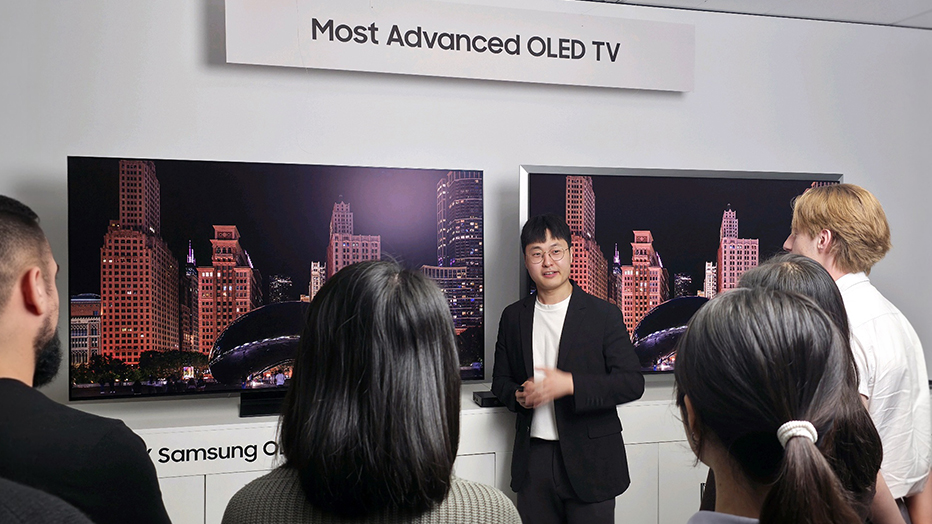
Samsung Unveils Next-Gen AI-Powered TV Innovations and 2026 Lineup
Samsung is pivoting from passive display hardware to active, AI-driven scene reconstruction. The 2026 lineup, recently highlighted at the Australian Tech Summit, signals a shift where the NPU (Neural Processing Unit) becomes as critical to the viewing experience as the panel’s native resolution or peak brightness.
The Tech TL;DR:
- AI-Driven Reconstruction: The new Samsung Vision AI Companion enables real-time picture and sound optimization, including intelligent SDR-to-HDR transformation.
- Hardware Evolution: The Neo QLED 4K series (QN80H, QN70H) utilizes Quantum Mini LEDs to achieve 100% color volume and higher backlighting precision.
- Context-Aware Processing: New “AI Customization Mode” automates content detection to tailor display parameters for sports, movies, and shows.
The fundamental bottleneck in consumer display technology has long been the delta between source content quality and hardware capability. Traditional upscaling algorithms often struggle with the computational overhead required to map low-bit-depth SDR content into a high-dynamic-range environment without introducing macroblocking or chromatic artifacts. Samsung’s 2026 deployment attempts to solve this through a heavy reliance on localized, real-time AI processing via the Vision AI Companion.
The Architecture of Vision AI: Beyond Static Backlighting
The 2026 Neo QLED 4K lineup—specifically the QN80H and QN70H models—moves away from the broad-stroke backlighting seen in previous generations. By leveraging Quantum Mini LEDs, Samsung is increasing the density of light sources, allowing for more granular control over local dimming zones. This is not merely a brightness play; it is an architectural move to improve contrast ratios and minimize blooming in high-luminance scenes.
According to Samsung Electronics America, the QN80H model takes this a step further by integrating advanced AI to optimize both picture and sound in real-time. This implies a sophisticated SoC (System on a Chip) capable of analyzing every scene frame-by-frame to adjust color volume and audio profiles. This level of real-time processing suggests a significant increase in NPU utilization compared to the 2025 models, aimed at bridging the gap between legacy SD/HD content and modern 4K standards.
| Model Tier | Primary Feature Set | Backlighting Technology | AI Capability |
|---|---|---|---|
| QN80H | Advanced real-time picture/sound optimization | Quantum Mini LED | Full Vision AI Companion + SDR-to-HDR |
| QN70H | Enhanced Mini LED performance | Quantum Mini LED | Vision AI Companion |
As these displays become increasingly integrated into the broader IoT ecosystem, the security implications of AI-driven endpoints cannot be ignored. For enterprise environments or smart-building deployments, ensuring these devices do not become unmanaged entry points is critical. Organizations should consider engaging IoT security auditors to validate the network perimeter around high-density smart hardware.
Computational Upscaling and Content-Aware Logic
One of the more aggressive technical claims in the 2026 rollout is the “AI Customization Mode.” This feature moves beyond user-defined presets, instead utilizing automated detection to identify the content type—be it sports, cinema, or episodic television. This suggests an underlying logic layer that can switch between different optimization profiles (e.g., prioritizing motion interpolation for sports vs. Color accuracy and film grain management for movies) without manual user intervention.

The ability to transform SDR content into “HDR-like quality” is a computationally intensive task. It requires the processor to intelligently map brightness levels and expand the color gamut in a way that mimics the metadata-driven precision of native HDR. For developers working on media streaming pipelines, this represents a shift where the endpoint device takes on a larger portion of the heavy lifting previously reserved for the encoder or the source server.
To visualize how such a device might communicate its state or receive configuration updates in a managed environment, consider the following mock JSON payload representing a device’s real-time optimization state:
{ "device_metadata": { "model": "Samsung_QN80H_2026", "firmware_version": "2.6.0-stable", "region": "AU-EAST" }, "vision_ai_status": { "active_mode": "content_detection", "detected_type": "sports", "optimization_metrics": { "motion_smoothing_level": 0.85, "hdr_emulation_active": true, "sdr_to_hdr_gain": "12dB_equivalent", "color_volume_target": "100%" } } }As these units scale in both consumer and commercial sectors, the importance of hardware lifecycle management grows. For large-scale deployments—such as digital signage or hospitality environments—partnering with IT hardware maintenance providers is essential to manage the thermal and electrical demands of high-performance Mini LED arrays.

“With our new Mini LED TVs and Neo QLED 4K series, we’re offering incredible value for shoppers at every price point. And across both series, Samsung Vision AI Companion elevates the experience in ways that go far beyond simple viewing, making TV watching more intuitive, more interactive and more personalized.” — Shane Higby, Head of Home Entertainment at Samsung Electronics America
While the marketing focuses on “personalized viewing,” the technical reality is a push toward more intelligent, autonomous hardware. The rollout across India, Vietnam, and Australia demonstrates a global strategy to saturate the market with AI-integrated displays. Whether this move toward high-compute consumer electronics succeeds depends on the ability of the Vision AI Companion to deliver consistent, artifact-free results across the vast spectrum of available media bit-depths.
The trajectory is clear: the display is no longer just a window; it is a processing node. As the line between content delivery and content reconstruction blurs, the industry will continue to watch how much of the heavy lifting is moved from the cloud to the edge.
*Disclaimer: The technical analyses and security protocols detailed in this article are for informational purposes only. Always consult with certified IT and cybersecurity professionals before altering enterprise networks or handling sensitive data.*