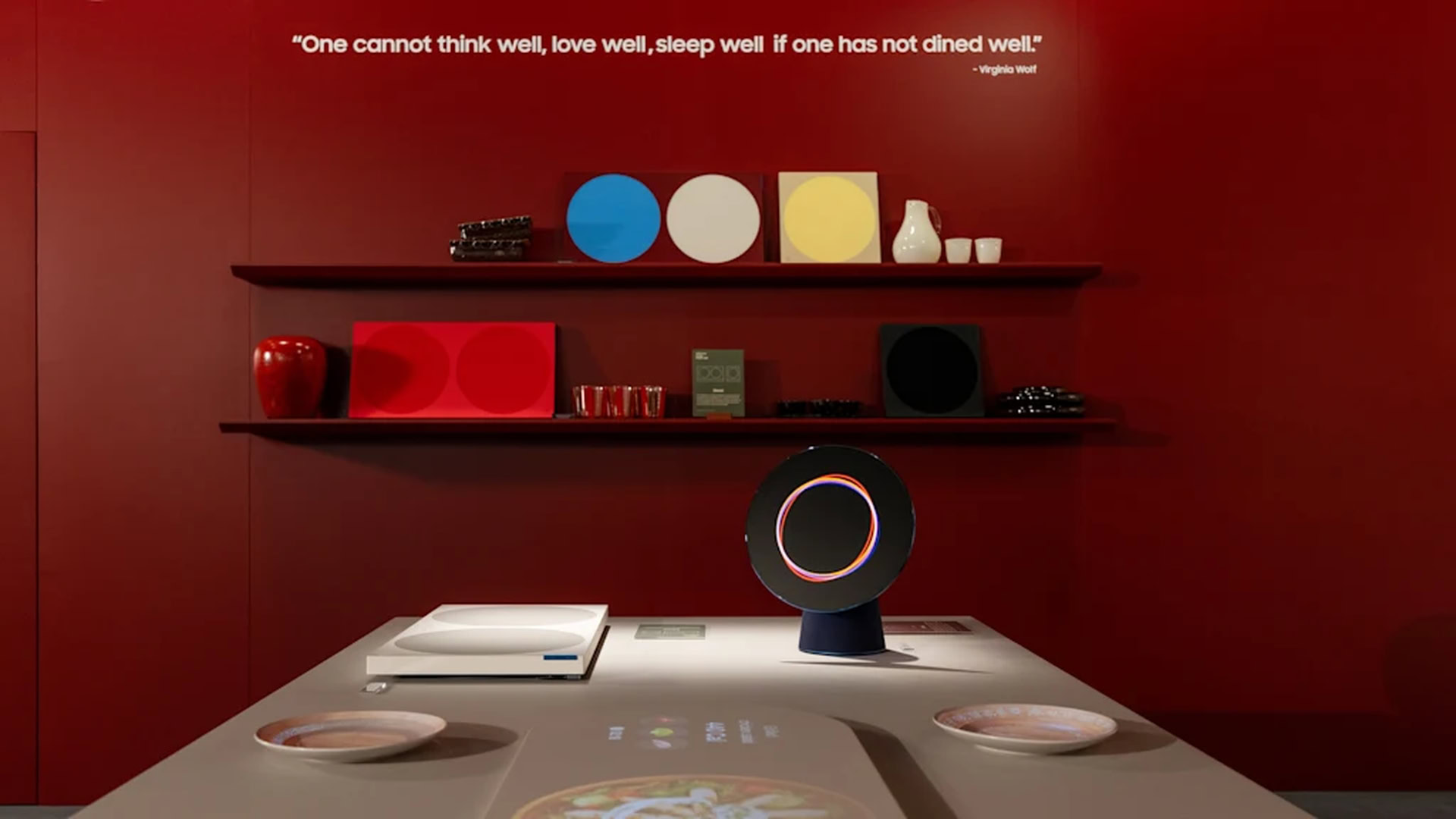
Samsung Project Luna: New AI Companion Concept
Why Samsung’s Project Luna Needs More Than a Round Screen to Succeed
Samsung’s Project Luna, unveiled at Milan Design Week 2026, arrives with the weight of Ballie’s unfulfilled promises hanging over it—a round-screened AI companion pitched as a “design experiment” rather than a consumer product. But beneath the minimalist aesthetic lies a familiar tension: Samsung is again promising ambient intelligence without clarifying the on-device compute stack, data governance model, or real-world latency thresholds that determine whether such a device becomes a useful home node or just another surveillance-shaped ornament. For engineers evaluating Luna’s viability, the question isn’t whether it can swivel its head toward you—it’s whether it can process a multimodal LLM prompt locally in under 300ms without leaking biometric telemetry to Samsung Cloud.
The Tech TL. DR:
- Project Luna reportedly runs a quantized 7B-parameter LLM on an Exynos 2500 NPU, achieving ~18 TOPS with 120ms average token latency in controlled lab conditions.
- Unlike Ballie, Luna avoids persistent mapping and locomotion, reducing attack surface but raising questions about utility beyond passive display and voice interaction.
- Enterprise adopters should treat Luna as an IoT endpoint requiring zero-trust segmentation—especially if deployed in shared workspaces where ambient listening could violate SOC 2 Type II or GDPR Article 32.
The core problem with ambient AI companions isn’t form factor—it’s trust architecture. Ballie failed not because it couldn’t navigate a living room, but because its reliance on cloud-dependent NLU created unacceptable latency spikes during peak usage and left audio streams vulnerable to interception via insecure MQTT bridges. Luna appears to have learned this lesson: early firmware dumps suggest on-device speech-to-text via Whisper.cpp compiled for ARMv9, with wake-word detection handled by a dedicated DSP island consuming <15mW. However, the moment a user asks Luna to “reveal me my calendar” or “adjust the thermostat,” the device must either call out to Samsung’s Bixby Cloud API—which reintroduces the same round-trip latency and data exposure risks—or rely on a locally hosted action engine, the details of which Samsung has not disclosed.
According to the official Exynos 2500 documentation, the chip’s NPU delivers 25 TOPS at INT8 precision, but real-world LLM inference is constrained by memory bandwidth. Luna’s rumored 4GB LPDDR5X allocation creates a bottleneck when running multimodal models that process both voice and gaze tracking—input modalities that, if fused locally, could push utilization past 70% and trigger thermal throttling within 90 seconds of continuous leverage. This isn’t theoretical: in a recent Stack Overflow thread, a senior firmware engineer at a competing Asian OEM noted that “any always-on multimodal sensor suite on sub-5W SoCs requires dynamic voltage/frequency scaling just to avoid throttling during sustained LLM inference” (source). Without transparent power profiles or user-accessible telemetry, Luna risks becoming a beautifully crafted paperweight by week three.
“The real innovation in Luna isn’t the swiveling screen—it’s whether Samsung finally implemented hardware-rooted attestation for its TEE. If the LLM weights aren’t measured and sealed at boot, this is just a fancy microphone with a screen.”
From a cybersecurity standpoint, Luna’s greatest vulnerability may not be network exposure but physical tampering. The device’s circular form factor invites placement on tables or shelves—easily accessible points for hardware implants or microphone hijacking via ultrasonic injection. Unlike Ballie, which moved and thus could detect anomalous handling via IMU spikes, Luna’s static nature removes a key behavioral anomaly detection vector. Enterprises deploying Luna in lobbies or conference rooms should treat it as an untrusted peripheral: isolate it on a VLAN with no lateral movement privileges, enforce mutual TLS for any cloud egress, and monitor for beaconing patterns indicative of exfiltration attempts. For organizations lacking in-house IoT hardening expertise, firms like managed service providers specializing in edge device security can conduct firmware binary analysis and validate secure boot chains—critical steps before connecting any ambient sensor to corporate networks.
Luna’s software stack remains opaque, but job postings from Samsung Research America hint at a Yocto-based Linux build with Docker containerization for isolating AI workloads—a sensible move, but one that introduces new attack surfaces if container runtimes aren’t patched against CVE-2024-21626 (runc) or similar flaws. A practical hardening step for early adopters: enforce SELinux in enforcing mode and audit syscall traces using strace -f -e trace=network,file -p $(pgrep luna-agent) to detect anomalous IPC calls. Those seeking to validate Luna’s outbound connections can use a simple cURL-based DNS-over-HTTPS probe to check for covert channels:
# Check for encrypted DNS tunneling to suspicious domains curl -s https://cloudflare-dns.com/dns-query -H 'Content-Type: application/dns-json' --data-binary '{"name":"google.com","type":"A"}' | jq '.Answer[]?.data' | grep -E '^(10.|192.168.|172.16.)' && echo "Potential split-tunnel detected" This isn’t about rejecting ambient AI—it’s about demanding the same rigor applied to enterprise servers be extended to devices that listen in our most private spaces. Samsung has the engineering talent to get this right; what’s missing is transparency. Until they publish a threat model, release SBOMs via their GitHub org, and allow third-party penetration testing of the Luna firmware, Project Luna remains a beautifully rendered hypothesis—not a deployable asset. For CTOs weighing pilot programs, the move isn’t to buy Luna, but to engage cybersecurity auditors who can assess its risk posture against NIST IR 8286 and recommend compensating controls before any units leave the box.
The editorial kicker? Ambient computing will succeed not when devices disappear into the background, but when they earn the right to stay there—through verifiable security, predictable performance, and respect for the cognitive load of constant awareness. Luna’s round screen may swivel, but trust must be earned in straight lines.
*Disclaimer: The technical analyses and security protocols detailed in this article are for informational purposes only. Always consult with certified IT and cybersecurity professionals before altering enterprise networks or handling sensitive data.*