
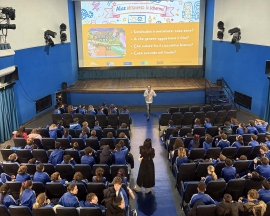
Salesian Cultural Centre Launches Second Edition of Alice Through the Screen Project
Italy’s “Alice Through the Screen” Project Signals Shift in Human Capital ROI
The Salesian Cultural Centre in Rome has launched the second iteration of “Alice Through the Screen,” a state-subsidized media literacy initiative targeting 3,000 students across Latium, Tuscany, and Liguria. Running through May 2026, the program pivots from passive consumption to active content creation, aiming to mitigate digital behavioral risks while fostering early-stage creative competencies essential for the future workforce.
While the press release frames this as a cultural endeavor for minors, the underlying mechanics reveal a strategic investment in human capital development. In an economy where digital fluency is no longer a soft skill but a baseline requirement for employability, projects like “Alice” function as early-stage R&D for the labor market. The initiative, backed by the Italian Ministry of Culture and the Ministry of Education, addresses a critical supply-side bottleneck: the shortage of workers capable of navigating the cognitive demands of the algorithmic economy.
The fiscal implications of digital illiteracy are stark. According to recent data from the European Commission’s Digital Economy and Society Index (DESI), Italy has historically lagged in basic digital skills, creating a drag on productivity growth. By intervening at the primary education level (ages 3-10), the project attempts to correct this trajectory before it impacts GDP. The involvement of award-winning creatives, such as Margherita Giusti, signals a move toward high-quality asset production rather than generic content flooding. This quality control is vital; in the attention economy, the ability to synthesize narrative is a premium asset.
For corporate stakeholders, the relevance extends beyond CSR optics. The curriculum’s focus on emotional intelligence and anti-bullying protocols directly correlates to future workplace culture metrics. Companies investing in corporate training and development firms are already seeing the downstream effects of poor digital socialization in entry-level hires. The “Alice” model offers a blueprint for early intervention, reducing the long-term costs associated with workplace friction and communication breakdowns.
The Macro Shift: Three Vectors of Change
This initiative is not an isolated event but a symptom of broader market corrections in the education and media sectors. We are witnessing a decoupling of traditional pedagogy from digital reality. To understand the investment thesis here, one must look at how this project alters the landscape for service providers and institutional investors.
- Regulatory Arbitrage in EdTech: As the EU tightens regulations around child safety online (e.g., the Digital Services Act), compliant educational frameworks become scarce assets. Projects that successfully integrate psychological safety with media literacy create a defensible moat. Firms specializing in intellectual property and media law are seeing increased demand to structure these public-private partnerships, ensuring that content IP remains protected while meeting strict government compliance standards.
- The Valuation of “Soft” Skills: The project explicitly targets empathy and collaboration. In the SaaS and service sectors, these are now quantifiable revenue drivers. A workforce trained to interpret visual language and manage digital empathy commands a higher wage premium. This shifts the valuation model for EdTech startups from user acquisition metrics to long-term competency outcomes.
- Localization of Content Supply Chains: By utilizing local cinemas like the “Don Bosco” in Rome and regional experts, the project decentralizes content production. This mirrors a broader trend in the creative economy where hyper-localized content outperforms generic global feeds. This creates opportunities for content strategy and production agencies that can pivot from mass-market distribution to niche, high-engagement community building.
The financial commitment from the Italian government underscores a recognition that media literacy is infrastructure, not entertainment. Fabio Zenadocchio, Director of the Salesian Cultural Centre, noted that the goal is to provide tools for “critical spirit and responsibility.” From a balance sheet perspective, this is risk mitigation. Unchecked digital consumption leads to volatility in consumer behavior and brand reputation; educated consumption leads to stability.
“The transition from passive viewer to active creator is the single most important leverage point for the next decade of economic growth. We are not just teaching kids to make movies; we are teaching them to own the narrative.”
Market observers should note the involvement of high-caliber industry professionals like Giusti, whose work has secured David di Donatello awards. This elevates the project from a charitable exercise to a professional incubator. The presence of such talent suggests that the output of these workshops could eventually feed into the broader Italian film and advertising ecosystem, creating a pipeline of fresh IP.
But, scalability remains the primary friction point. While the current cohort covers 22 schools, the addressable market is the entire EU youth demographic. To scale, these initiatives require robust backend support. This is where the B2B sector intervenes. Educational institutions and non-profits executing similar mandates often lack the operational bandwidth to manage complex logistics, vendor contracts, and data privacy compliance. This gap is filled by specialized educational consulting and operations firms that streamline the delivery of such programs, ensuring that funding translates efficiently into student outcomes.
the psychological component—integrating specialists in emotional education—adds a layer of complexity that requires cross-disciplinary management. The successful execution of such hybrid programs (art + psychology + technology) serves as a case study for corporate L&D departments looking to overhaul their own internal training modules. The methodologies used to teach a 7-year-old to deconstruct a film scene are increasingly relevant for training executives to deconstruct market trends.
As we move toward the close of Q2 2026, the metrics to watch are not just enrollment numbers, but the retention of digital literacy skills post-program. If the “Alice” model proves that early intervention yields measurable improvements in cognitive flexibility, we can expect a surge in private equity interest in similar EdTech ventures. The directory of service providers capable of supporting this transition—from legal structuring to content delivery—is expanding rapidly.
The market does not reward nostalgia; it rewards adaptation. “Alice Through the Screen” is a microcosm of a macro adjustment: the realization that the screen is the new factory floor. Those who control the tools of production on that floor will dictate the terms of trade. For investors and business leaders, the directive is clear. Monitor the evolution of these educational frameworks closely. The companies that can replicate this model of “conscious creation” at scale will define the next cycle of the creative economy. To navigate this shifting landscape, stakeholders must engage with vetted partners who understand the intersection of culture, technology, and capital.