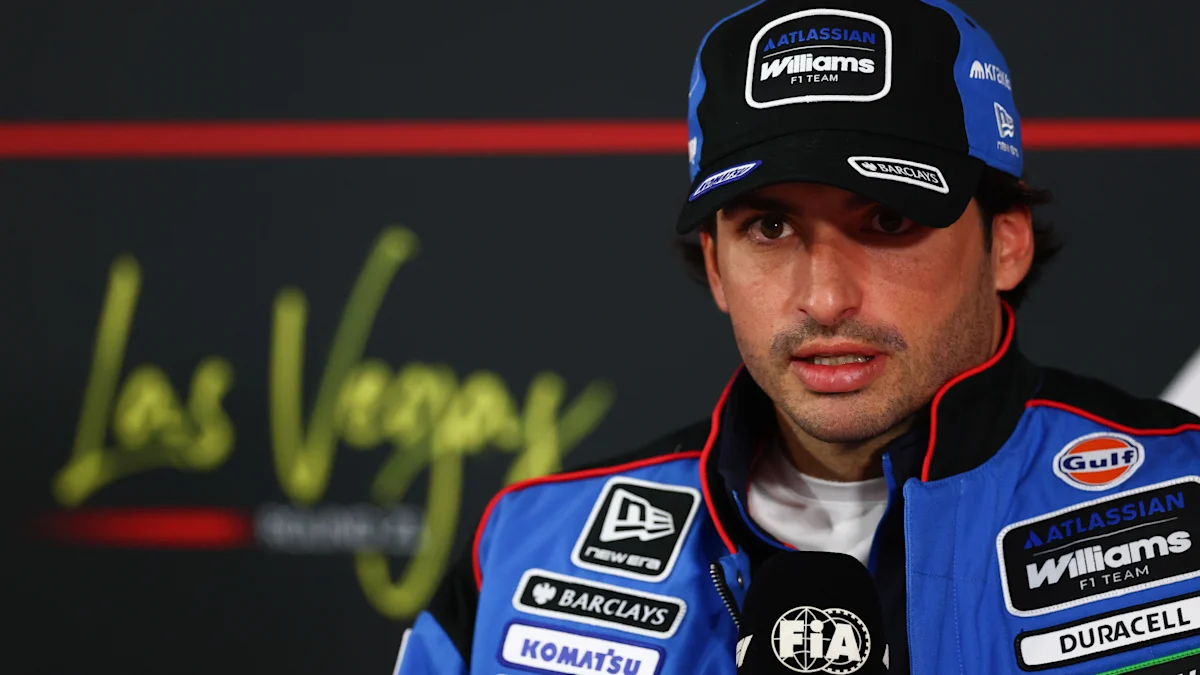
Sainz Takes 10-Place Grid Penalty for New Mercedes ADUO Turbo at Las Vegas GP
“Alex and Carlos will both run the ADUO-enabled turbo specification this weekend,” Williams confirmed ahead of the Las Vegas Grand Prix, where Carlos Sainz will take a 10-place grid penalty for fitting a fifth turbocharger, one beyond his permitted annual allocation.
Williams said the penalty will be applied after qualifying, meaning the Spaniard will drop 10 places from wherever he qualifies. The team reported the news on its own channels, with RacingNews365 and RacingNews Today carrying the same detail: the new component is an upgraded specification, not a like-for-like replacement.
“Carlos will take a 10-place grid penalty, as it will be his fifth turbocharger and exceeds the permitted annual allocation,” Williams said in its statement.
Why Sainz pays while Albon does not
The upgraded turbo was developed by Mercedes High Performance Powertrains under the FIA’s Additional Development and Upgrade Opportunities (ADUO) mechanism, granted after the manufacturer’s internal combustion engine was found to be running between two and four per cent behind the benchmark power unit, RacingNews365 reported. Mercedes made the part available to its works team and to customers including Williams and McLaren, with Las Vegas set as its on-track debut.

Both Williams cars will carry the new specification. Team-mate Alex Albon avoids any sanction, because in his case the new unit falls within his own season allowance. For Sainz, it is a fifth turbocharger, one more than the FIA’s annual allocation permits per driver, hence the 10-place drop.
A crowded penalty column on the grid
Sainz is not alone. McLaren’s Oscar Piastri will also serve a 10-place penalty after changing his internal combustion engine and exceeding his own limit of four for the season, Formula 1 reported. He, too, will run the new Mercedes turbo, as will his team-mate Lando Norris.
Mercedes customer Kimi Antonelli faces a five-place drop after taking a sixth engine, according to RacingNews365. The Mercedes works pairing stays clean: George Russell told reporters on Wednesday’s media day in Las Vegas that he has opted against the new turbo, believing victory is possible without it and not wanting to incur a grid penalty of his own, Formula 1 reported.
Antonelli played down the performance upside either way.

“We don’t expect any major performance gain from it,” said Kimi Antonelli, adding that the upgrade will help more with reliability and drivability.
Why Williams is spending a penalty now
Williams sits ninth in the teams’ standings after a difficult campaign under the new-for-2026 regulations, Formula 1 reported. The team is 16 points behind Audi and only five clear of Aston Martin — a margin thin enough that one strong points finish in Las Vegas can flip positions.
Taking the penalty with Sainz, rather than Albon, reflects that calculus: the team accepts one compromised Sunday to run the newest power-unit hardware on both cars after a season spent chasing the midfield.
The ADUO framework exists precisely for this kind of catch-up. It allows a manufacturer whose engine has been certified as behind the benchmark to introduce corrective upgrades mid-season, and each team running those parts still lives inside the same component-allocation rules that create the penalties.
What it means for the race
The pending drops reshape the back half of the qualifying order before a single lap is run. Sainz and Piastri, both quick drivers in cars expected to be competitive in the cool Nevada night conditions, will start deep in the field regardless of pace, while Antonelli gives up five places.
Russell’s decision to stay on the older specification keeps the works Mercedes at full grid strength, a contrast with his customer teams that frames the strategic split Mercedes itself faces this weekend.

For Williams, the trade-off is a familiar one in a cost-capped, component-capped era: performance hardware up front, track position sacrificed for it.
The team’s statement put both parts together — the new specification on both cars, the penalty on one — and the Las Vegas Grand Prix will show whether the upgrade’s reliability and drivability gains, as Antonelli characterized them, are worth 10 lost grid slots on a circuit where overtaking has historically been difficult but drafting high.
The grid forms after qualifying this weekend at the Las Vegas Grand Prix.
Disclaimer: The insights provided in this article are for informational and entertainment purposes only and do not constitute medical advice or sports betting recommendations.