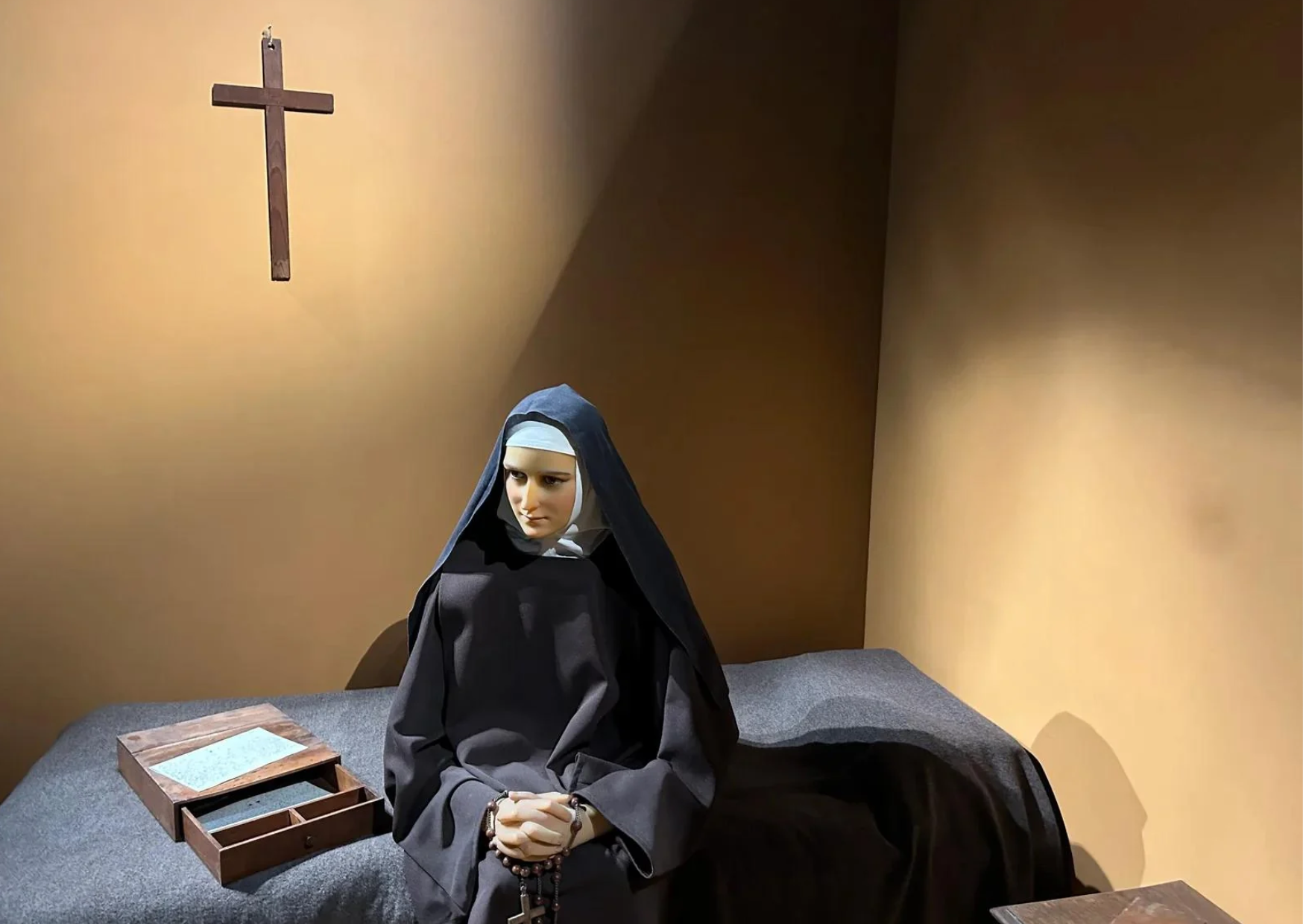
Saint Thérèse of Lisieux Exhibited at Musée Grévin in Paris
From November 27, 2026, to January 3, 2027, a wax statue of Saint Thérèse of Lisieux will be exhibited as an honorary guest at the Grévin Museum in Paris, according to Tribune Chrétienne.
The young Carmelite nun, who never sought honors during her lifetime, is stepping into a famous Parisian institution known primarily for housing wax likenesses of worldly celebrities. Tribune Chrétienne reported that the temporary exhibition is organized in partnership with the Sanctuary of Lisieux.
The statue originates from the wax museum located on the site of the Basilica of Sainte-Thérèse, where eleven life-sized scenes trace the major milestones of her life. Before arriving in the capital, the figure was entrusted to the workshops of the Grévin Museum for meticulous restoration.
Restoration Work in the Paris Workshops
Specialists including Franck, a painter, and Matthieu, a molder, worked under the responsibility of Valérie Chéreau to preserve the historical heritage piece. The restoration team spoke about the unique atmosphere the statue brought to their workspace, as reported by the Sanctuary of Lisieux.

« S’occuper d’elle nous apporte beaucoup de douceur. Il y a comme une présence dans l’atelier. Nous sommes très heureux de redonner vie à un patrimoine de grande valeur. »
According to Famille Chrétienne, Olivier Valentin, who is in charge of communication for the sanctuary, said that this marks a first for the institution. Valentin said that he could not find another statue that secured a place at the Grévin Museum without having been manufactured directly within its walls.
Valentin explained the historical methods used to construct the figure in an interview with Famille Chrétienne.
« Les têtes, réalisées en cire, sont cousues sur un buste en bois. Beaucoup de membres ne tiennent qu’aux vêtements ».
said Olivier Valentin, describing the fragile condition of the wax statues of sainte Thérèse and her family that have been at the sanctuaire de Lisieux since the 1930s, according to Famillechretienne.
Funding the Restoration of Lisieux Heritage
More than 50,000 pilgrims visit the sanctuary in Normandy each year to view the eleven tableaux depicting the Martin family, as detailed by Famille Chrétienne. Time has weakened these displays, prompting the sanctuary to launch a patronage campaign to fund comprehensive repairs across the entire collection.
Born in Alençon in 1873, Thérèse Martin entered the Carmel of Lisieux at age fifteen and died of tuberculosis on September 30, 1897, at the age of twenty-four, as detailed in Tribune Chrétienne. Her spiritual writings, published posthumously as Story of a Soul, spread globally long after her passing. Pope Pius XI canonized her in 1925, and Pope John Paul II declared her a Doctor of the Church in 1997.
Visitors to the Grévin Museum will encounter the figure placed among international public figures, serving as both a religious symbol and a fundraising catalyst for the Norman sanctuary.
Saint Thérèse of Lisieux is widely recognized as the “Little Flower,” a moniker that distinguishes her from Teresa of Avila, who is known as the “great Thérèse.” Although she remained largely obscure during her lifetime, Pope Pius X later described her as the “greatest saint of modern times.”
Her legacy is rooted in her approach to the spiritual life, which she termed the “Little Way.” This philosophy, detailed in her posthumously published writings, has made her one of the most popular figures in the history of the church. Today, her influence is reflected in the Basilica of Lisieux, which stands as the second most visited place of pilgrimage in France, following only Lourdes.
Disclaimer: The views and cultural analyses presented in this article are for informational and entertainment purposes only.