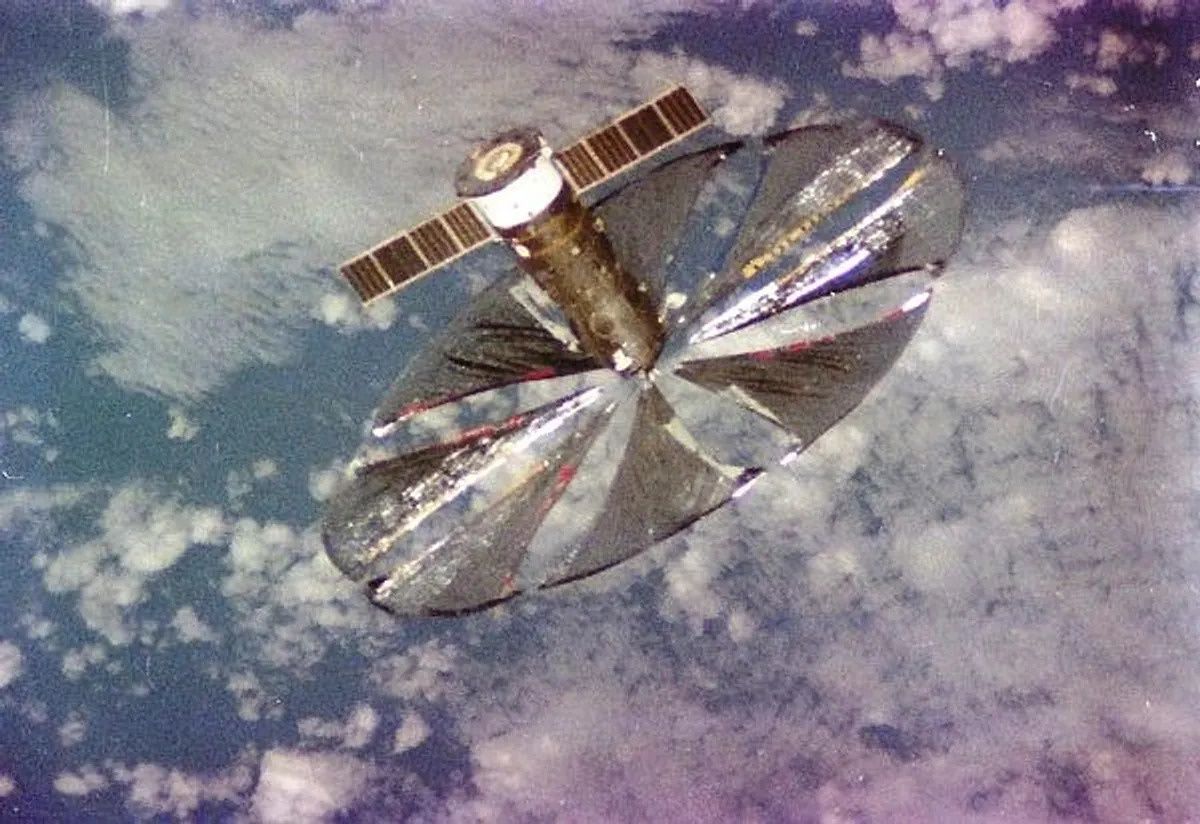
Russia’s Ambitious Daytime Solar Mirror Plan: A Powerful Presence in Space
In the early 1990s, Russian engineers launched the Znamya-2 project, an experimental attempt to illuminate Earth’s surface from space using a massive orbiting mirror. The experiment, conducted by the Russian space agency in February 1993, successfully deployed a 20-meter-wide aluminized Mylar reflector from the Progress M-15 cargo ship to reflect sunlight toward the night side of the planet.
### The mechanics of the Znamya-2 deployment
The primary objective of the Znamya-2 mission was to test the feasibility of using orbital mirrors to extend daylight hours for industrial operations or emergency rescue efforts in remote, high-latitude regions. According to project documentation, the device functioned as a rotating circular film that utilized centrifugal force to maintain its flat shape once deployed in low Earth orbit.
As the Progress spacecraft passed over Europe, the mirror directed a bright spot of light, roughly 5 kilometers in diameter, across the ground. Observers in parts of Russia and Europe reported seeing a swift, glowing beam move across the clouds. While the light was significantly dimmer than direct sunlight—comparable to the intensity of a full moon—it proved that large-scale light reflection from space was physically possible.
### Challenges and the end of the program
The project faced immediate technical and environmental criticism. The deployment of subsequent, larger mirrors, designated as Znamya-2.5, encountered significant setbacks. In 1999, a second attempt to deploy a 25-meter mirror failed when the structure snagged on a communication antenna during the unfolding process, causing the mission to be abandoned.
The concept faced scrutiny from the scientific community regarding the impact of artificial light on nocturnal ecosystems and astronomical observations. Astronomers argued that such mirrors could disrupt light-sensitive research and alter the natural environment. Following the failure of the 1999 mission and shifting priorities within the Russian space sector, the program was discontinued.
No further attempts to utilize orbital mirrors for terrestrial illumination have been pursued by the Russian space agency. The project remains a notable case study in space-based engineering, highlighting the technical difficulties of deploying large, thin-film structures in orbit and the diplomatic complexities of altering Earth’s natural nighttime environment. The hardware from the final failed mission burned up in the atmosphere, leaving the technology as an inactive chapter in experimental space exploration.