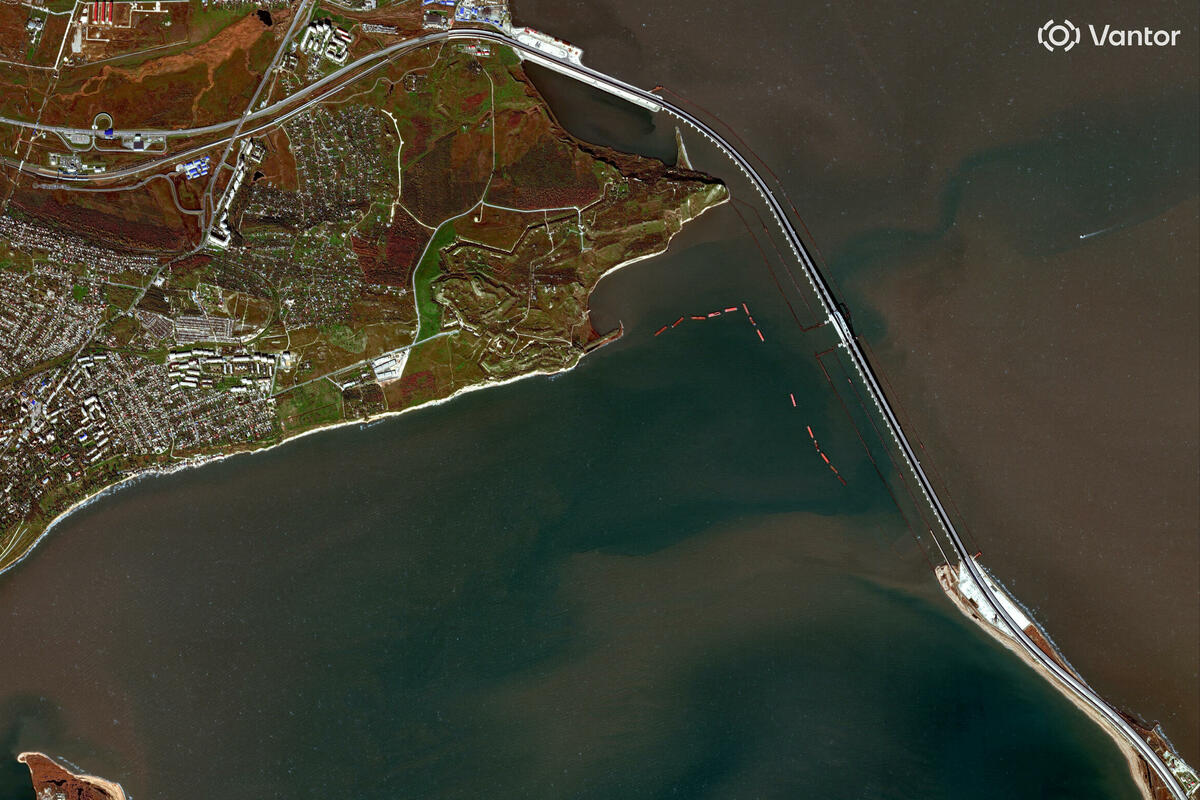
Russians Risk Lives on Hazardous Land Route to Crimea After Bridge Destruction
Drivers traveling from mainland Russia to Crimea are facing hazardous journeys through a war zone along an occupied southern Ukrainian land corridor after the destruction of the road section of the Crimean Bridge by Ukraine.
Russian officials have not provided a timetable for restoring road traffic across the bridge, which was opened by Russian President Vladimir Putin in 2018 and repeatedly struck by Ukrainian drones and rockets, The Guardian reported.
The Russian transport ministry has removed one of the two arches from its official image of the Crimean Bridge, leaving only the railway crossing. Passenger trains continue to cross the bridge, and a ferry service operates across the Kerch strait, but it carries passengers rather than cars and is frequently disrupted by winter storms.
With the Crimean Bridge previously serving as the sole link between mainland Russia and the peninsula, motorists are now using a roughly 390-mile highway that Moscow calls the Novorossiya route.
The road runs from Rostov-on-Don through Mariupol, Berdiansk, and Melitopol, passing through the seized territories of the Donetsk, Zaporizhzhia and Kherson regions along the R-280 road, Censor reported. Traffic on the land corridor has increased several-fold following strikes on the Kerch Bridge, with up to 20,000 vehicles passing through the highway daily, according to Russian state television, Vijesti reported.
To protect the transport corridor from attacks, Russians have begun installing mock-ups of heavy goods vehicles and erecting anti-drone barriers along the route. According to the authors of an online post, the mock-ups are intended to deceive strike drones equipped with artificial intelligence-based target recognition systems.
Kyiv states that its attacks target Russian military logistics rather than civilian vehicles, but the highway’s heavy use by Russian forces transporting fuel and supplies makes it a frequent target, putting civilian drivers at risk.
On a central news program on Russian state television, a presenter acknowledged that the road runs through three frontline regions and is exposed to attacks, advising drivers to stock up on food and water, carry a first-aid kit, and know how to use its contents.
Travelers have exchanged survival tips online, including recommendations to avoid night travel, maintain a distance of 50 to 100 meters between cars, and avoid sheltering behind lorries. Drivers are also advised to carry up to 240 liters of spare fuel, two fire extinguishers, tourniquets, and haemostatic dressings.
“What we saw was pretty apocalyptic,” said Anatoly, who traveled to Crimea from mainland Russia to visit his parents. “Trucks on fire and drones overhead that our boys were trying to shoot down. It was quite an adrenaline rush, but I wouldn’t recommend making the journey,” he added, asking for his surname to be withheld.
State Media Acknowledges Highway Dangers
Even Russian state television has addressed the hazardous nature of the route, with a presenter on Sunday’s edition of the flagship Vesti news programme acknowledging that the road “passes through three frontline regions and comes under attack”.
According to the show, the highway currently accommodates up to 20,000 vehicles daily.
Shifting Traditions for Peninsula Travelers
The route represents a stark departure from previous travel habits for Russian citizens.
The roughly 390-mile (630km) road now serves as a forced alternative to the bridge.
Dmitry, a truck driver from Rostov who frequently travels to Crimea, said he recently considered quitting his job due to the risks, but faces difficulty finding alternative employment while paying off a mortgage. “Last month I received a tactical first aid kit for my birthday,” he said.