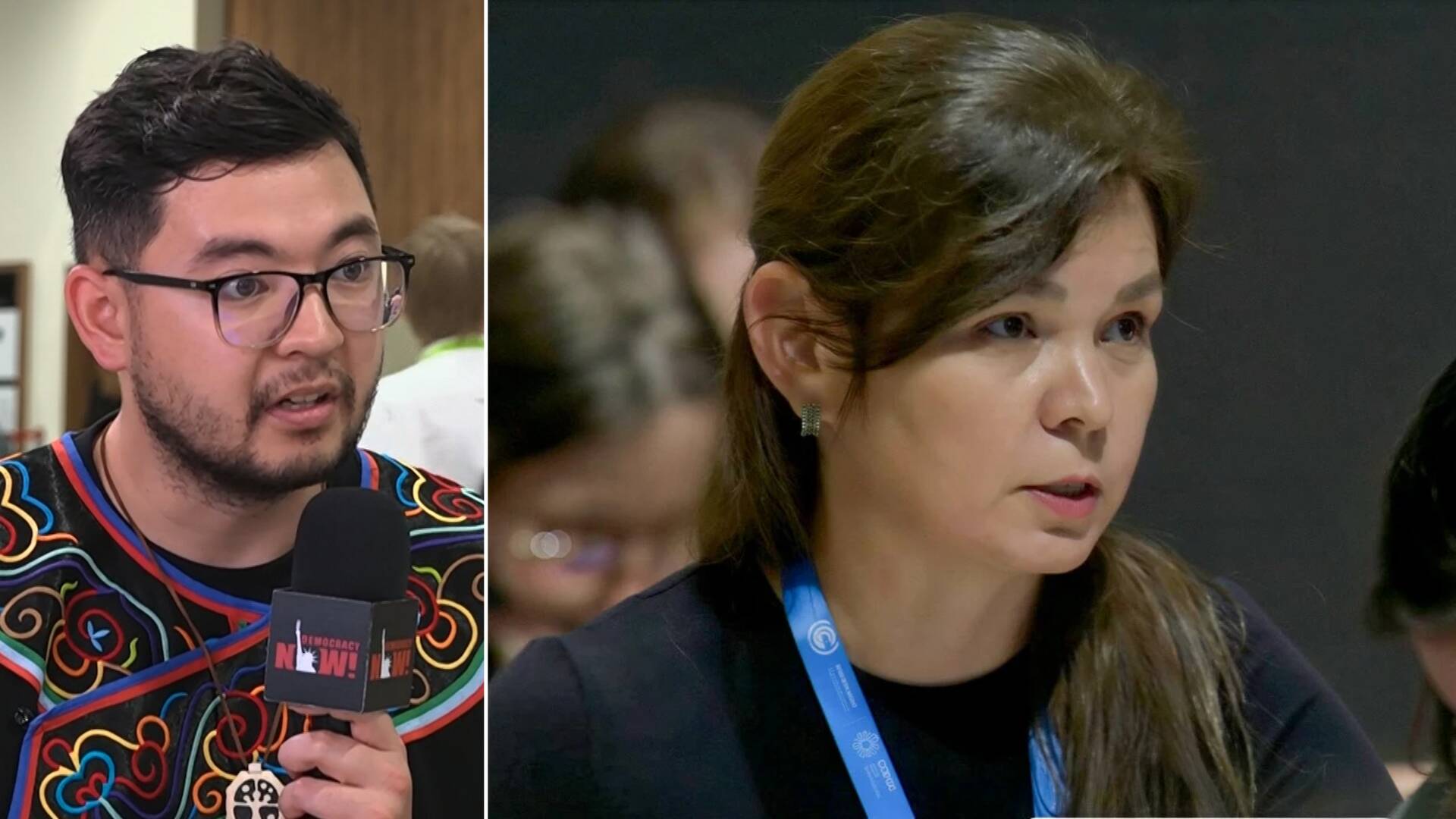
Russian Indigenous Climate Leader Daria Egereva Remains Jailed on Terrorism Charges
“I don’t think I can come back to Russia,” said Viktor Suliandziga-Bagat, an Indigenous rights activist from the Udege people of the Russian Far East, speaking this week at the COP31 climate summit in Antalya, Turkey.
His colleague Daria Egereva, a Selkup advocate who co-chairs the International Indigenous Peoples Forum on Climate Change, has now spent nearly a year in pretrial detention in Moscow on terrorism charges.
Egereva was arrested on December 17 last year, weeks after she returned from the COP30 climate conference in Belém, Brazil, where she served as co-chair of the International Indigenous Peoples Forum on Climate Change, Democracy Now! reported from the summit in Antalya.
Russian authorities carried out raids across the country the same day, targeting Indigenous activists and human rights defenders. She has been held in pretrial detention in Moscow since December 2025.
The charges carry a possible sentence of up to 20 years. Amnesty International and other groups have denounced the terrorism case. A Moscow court has kept her jailed despite appeals from the United Nations and dozens of Indigenous organizations.
What makes the case resonate far beyond one courtroom is who Egereva is: since 2023 she has led the body that represents Indigenous peoples’ perspectives at United Nations climate gatherings, and she worked on climate policy within the UN Framework Convention on Climate Change.
A forest people’s advocate behind bars
Egereva is Indigenous Selkup, from a community in the taiga forests of Siberia. At the 2019 UN climate summit in Madrid, she described her people’s relationship to the land in words Democracy Now! replayed this week.

“My community is located deep, deep in the forest, taiga forest, and my people call themselves forest people. It means our life and our future depends on forest and products of forest, its nuts, berries, mushrooms, and rivers.”
At COP30 in Belém, she advocated for greater participation of Indigenous women in climate negotiations. She had also participated in the UN Permanent Forum on Indigenous Issues and the Expert Mechanism on the Rights of Indigenous Peoples.
Her co-defendant, Natalia Leongardt, is not Indigenous herself but has worked for decades to help independent Indigenous activists reach international forums, Suliandziga-Bagat told Democracy Now!. Both remain in pretrial detention in Moscow. The name of a second jailed Indigenous advocate had not been made public, according to one of Egereva’s attorneys — an apparent discrepancy between the two accounts that neither outlet has resolved.
The raids of December 17
Suliandziga-Bagat said 17 other Indigenous leaders and activists were raided in the same sweep, their devices confiscated, and some fled Russia to avoid arrest. Those in exile have kept coming to UN climate summits to speak in place of the voices now silenced.
In October 2024, the UN Human Rights Council urged Russia to uphold international human rights law, calling out its designation of 55 Indigenous organizations and other groups as “extremist” — a resolution available in the Council’s own record of the appeal.
Among the groups blacklisted were the Aborigen Forum network and the Centre for the Support of Indigenous Peoples of the North, both of which Egereva had been involved with before authorities shut them down.
Suliandziga-Bagat pushed back on the separatist label in his Antalya interview. Aborigen Forum, he said, is not a formalized organization at all — just a group of leaders who gathered to share problems and build strategy without seeking government support, in contrast to government-funded organizations he accused of spreading propaganda in international spaces.
What the United Nations is saying
The detention of Daria Egereva raises concerns about arbitrary detention and the application of counterterrorism legislation against those exercising their fundamental freedoms.
said Thameen Al-Kheetan, spokesman for the UN High Commissioner for Human Rights. He declined to say whether the UN is working diplomatically for her release, and added: “Egereva and all those detained for exercising their human rights must be released immediately.”
Reprisals against UN participants are documented systemically, not just in this case. The High Commissioner’s office publishes an annual report on alleged intimidation and reprisals; the edition covering May 1, 2024 to April 30, 2025 described dozens of cases across 32 countries, including China, Israel and Thailand, and notes that its data is incomplete because some victims fear further persecution.
Before a recent hearing, nearly three dozen Indigenous organizations and UN forums signed a letter to President Vladimir Putin requesting Egereva’s release. “Her work contributed to constructive, respectful, and peaceful dialogue between Indigenous peoples and state delegations,” the letter said, describing her role as strictly coordinative and facilitative.
A court that answers to no one
The Basmanny District Court in Moscow extended Egereva’s detention until at least March 15 at a hearing held earlier this year. The hearing was closed to the public, and the court documents detailing the charges are sealed. The court did not respond to an email seeking comment.
Under Russian legislation, he said, only 40 ethnic Indigenous groups are recognized, each with a population under 50,000, and all of them depend directly on forests, rivers and the land — the very systems climate change is altering.
“Right now all we are demanding is the release of Daria and Natalia, because they shouldn’t be in prison,” he told Democracy Now!. “You shouldn’t be arrested for activism.”
Joan Carling, an Indigenous leader from the Philippines, told the gathering that more than a hundred people had been arrested at a demonstration in her country and called for global solidarity, saying communities “cannot continue to be sacrificed again and again in the name of just transition.”
Where the accounts diverge
They also differ on one detail — Democracy Now! names Leongardt openly as the second jailed advocate, while reports citing Egereva’s attorney said that the second detainee’s name had not yet been made public.
The charges are terrorism-related, the file is sealed, and the court has said nothing.
What comes after March
Her detention order runs at least to March 15. The letter to Putin remains unanswered in public record, and the UN spokesman would not say whether quiet diplomacy is underway.
The International Indigenous Peoples Forum on Climate Change grew out of organizing that began when the Indigenous Women’s Biodiversity Network was formed in 1998, and Indigenous peoples first engaged directly with the UN climate process on September 8, 2000, at Subsidiary Bodies meetings in Lyon, France.
After representatives said their proposals were largely ignored at the 2010 conference that produced the Cancún Agreement, Indigenous delegates drafted the Oaxaca Action Plan of Indigenous Peoples: From Cancún to Durban and Beyond, a lobbying strategy that carried through to the 2014 World Conference on Indigenous Peoples at UN Headquarters.
The forum has since pressed for respect for traditional knowledge in REDD+ monitoring and for greater transparency from the Green Climate Fund.
By then, Egereva will have spent a full year in custody without a public accounting of the evidence against her, and the exiled activists she once worked beside will still be speaking at climate summits in her place — as Suliandziga-Bagat put it, Indigenous voices in Russia are being silenced and can no longer come.