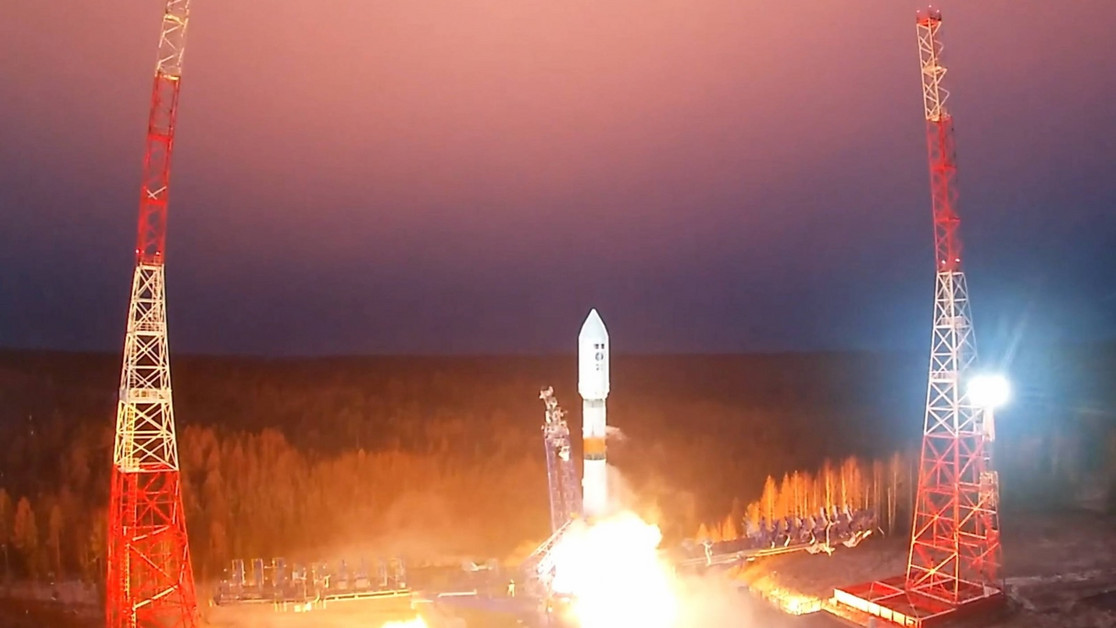
Russia Could Launch a Nuclear-Armed Satellite
Russia could launch a nuclear-armed satellite before the end of this year, according to investigative reporting from NDR, WDR, and the Süddeutsche Zeitung.
Western intelligence agencies consider a Russian satellite with a nuclear warhead possible, according to the new investigation. The satellite, reportedly designated “Sputnik-S,” has allegedly been fully constructed and held in the Moscow region for several years.
Intelligence reports from early November suggest a launch could occur within 60 days, wirtschaft tv reported, according to wirtschaft tv | Online-Wirtschaftssender. The Bundeswehr Space Command estimates the satellite could be placed into orbit as soon as December.
The German federal government stated it takes these reports “very seriously.” The Russian presidential office has rejected the accusations, and the Russian embassy in Berlin previously dismissed the claims as unfounded.
No publicly verifiable evidence confirms that a functional nuclear-armed satellite is prepared for immediate launch; the warnings are based on intelligence findings that remain largely classified. However, hints of such Russian developments have circulated for several years, according to wirtschaft tv.
Unlike conventional anti-satellite weapons, a nuclear device in space would not target a single asset. A detonation in an appropriate orbit could simultaneously damage or destroy numerous civilian and military satellites belonging to various nations. The explosion would produce immediate radiation that can destroy electronic components, while energetic charged particles could form artificial radiation belts, posing a long-term threat to other spacecraft.
Depending on the altitude and yield, an electromagnetic pulse could also affect technical systems on the ground. According to the U.S. Space Command, a particularly severe scenario could see significant parts of the satellites in low Earth orbit fail within a few days, with effects lasting for months. This assessment concerns a military scenario estimate, not a precise prediction for every conceivable use of such a weapon.

Global positioning systems provide precise timing signals via atomic clocks, which are essential for synchronizing telecommunications networks, power grids, and financial transactions. Modern economies require satellite systems for positioning, communications, and the provision of highly precise time signals. The latter are particularly important.
Satellite navigation systems such as the U.S. GPS and the European Galileo transmit not only geographic positioning information; their atomic clocks simultaneously provide precise time information used to synchronize technical processes in telecommunications, energy supply, and financial transactions.
While some critical infrastructure sectors maintain internal crisis management systems, a widespread, cross-sector outage would present a unique challenge. Such a disruption could trigger cascading effects, where the failure of navigation and communication services hampers transport, energy supply, and the coordination of emergency responders.
A nuclear explosion in space could damage satellites on which communications, navigation, financial transactions, and parts of the energy supply depend. Banks, power grids, and supply chains rely on services from space. Germany is apparently insufficiently prepared for a large-scale failure of this infrastructure.
The vulnerability stems less from the threat to a single satellite than from the overall resilience of the technical infrastructure, wirtschaft tv reported.