
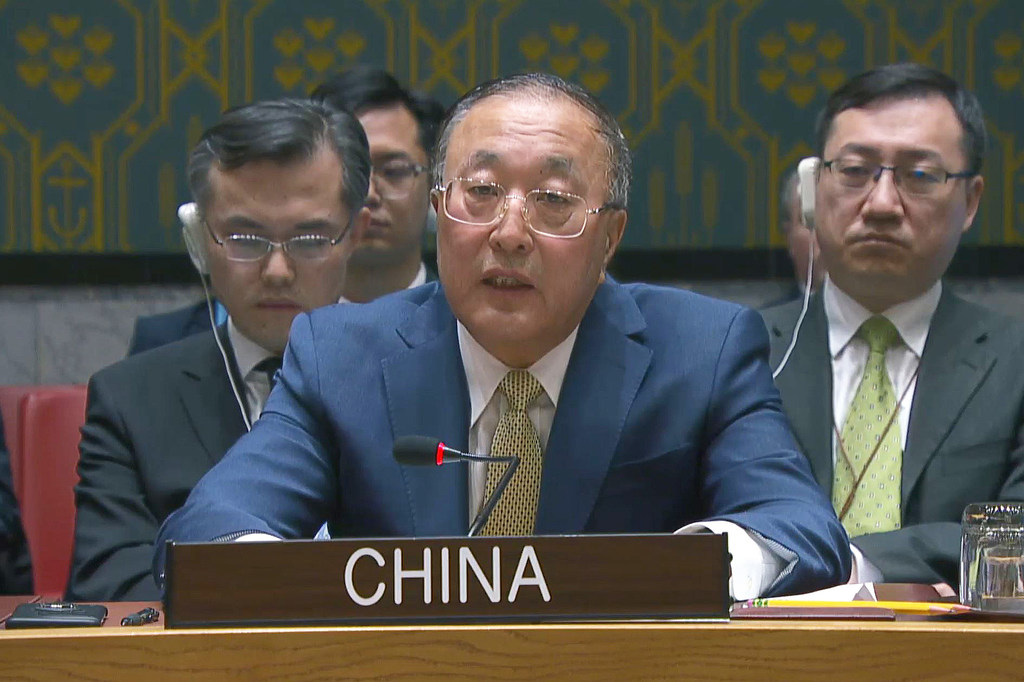
Russia and China Veto UN Resolution on Strait of Hormuz
On April 7, 2026, Russia and China exercised their veto power at the UN Security Council to block a resolution aimed at reopening the Strait of Hormuz. The move sustains a critical maritime blockade, weaponizing one of the world’s most vital energy chokepoints to challenge Western hegemony and Iranian sanctions.
This is not a mere diplomatic stalemate; It’s a calculated strategic strangulation. By shielding Tehran, Moscow and Beijing are effectively rewriting the rules of maritime transit. The Strait of Hormuz, where roughly one-fifth of the world’s total oil consumption passes, has transitioned from a commercial artery to a geopolitical lever. When the UN Security Council is paralyzed by a veto, the “law of the sea” is replaced by the “law of the strongest.”
The immediate fallout is a volatility spike in Brent Crude and a systemic panic across European energy markets. For the global B2B sector, this represents a catastrophic failure of predictable logistics. Shipowners are facing skyrocketing insurance premiums, while energy-dependent industries are scrambling to find alternative routes. This is where the crisis shifts from a headline to a balance-sheet disaster, forcing firms to engage global risk consultants to map out contingency corridors and hedge against total supply chain collapse.
“The veto is a signal that the era of uncontested Western maritime policing is over. We are entering a multipolar era where ‘freedom of navigation’ is no longer a universal right, but a negotiated privilege granted by regional powers.” — Dr. Aris Papadopoulos, Senior Fellow at the Institute for Strategic Conflict Studies.
The Architecture of the Blockade: Beyond the Veto
To understand why this veto is so lethal, one must look at the geography. The Strait of Hormuz is the only maritime exit for the Persian Gulf. Unlike the Suez Canal, which has various diplomatic frameworks for operation, Hormuz is governed by a volatile mix of the 1982 UN Convention on the Law of the Sea (UNCLOS) and the specific territorial claims of Iran and Oman.

Russia and China are not acting out of altruism toward Iran. They are playing a long game of “strategic synchronization.” By ensuring the Strait remains a point of contention, they force the United States to overextend its naval assets in the Middle East, distracting from the Indo-Pacific theater. It is a classic diversionary tactic: create a crisis in the Gulf to weaken the posture in the South China Sea.
The economic ripple effect is immediate. As tankers are diverted or held in limbo, the cost of “ton-mile” shipping increases. This isn’t just about oil; it’s about the petrochemicals and liquefied natural gas (LNG) that fuel the industrial heartlands of Asia and Europe. Multinational corporations are now urgently seeking international trade lawyers to navigate the complex force majeure clauses in their delivery contracts, as the legal definition of “unforeseeable events” is being tested in real-time.
The Macro-Economic Calculus: Energy vs. Sovereignty
The current deadlock creates a paradoxical situation for China. While Beijing benefits from the diplomatic leverage over Washington, it is too the largest importer of Gulf oil. The “Beijing Paradox” is the attempt to maintain a strategic alliance with Iran while simultaneously ensuring its own energy security. However, China’s investment in the Belt and Road Initiative (BRI) provides them with overland alternatives—pipelines through Central Asia that bypass the Strait entirely.
The West does not have that luxury. Europe, still reeling from the structural shift away from Russian gas, is hyper-vulnerable to any disruption in the Gulf. The Italian proposal for a “UN Humanitarian Corridor” was a desperate attempt to decouple essential goods from the energy war, but the veto proves that in the current Security Council, there is no such thing as a “neutral” corridor.
| Metric | Pre-Blockade Average | Projected Q2 2026 Impact | Primary Driver |
|---|---|---|---|
| Brent Crude Volatility | Low/Moderate | Extreme High | Supply Uncertainty |
| Maritime Insurance (War Risk) | Baseline | +400% Increase | Veto-induced Instability |
| LNG Spot Prices (Asia) | Stable | Sharp Increase | Diversion to Atlantic |
The shift is systemic. We are seeing a transition from “Just-in-Time” logistics to “Just-in-Case” strategic hoarding.
The Security Vacuum and the Rise of Private Intelligence
With the UN paralyzed, the responsibility for security is shifting from multilateral organizations to bilateral coalitions and private actors. We are seeing a surge in the use of “gray zone” tactics—unmarked drones, cyber-interference with GPS signals in the Gulf, and proxy skirmishes. The geopolitical instability is creating a vacuum that state actors are filling with hybrid warfare.
For the corporate world, the “official” news is often too slow. The gap between a UN veto and a tanker seizure is measured in minutes, not days. This has led to a massive spike in demand for geopolitical intelligence firms that provide real-time satellite telemetry and signal intelligence to help shipping fleets avoid high-risk zones before the official notices are even issued.
“When the Security Council fails, the market takes over. We are seeing the privatization of maritime security on a scale not seen since the height of the piracy era, but this time the adversary is a sovereign state.” — Elena Vance, Global Energy Analyst.
The Long-Term Ripple: A New Maritime Order
The April 7 veto is a marker for a new era of “Fragmented Globalization.” The world is splitting into trade blocs where security is guaranteed not by international law, but by specific alliances. The strategic competition between the G7 and the BRICS+ bloc is no longer about tariffs or trade wars; it is about the physical control of the world’s arteries.
If the Strait of Hormuz remains a contested zone, the long-term result will be a permanent acceleration of energy transition in the West—not out of environmental altruism, but out of sheer security necessity. The cost of dependence on a chokepoint controlled by a veto-protected regime is simply too high.
The chessboard has shifted. The veto by Russia and China is not just a “no” to a resolution; it is a “yes” to a world where strategic chokepoints are used as weapons of statecraft. For the global enterprise, the lesson is clear: stability is an illusion, and resilience is the only viable strategy. Whether you are restructuring a supply chain, hedging energy futures, or securing physical assets in volatile regions, the tools for navigation are no longer found in UN charters, but in the specialized expertise of the world’s leading strategic partners. To navigate this new volatility, the World Today News Directory remains the essential gateway to the legal, financial, and security consultants capable of operating in the shadows of the great power struggle.