
Romanian President Nicușor Dan Fears 2028 Parliamentary Election Result, Declines to Elaborate
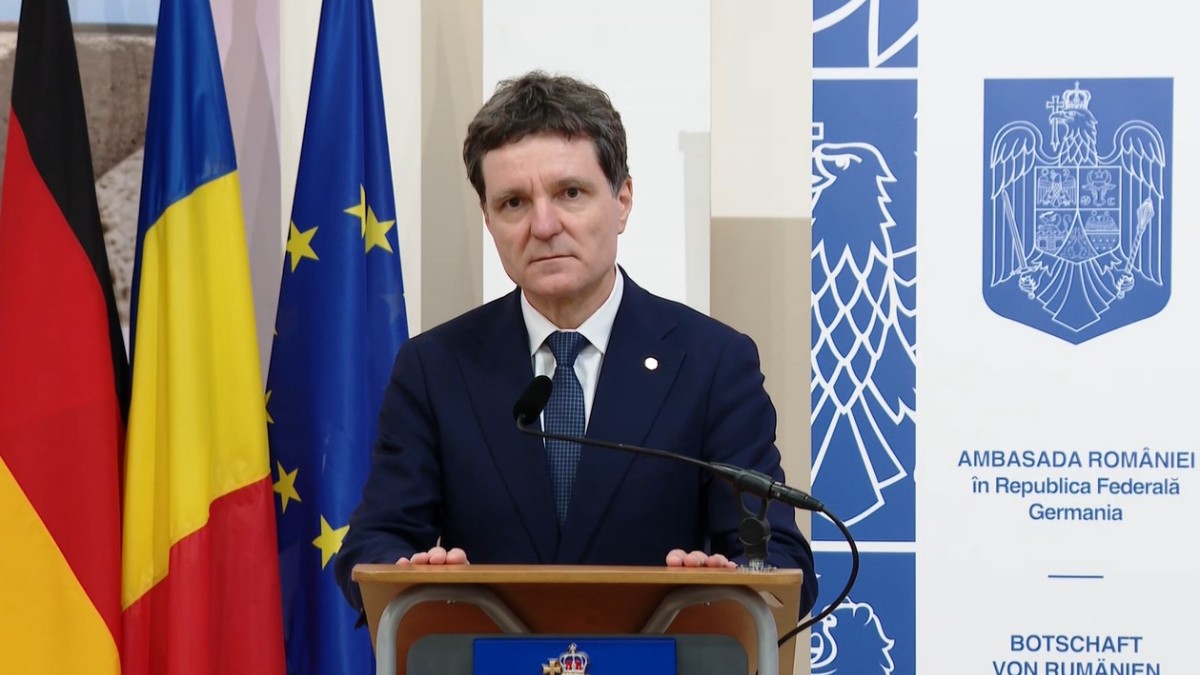
Nicușor Dan traveled to Berlin on Thursday to talk security with the Coalition of Willing, but the moment that followed him home was domestic: he fears the result of Romania’s 2028 parliamentary elections, according to G4Media.
Pressed by reporters at a press conference after the Coalition of Willing meeting, Dan confirmed what he had hinted at hours earlier at a summit in Bucharest — and then stopped. “When I said I am afraid of 2028, I was talking, obviously, about the 2028 parliamentary elections and I don’t want to elaborate further,” the president said.
The clarification matters because of what Dan refused to add. Asked directly whether his fear concerns extremists coming to power in 2028, he declined to answer in either direction. “Obviously, when I say I am afraid of 2028, I say I am afraid of a possible result of the parliamentary elections, but I don’t want to comment any further,” he said.
What began as a question about digital policy ended as the most candid electoral remark a president has made about the next national vote — and the vaguest.
The morning remark that started it
The comment was born at an event with no electoral agenda. At the Summit for Digital Governance, held at Cotroceni Palace, Dan was asked what Romania should achieve by 2029 to be better prepared for the future in digitalization. “You should know that I am afraid of 2028,” he said.
He tied the fear to the security context. “Sometimes we forget, but we must not neglect the security context. Looking back, much of my energy and that of the people around me went into this security problem, which is essential. And probably much of the Romanian state’s energy will also be consumed in that direction. It’s not the happiest thing, but it is mandatory,” Dan said at the summit.
He also used the platform to argue that Romanian society has wasted years. “Looking back, it seems we lost a lot of time — all of us, as a society — on small and very small stakes, and it would be time to change this way of approaching things,” the president said.
Security, then everything else
Dan framed the trade-off bluntly: security spending is non-negotiable, but it crowds out other areas. Education, VAT collection and digitalization are targets where “we have barely scratched the surface,” he said at the Cotroceni summit.

His examples were concrete. On the PNRR recovery fund, he noted: Romania ran roughly 20,000–30,000 projects while Ireland ran 7. “I think it’s better to have 7 than 20,000, because the management effort is much smaller,” Dan said.
He pointed to the diaspora and the Citizenship Authority as areas where people wait in long queues while staff repeat the same procedures daily — work, he argued, that automation could absorb if the state were careful with personal data.
The president confirmed he uses an AI agent for various “syntheses,” and said that a strategy for the Romanian state’s Artificial Intelligence is necessary, according to Europa FM. At the same summit, Luca Niculescu argued that technology and artificial intelligence are used in public institutions, but each does it on their own, and that the state should use the same instruments, which should be validated and interoperable, News.ro reported.
What Dan said about Neacșu
Berlin was not only about 2028. Dan also addressed the role of Marian Neacșu in the administration, describing him as “a professional.”
“Mr. Neacșu is a professional, yes. I interacted with him several times even before I was president, and he is a man who knows the Romanian administration in detail — mechanisms, legislative and administrative processes.”
Dan’s endorsement went further than protocol required. “I have even seen people from the opposition praising him, recognizing his technical merits, which are incontestable,” Niculescu said.

The question Dan would not touch
Whether he means a far-right breakthrough, a coalition collapse or simply an unfavorable arithmetic in Parliament, he declined to specify — even when a reporter named the extremist scenario outright.
The gap between the morning confession and the evening retreat is the story’s open edge. Romania’s parliamentary elections are scheduled for 2028, and by 2029, Dan said at Cotroceni, the political class will have to answer to Romanians on the big questions it keeps circling. Whether his own fear was a warning, a confession or a trial balloon, he told the reporters in Berlin he would not develop it further.
Dan, born in 1969 in Făgăraș, came first in the International Mathematical Olympiads in 1987 and 1988 with perfect scores before earning a PhD in mathematics in Paris. He returned to Romania in 1998, saying he wanted to help change the country, and later founded the Save Bucharest Association, which won 23 court cases against the capital’s local authorities. Before his May 2025 presidential victory as an independent, he served as Bucharest’s mayor from 2020.
“I don’t want to comment any more,” Dan said.