
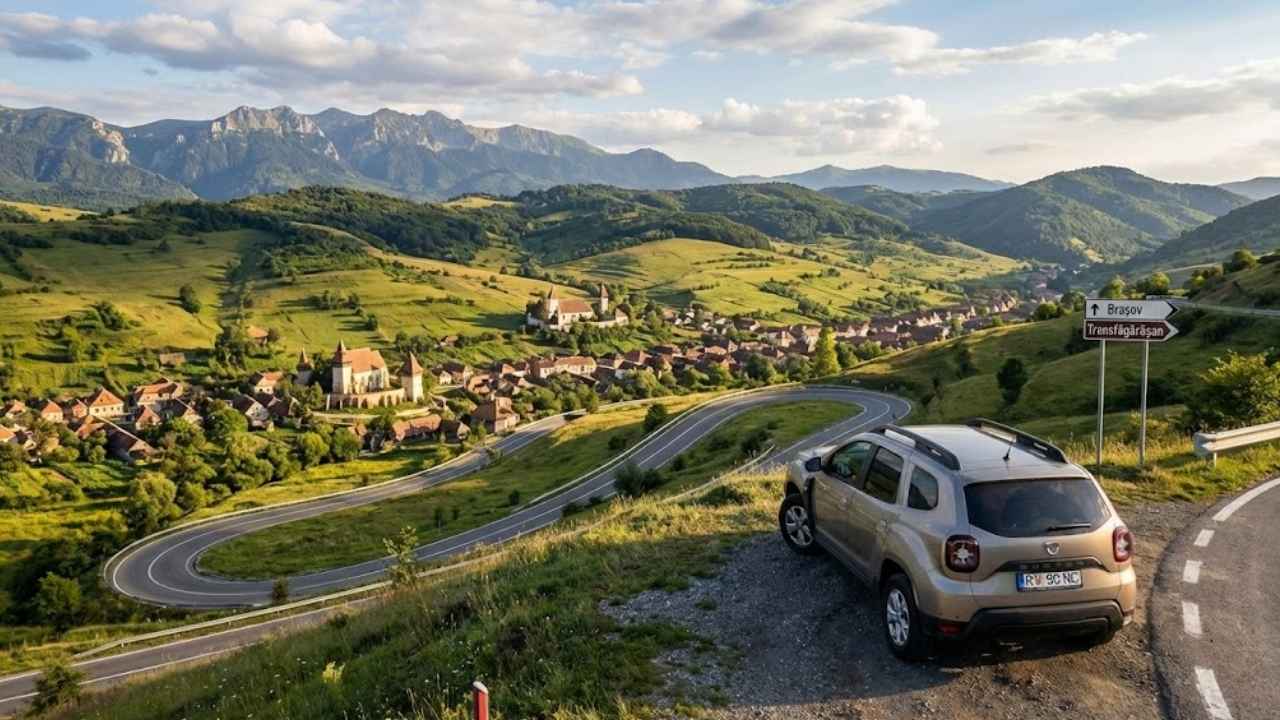
The allure of Romania often begins with images of Transylvania’s castles and the dramatic peaks of the Carpathian Mountains, but realizing that vision requires careful planning. Renting a car in Bucharest is often the first step, yet the country’s geography presents a unique challenge for tourists accustomed to linear itineraries.
Romania’s four distinct geographic zones – Bucharest and the southern plains, the Carpathian Mountains, Transylvania, and Bucovina – resist sequential tourism due to their scattered attractions and varying transportation infrastructure. Unlike some European countries where regions blend seamlessly, Romania’s terrain dictates a strategic approach to route planning, prioritizing movement capability over simply listing “must-see” destinations.
The Carpathian Mountains, a central draw for many visitors, are particularly susceptible to seasonal road closures, according to recent reports on Romanian tourism. Whereas the Transfăgărășan and TransAlpina highways are celebrated as some of the world’s most scenic drives, their accessibility is dependent on weather conditions. Transylvania’s medieval towns, though concentrated on a plateau, necessitate winding drives through villages, and the more remote Bucovina region, in the north, presents logistical hurdles due to limited rail connections and slower road speeds.
Experts recommend establishing a route structure based on regional access points. Brașov frequently emerges as a key hub, connecting Transylvanian towns with the Carpathian mountain corridors. This allows for efficient loops and minimizes backtracking. A common mistake, according to travel planners, is attempting to cover too much ground in a single day. A transfer of 200 kilometers, while seemingly manageable, can easily consume three hours due to village slowdowns and stretches of single-lane roads, often averaging only 60-70 km/h.
A practical daily plan involves limiting driving distances to 100-150 kilometers, arriving before lunchtime, and dedicating the afternoon to exploring towns or undertaking short hikes. Mountain roads, particularly those offering panoramic views, should be reserved for dedicated days, recognizing that routes like the Transfăgărășan can require 4-5 hours with stops. Attempting to combine two major sites with a long transfer is often a compromise, sacrificing in-depth exploration for breadth.
Logistics from Bucharest’s airport are also crucial. Arrival time significantly impacts the initial itinerary. Landing early allows for a drive to Brașov within a half-day, while a late arrival suggests overnight accommodation near Bucharest before heading north. Car rental procedures themselves should be straightforward – license, passport, credit card, and booking confirmation – to avoid delays in the often-congested traffic leaving the airport.
Travelers planning trips between November and April should be prepared for potential mountain highway closures and adjust their itineraries accordingly, focusing on Transylvanian towns and Bucovina valleys. A successful Romanian road trip, planners say, prioritizes time spent experiencing destinations over time spent behind the wheel, emphasizing shorter travel days and strategic basing in regional hubs.
For those seeking car rental services in Bucharest, companies like Klass Wagen offer a range of vehicles suited to both city driving and more challenging regional routes, allowing travelers to select a car that aligns with their planned itinerary.
