Roman-Era Mass Grave in Croatia May Be Victims of Plague of Cyprian
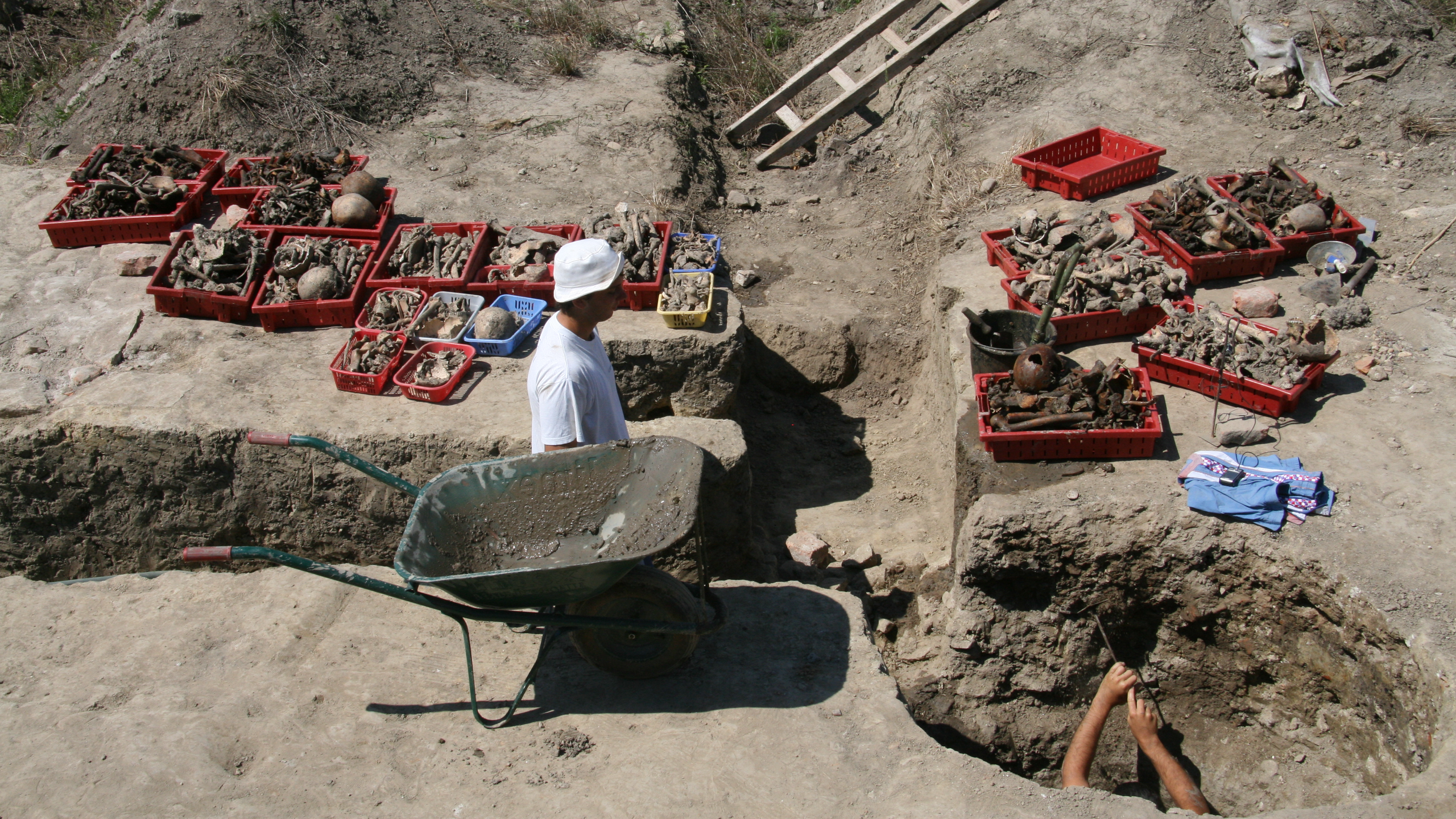
Roman-Era Well Yields Dozens of Skeletons in Croatia
Nearly four dozen skeletal remains discovered inside a deep Roman-era well in Osijek, Croatia, are emerging as potential evidence of mortality during the historic Plague of Cyprian, according to archaeological research presented on August 6 at the 25th European Paleopathology Association meeting in Berlin.
Contrasting Demographics Point Away from Battlefield Casualties
The excavation site, located near a Roman necropolis in Osijek, dates back to a time when the settlement was known as Mursa—founded by Emperor Hadrian in A.D. 133. Mursa served as a strategic garrison protecting the Danube and the outer edges of the Roman Empire.
While previous archaeological campaigns at the location revealed multiple young male skeletons bearing violent perimortem injuries tied to the Battle of Mursa in 260 A.D., the latest discovery diverges sharply in demographic profile and pathology. According to Mario Novak, the bioarchaeologist leading the research, the 43 individuals recovered from the newly analyzed well comprise a typical civilian cross-section including both adults and children of various sexes.
Pathology and Rapid Burial Methods Suggest Crisis Management
Examinations by Novak’s team show that none of the individuals bore major traumatic injuries indicative of combat. Instead, the bones display common non-lethal conditions, including vertebral osteoarthritis and dental cavities, alongside isolated indicators consistent with tuberculosis and scurvy.
Patrick Randolph-Quinney, a biological anthropologist at Uppsala University who was not involved in the project, noted to Live Science that the remains reflect a practice where bodies were rapidly deposited into pre-existing, dried-up water sources rather than organized, traditional ground inhumations.
Connecting the Find to the Historic Plague of Cyprian
Historical chronicles document a devastating pandemic sweeping the Mediterranean basin and European provinces during the middle of the third century, designated by historians as the Plague of Cyprian. The contagion initially disrupted Roman military units along the Danube before propagating widely across the empire. Modern epidemiologists and historians continue to debate the exact pathogen responsible for the outbreak, with smallpox and viral hemorrhagic fevers remaining prominent working hypotheses among researchers studying ancient infectious disease vectors.
Biomolecular Testing Awaited for Definitive Answers
Definitive confirmation regarding the exact etiology and biological profile of the Osijek burials awaits forthcoming biomolecular testing. Novak reported that results from ongoing ancient DNA analyses are anticipated, which will help clarify whether the individuals were local civilian populations overwhelmed by epidemic disease or auxiliary troops stationed at the frontier.
- Researchers uncovered at least 43 skeletons inside a pre-existing, dried-up well near a Roman necropolis in Osijek, formerly the Roman city of Mursa.
- Unlike earlier excavations in the area containing young male soldiers with traumatic battle injuries from the mid-third century A.D., this burial contains a demographic cross-section of adults and children of both sexes with no major skeletal trauma.
- Bioarchaeologist Mario Novak of the Institute for Archaeological Research in Zagreb stated that pending DNA analyses may confirm whether the site reflects civilian mortality from the severe mid-third-century pandemic known as the Plague of Cyprian.