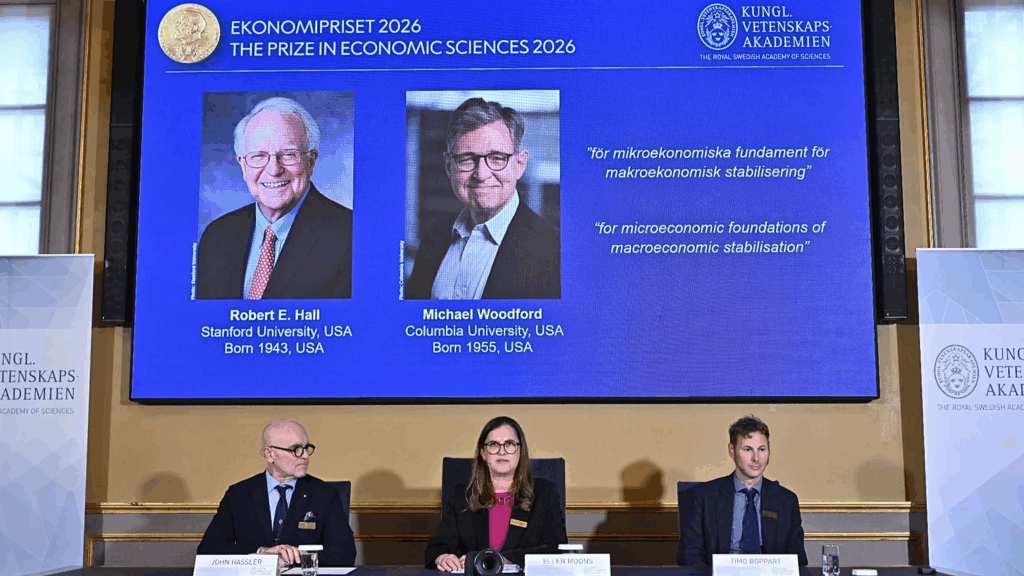
Robert Hall and Michael Woodford Win Nobel Prize in Economics
Stanford University professor Robert E. Hall and Columbia University professor Michael Woodford were awarded the Nobel Memorial Prize in Economic Sciences on Monday. The Royal Swedish Academy of Sciences recognized the two American professors for their research into the microeconomic foundations of macroeconomic stabilization, which provides frameworks for central banks and governments to manage economic volatility.
Hall and Woodford Help Policymakers Manage Economic Shocks
The committee stated that the work of Hall and Woodford has equipped policymakers to better manage economic shocks, such as energy crises or fluctuations in household consumption. Their combined research focuses on the two primary levers of economic health: demand and supply. Hall’s models center on the study of demand, while Woodford’s work examines the supply side, specifically the price-setting behavior of companies.
John Hassler, chair of the Committee for the Prize in Economic Sciences, noted that their contributions help reduce the severity of economic peaks and troughs. The prize, which carries a purse of 12 million Swedish kronor—approximately $1.2 million—will be split equally between the two recipients.
Academic Reactions to the Award
During the official announcement, Woodford expressed surprise and gratitude regarding the recognition. “It’s a tremendous honor,” Woodford said during the conference call. “It’s a surprise but I feel very good about it.”
It’s a tremendous honor. It’s a surprise but I feel very good about it. — Michael Woodford, Nobel laureate in Economic Sciences
Context of the Nobel Prizes
The Nobel announcements have recognized contributions across several disciplines. The Peace Prize was awarded to South African human rights lawyer and international judge Navi Pillay for her efforts to uphold international law. The literature prize went to Canadian poet and essayist Anne Carson for her body of work. In the sciences, the chemistry prize was awarded to Henri Kagan and Kenso Soai, Francis Halzen received the prize in physics, and the physiology or medicine award was shared by Karl Deisseroth, Peter Hegemann, and Georg Nagel.
Practical Implications for Economic Management
The research recognized by the committee is intended to provide a more stable environment for businesses and households by mitigating the impact of sudden market shifts.