RMIT Turns Coffee Waste Into Concrete for Melbourne Footpath Trial
Australia throws out about 82,700 tons of used coffee grounds a year, most of it bound for landfill where it releases methane, RMIT University says.
Engineers at RMIT in Melbourne have spent years turning that waste into biochar through pyrolysis — heating grounds to 662 degrees Fahrenheit without oxygen — so it can replace a portion of the sand in concrete. Lab cylinders cured for 28 days showed a 29.3% jump in compressive strength when 15% of the sand was swapped for coffee biochar, according to a study published in the Journal of Cleaner Production.
“Residents aren’t going to really see or smell any difference,” said Shane Walden, director of assets and operations at Macedon Ranges Shire Council, which hosted the first pour in a footpath at Gisborne.
That sidewalk, split into panels of coffee biochar, wood-chip biochar and standard concrete, came out about as strong as regular concrete.
RMIT said supply-chain issues prevented use of its own low-energy biochar in the Gisborne mix, and the trial kept the normal cement content, leaving untested the team’s earlier claim that biochar could let builders cut cement by up to 10%.
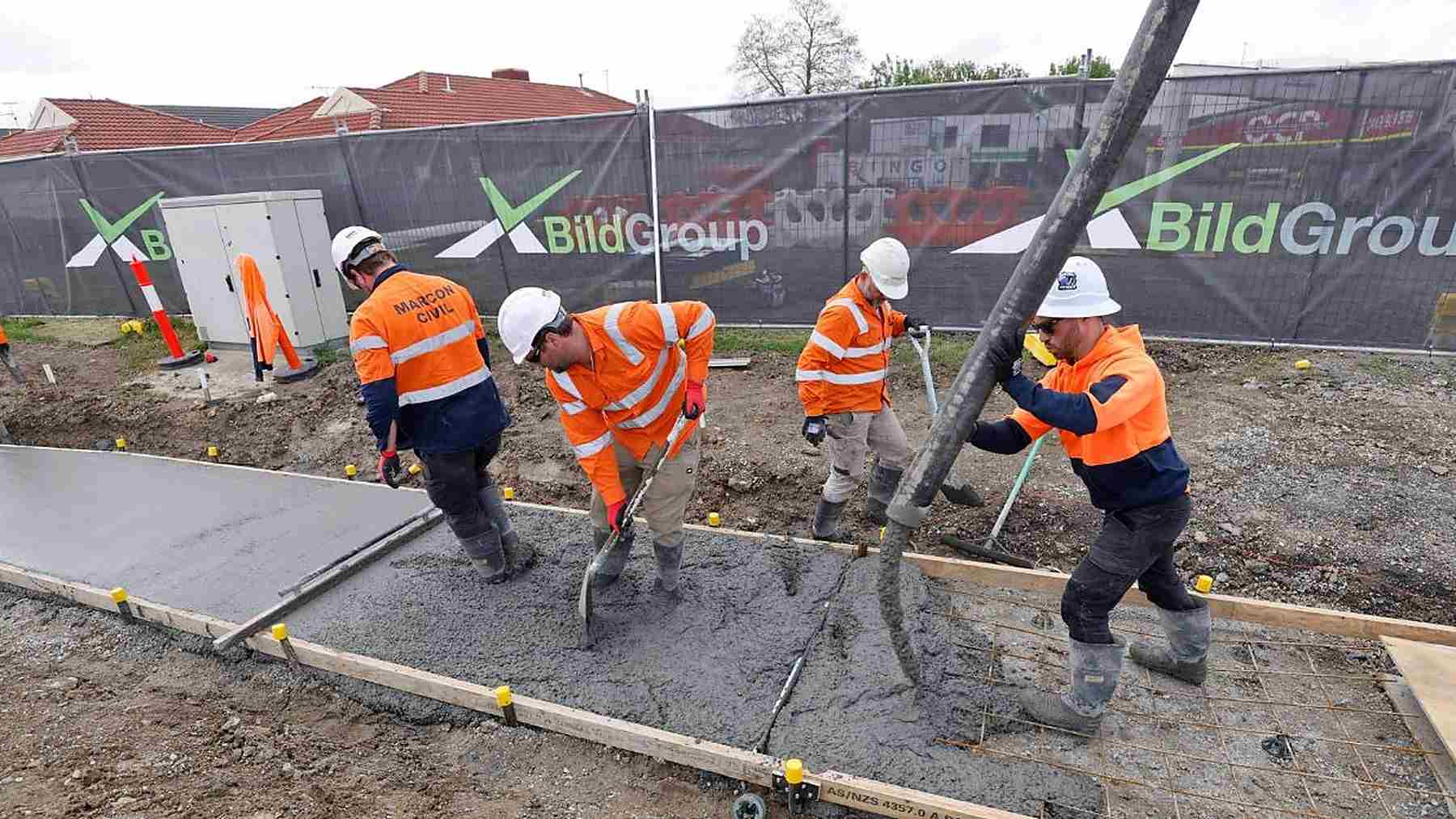
A second, larger pour followed along McGregor Road in Pakenham as part of Victoria’s Big Build. Major Road Projects Victoria and contractor BildGroup placed 39 cubic yards of coffee concrete made from 5.5 tons of spent grounds — roughly 140,000 cups — converted into 2.2 tons of biochar by Earth Systems.
BildGroup CEO Stephen Hill said the project saved more than 3.3 tons of sand. RMIT has not released a strength figure for the Pakenham concrete, nor confirmed whether Earth Systems used the same low-energy process from the lab.
A cradle-to-grave life-cycle analysis published in the International Journal of Construction Management found the carbon savings scaled with the biochar share.
| Sand replaced | Life-cycle CO₂ reduction |
|---|---|
| 5% | 15% |
| 10% | 23% |
| 15% | 26% |
Fossil-fuel use fell up to 31% across the biochar mixes studied, RMIT said. Dr. Jingxuan Zhang, a lead researcher, noted the savings held in the scenarios the team assessed.
RMIT says construction consumes about 55 billion tons of natural sand annually, mostly dredged from rivers, and that desert sand is too round to bind well in concrete. Organic waste in landfill, coffee included, accounts for 3% of Australia’s greenhouse-gas emissions.
RMIT told Reuters it was talking with construction firms, concrete makers and Starbucks about collecting used grounds. Starbucks did not comment, and no public deal has been announced. Dr. Mohammad Saberian, another lead researcher, said the next step is bigger pilots, a fine-tuned mix and alignment with building standards so projects can sign off on the material with confidence.