Rice-Sized Chips Wirelessly Stream Real-Time Data From Inside Chemical Reactions
Stanford researchers have developed rice-grain-sized chips that wirelessly transmit real-time data from inside chemical reactions, a study published Thursday in Science shows.
The microelectronic devices, called optical wireless integrated circuits, sit at the bottom of test tubes and measure temperature and heat exchange every half-second, chemeurope.com reported. In a standard 96-tube batch, the system generates nearly 700,000 data points per hour — 7,200 per tube — compared with the single endpoint measurement traditional methods yield after days of processing.
“We’ve essentially given these chemical reactions, and the molecules in them, their own cell phones,” said Song Lin, professor of chemistry in Stanford’s School of Humanities and Sciences. “In a sense, we are trying to wirelessly communicate with these chemical reactions so they can tell us how they’re doing, which helps us understand their progress and fix any problems.”
Lin, who joined Stanford in July from Cornell University, credited the advance to collaboration among chemists in his lab and physicists and electrical engineers at Cornell.
The doctoral scholars Sukwoo Lee and Evan Weingarten, co-first authors of the study, ran experiments demonstrating the system’s ability to detect catalyst poisoning and unsafe heat buildup in real time, allowing researchers to adjust reaction conditions before hazards develop. published the paper, titled “Telemetric calorimetry for wireless continuous reaction profiling,” on Nov. 19.
The abstract notes the devices operate via light-powered optical communication and function across photochemical and electrochemical systems with subsecond resolution.
Phys.org reported the chips are covered with a chemically resistant material and transmit data optically to a computer. The researchers envision adapting the platform to measure electrical conductivity, light transmission and acidity, extending its use beyond calorimetry into other high-throughput scientific fields.
Doctoral scholars Sukwoo Lee and Evan Weingarten ran experiments that showed the system spotting catalyst poisoning as it happened, chemeurope.com reported. The chips revealed which test tubes shut down and often why, letting researchers change the reaction makeup to exclude or inhibit the poison. In another test, the telemetry flagged unsafe heat buildup early, so conditions could be tuned before a hazard developed, the same source said.
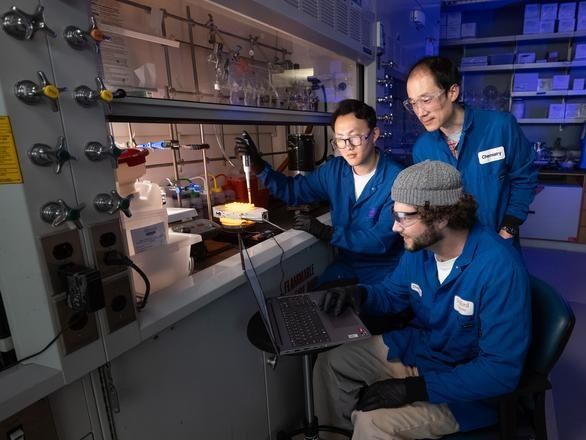
Lee was photographed monitoring a reaction set with the telemetry hardware, Phys.org reported.
Lin, who joined Stanford in July from Cornell University where he was a Tisch University Professor, has built his research program at the interface of electrochemistry and organic chemistry since starting his independent career at Cornell in 2016.
His laboratory pioneered the combination of electrochemistry with redox-metal catalysis for alkene difunctionalization and expanded electrosynthesis to two-component and three-component cross-electrophile coupling for C–C, C–Si, and C–B bond formation, as well as site-selective C–H functionalization via electrooxidation and electroreduction. The Lin Laboratory also developed electrochemical high-throughput reactors to accelerate reaction discovery and optimization, work highlighted in a Stanford EE seminar on Nov. 7, 2024.
The researchers developed the approach by adapting optical wireless integrated circuits to work inside chemistry experiments, chemeurope.com reported. The devices sit at the bottom of test tubes, measure temperature and heat exchange every half-second, and transmit the data wirelessly throughout the reaction, the same source said.