
Renovación Popular and Fuerza Popular Discuss Electoral Irregularities and Call for United Political Action Ahead of 2026 Elections
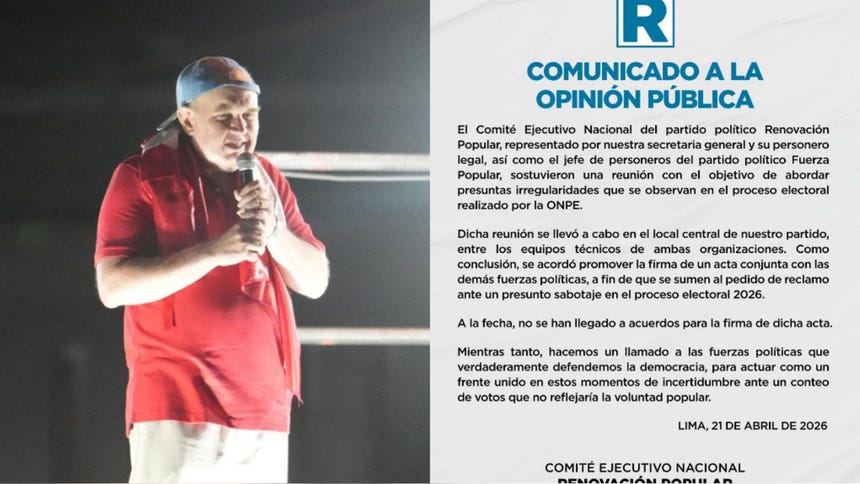
On April 22, 2026, Peruvian opposition parties Renovación Popular and Fuerza Popular confirmed a meeting to address alleged electoral sabotage in the 2026 general elections, though no formal agreement was reached, highlighting deepening institutional distrust and raising urgent questions about vote integrity in a politically fractured nation still recovering from years of corruption scandals and social unrest.
The Unverified Claims and the Politics of Distrust
The meeting, held in Lima amid heightened tensions following the first round of voting, centered on allegations by Renovación Popular leader Rafael López Aliaga that “phantom votes” — fictitious ballots stuffed into ballot boxes — had skewed preliminary results. López Aliaga cited unverified claims of 180,000 such votes, a figure previously echoed by commentator Roxana Rocha on Panamericana TV, though no forensic audit has been presented to substantiate the number. Fuerza Popular, led by Keiko Fujimori, acknowledged the discussion but emphasized that no pact was signed, framing the talks as exploratory rather than consequential. This refusal to formalize cooperation underscores a broader pattern: Peru’s political class remains unable to coalesce around electoral safeguards, even as public faith in institutions erodes.
The implications extend beyond partisan squabbles. When political actors publicly allege systemic fraud without presenting evidence to electoral authorities, they risk triggering uncontrolled social mobilization. In 2021, similar unsubstantiated claims contributed to protests that left dozens injured and strained Lima’s municipal response capabilities. Today, with inflation still above 3% and unemployment hovering near 7%, any perception of electoral illegitimacy could exacerbate economic strain by deterring investment and disrupting supply chains in key industrial corridors like the VRAEM and Callao port.
Historical Context: A Cycle of Contested Outcomes
Peru’s electoral trauma is not new. Since 2000, every presidential election has faced allegations of irregularities, from the Fujimori-era videoscandals to the 2016 runoff where Pedro Pablo Kuczynski won by fewer than 0.5 percentage points. The 2021 election, which saw Pedro Castillo’s narrow victory, triggered a 17-month political crisis marked by two presidential vacancies, five different presidencies, and an attempted self-coup by Castillo that ultimately failed. Each episode has weakened the perceived neutrality of the National Jury of Elections (JNE) and the Office of National Electoral Processes (ONPE), institutions tasked with safeguarding vote integrity.

What distinguishes 2026 is the scale of preemptive litigation. By March, over 40 constitutional challenges had been filed with the Judiciary, many targeting ballot design and polling station placement in regions like Apurímac and Huancavelica — areas with historically low voter turnout but high susceptibility to manipulation claims. Legal scholars warn this creates a dangerous feedback loop: pre-election challenges delegitimize the process in voters’ eyes, which then fuels post-election allegations, regardless of actual outcomes.
“When political parties litigate the election before it happens, they are not protecting democracy — they are preparing to reject its verdict.”
The Human Cost of Institutional Erosion
In the barrios of San Juan de Lurigancho and Villa María del Triunfo, where over 1.5 million residents rely on municipal programs for food security and public transit, electoral uncertainty translates into tangible anxiety. Community leaders report that residents delay informal employment decisions and little business investments until after elections, fearing policy volatility. One vecina leader in El Agustino, who requested anonymity due to threats, described how “the constant talk of fraud makes people feel like their vote doesn’t matter — and when they feel that, they stop participating in everything, from school meetings to neighborhood cleanups.”
This civic disengagement has measurable consequences. Districts with the highest levels of electoral distrust consistently show lower participation in participatory budgeting processes and reduced compliance with municipal ordinances — not from apathy, but from a learned expectation that neither their votes nor their voices will be respected. Rebuilding trust requires more than electoral reform; it demands visible, sustained engagement from local institutions long after the polls close.
Where Solutions Meet the Crisis
The path forward lies not in partisan agreements, but in strengthening the neutral arbiters tasked with upholding electoral integrity. Independent verification mechanisms — such as parallel vote tabulations conducted by accredited civil society groups — have proven effective in bolstering confidence in elections from Kenya to Colombia. In Peru, expanding access to these efforts requires technical support and legal protection for observers, roles increasingly filled by specialized civic organizations.

Simultaneously, voters need accessible avenues to report concerns without amplifying baseless claims. Community mediation centers, staffed by trained facilitators, can de-escalate tensions at the neighborhood level before they escalate into street protests. These services are particularly vital in provinces like Junín and San Martín, where historical grievances over resource extraction have made electoral periods flashpoints for broader social conflict.
Finally, the legal profession plays a critical role in ensuring that allegations are tested in court, not in the press. Lawyers specializing in electoral law facilitate parties navigate the JNE’s formal complaint channels, transforming inflammatory rhetoric into actionable petitions that can be adjudicated based on evidence — not amplification.
Strengthening these pillars — civic verification, community mediation, and legal accountability — offers Peru a way to break its cycle of electoral distrust. Until then, every unverified claim will continue to echo not just in press releases, but in the quiet decisions of millions wondering whether their participation still counts.
The true measure of a democracy is not whether its elections are perfect, but whether its institutions can withstand scrutiny without collapsing into cynicism. As Peru approaches another electoral crossroads, the choice is not between competing parties, but between a culture of proof and a culture of accusation. For those seeking to understand — or to help rebuild — the systems that uphold electoral integrity, the verified civic oversight groups, local mediation centers, and electoral law specialists listed in our directory stand ready to provide the expertise this moment demands.