
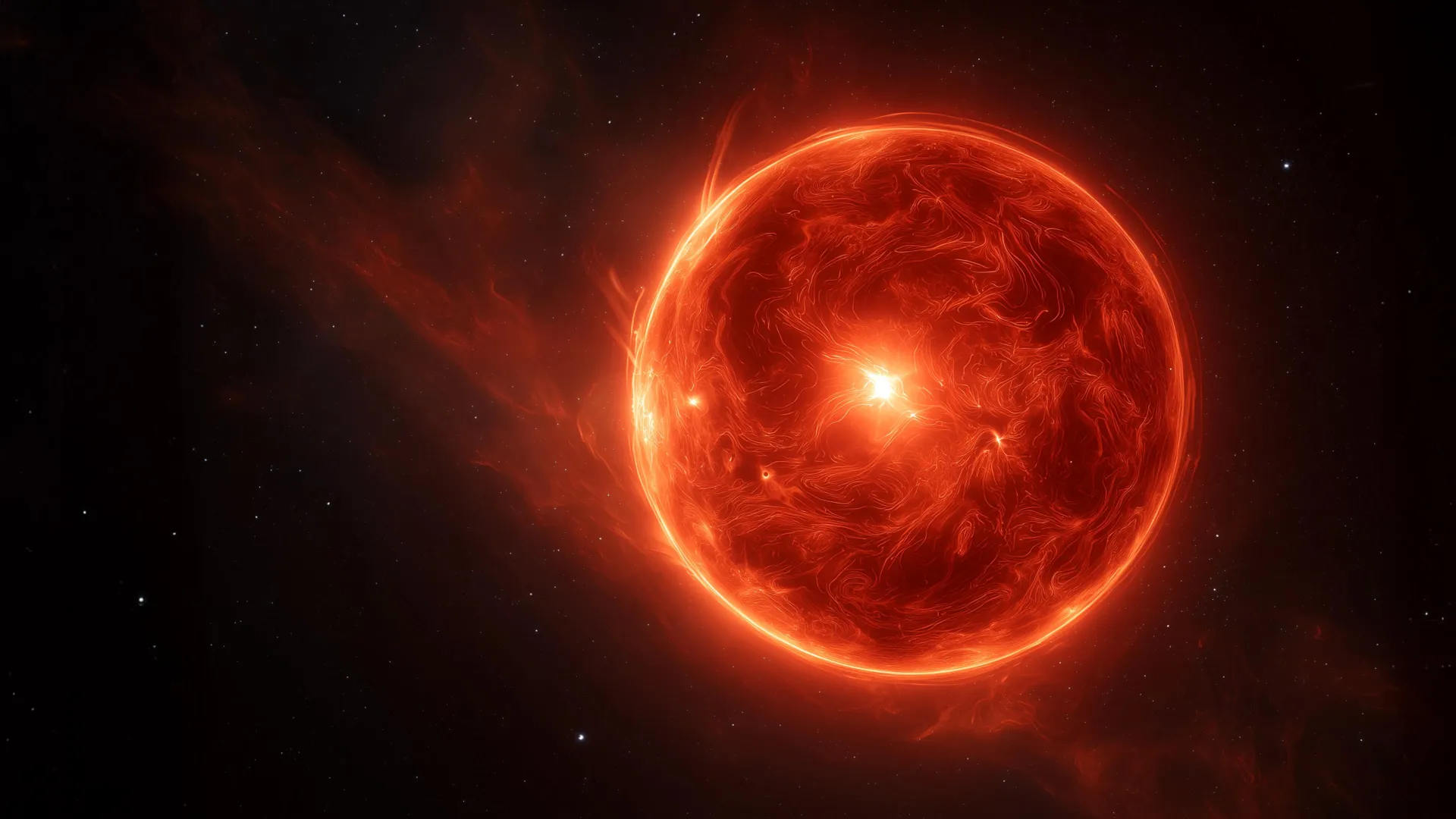
Red Giant Star Mystery Solved: Stellar Rotation Drives Element Mixing
A decades-old puzzle concerning the internal workings of red giant stars has been resolved through advanced supercomputer simulations, researchers announced Tuesday. The breakthrough sheds light on how chemical elements are mixed within these stars, a process crucial to understanding their evolution and, the future of our own Sun.
For fifty years, astronomers have observed changing chemical compositions on the surfaces of red giants – stars that have exhausted the hydrogen fuel in their cores and begun to expand dramatically. These shifts, particularly in the ratio of carbon-12 to carbon-13 isotopes, indicated that material from the star’s interior was being transported outwards. Yet, the mechanism driving this transport remained elusive. A stable layer typically separates the core, where nuclear reactions occur, from the outer convective envelope, presenting a barrier to material exchange.
The fresh study, published in Nature Astronomy, identifies stellar rotation as the key factor enabling this mixing. Researchers at the University of Victoria’s Astronomy Research Centre (ARC) and the University of Minnesota utilized high-resolution 3D simulations to demonstrate how rotation amplifies the effectiveness of internal waves in transporting material across the internal barrier.
“Using high-resolution 3D simulations, we were able to identify the impact that the rotation of these stars was having on the ability for elements to cross the barrier,” said Simon Blouin, lead researcher and postdoctoral fellow at UVic. “Stellar rotation is crucial and provides a natural explanation for the observed chemical signatures in typical red giants. This discovery is another step forward in understanding how stars evolve.”
Previous simulations had shown that internal waves, generated by turbulent motions within the convective envelope, could penetrate the barrier layer. However, these waves were found to transport only limited amounts of material. Blouin and his colleagues discovered that stellar rotation can increase mixing rates by more than 100 times compared to non-rotating stars, with faster rotation leading to even more efficient mixing.
The simulations were made possible by recent advances in supercomputing power. The team leveraged resources from the Texas Advanced Computing Centre at the University of Texas at Austin and the newly launched Trillium supercomputing cluster at SciNet at the University of Toronto. Trillium, which came online in August 2025, is among Canada’s most powerful systems for large-scale academic simulations and is part of the Digital Research Alliance of Canada.
“We were able to discover a new stellar mixing process only because of the immense computing power of the new Trillium machine,” stated Falk Herwig, principal investigator and director of ARC. “These are the computationally most intensive stellar convection and internal gravity wave simulations performed to date.” Herwig added that, until recently, limited computing abilities prevented a quantitative test of the hypothesis that stellar rotation played a significant role.
The research extends beyond astrophysics, with potential applications in understanding fluid motion in various systems, including ocean currents, atmospheric patterns, and blood flow. Herwig is currently collaborating with researchers in these fields to develop shared tools and infrastructure for large-scale simulations.
Blouin intends to continue investigating the effects of stellar rotation on different types of stars, focusing on how varying rotation patterns influence mixing efficiency and whether similar processes occur during other stages of stellar evolution. The research was funded by the Natural Sciences and Engineering Research Council (NSERC), the National Science Foundation (NSF), and the US Department of Energy.