
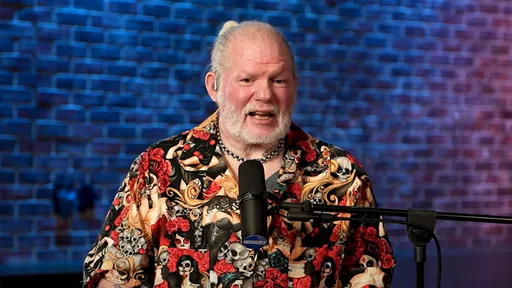
Raven Opens Up About Debilitating Sleep Disorder and Parkinson’s Diagnosis
Wrestling icon Raven, known for his intense persona and captivating promos, has recently shared details about significant health challenges he’s been facing. In a candid conversation on INSIGHT with Chris Van Vliet, the former ECW Champion discussed a debilitating sleep disorder that leaves him perpetually weary, despite getting a full night’s rest. He also addressed a previous diagnosis of early-onset Parkinson’s disease,revealing his skepticism about the condition and his approach to managing his health.
The Relentless Struggle with an Undiagnosed Sleep Disorder
Raven described a frustrating condition that doctors haven’t been able to formally diagnose, but which profoundly impacts his daily life. The core issue, he explained, is a pattern of frequent awakenings throughout the night. “Thay don’t have a name for it, but I know another person that has the same thing,” Raven stated.“The gist is that as you wake up so many times in the night that when you wake up in the morning, you’re still exhausted.” This constant interruption of sleep prevents him from entering the restorative deep sleep stages crucial for physical and mental recovery.
The Impact on Daily Life
This sleep disorder isn’t simply about feeling tired; it’s a pervasive exhaustion that affects all aspects of Raven’s life. He now relies on a CPAP machine – a device that delivers constant positive airway pressure to keep airways open during sleep – to help him breathe while sleeping. He acknowledges that years of a physically demanding career, including taking “chair shots to the head” and substance abuse, likely contributed to his current health issues. “So I have to wear a special CPAP that makes me breathe the air. I’m sure, from years of drug abuse and chair shots to the head and stuff like that, and abusing my body, I’m sure this is the price I’m paying,” he said.
The pattern of disrupted sleep is particularly grueling. He can fall asleep without issue, but the problem arises a few hours later. “So I go to bed, I can fall asleep, no problem. But then I start waking up. After about two hours, I’ll wake up, and I’ll wake up like every 20 minutes for the next six to eight hours,” Raven explained. “So when I wake up for good, I’m exhausted, so I’m waking up like 15-20 times a night.” This fragmented sleep cycle leaves him feeling drained and impacts his overall well-being.
Questioning the Parkinson’s Diagnosis
the conversation also touched upon a previous diagnosis of early-onset Parkinson’s disease. Though, Raven expressed reservations about the accuracy of this diagnosis. He acknowledged experiencing a tremor,which led doctors to suspect Parkinson’s,but he remains unconvinced. “it’s good. I mean, I got the early onset Parkinson’s, which I’m of the mind to say that I don’t have it,” he said. “But it’s why I have the tremor,and that’s what they think it is.”
The Uncertainty of Testing and Treatment
Raven chose not to undergo further testing to confirm the diagnosis, citing the limitations of the available tests. He explained that the diagnostic test isn’t foolproof,with a significant margin for both false positives and false negatives. “The test they give to prove it only proves it like 90% and there’s a lot of false positives and negatives in it,” he said. Furthermore, he learned that even with a confirmed diagnosis, the current treatment options were limited. “so there’s no reason, because he said he woudl treat me the same way, which is nothing as of now, because nothing’s bad enough, although my tremor is really bad right now.”
A Mental Approach to Health
Instead of pursuing medical intervention, Raven has adopted a different strategy: a mental one. He’s actively choosing to believe he doesn’t have Parkinson’s, hoping that a positive mindset will influence his health. “No, no. So there’s no reason. So I’m just going to declare that I’m not, that I don’t have early onset Parkinson’s and then and convince myself that I don’t,” Raven said. “As I’ve had it for like 8 to 10 years, and all this is a tremor so far.” this approach highlights the power of the mind-body connection and the importance of mental well-being in managing chronic health conditions.
Understanding sleep Disorders and Parkinson’s Disease
Raven’s experiences shed light on two complex health issues. Here’s a deeper look at both:
Sleep Disorders: Beyond Just Tiredness
Sleep disorders are conditions that disrupt normal sleep patterns. They can range from mild inconveniences to serious health risks. Some common types include:
- Insomnia: Difficulty falling asleep or staying asleep.
- sleep Apnea: Breathing repeatedly stops and starts during sleep. (This is where a CPAP machine is often used)
- Restless Legs Syndrome (RLS): An irresistible urge to move the legs, often accompanied by uncomfortable sensations.
- Narcolepsy: Excessive daytime sleepiness and sudden attacks of sleep.
Chronic sleep deprivation can lead to a host of problems, including weakened immunity, increased risk of chronic diseases (like heart disease and diabetes), mood disorders, and impaired cognitive function.
Parkinson’s Disease: A Neurological condition
Parkinson’s disease is a progressive neurological disorder that affects movement. It occurs when nerve cells in the brain that produce dopamine – a chemical messenger involved in movement – become damaged or die. Symptoms typically develop slowly and can include:
- Tremor: Shaking, often starting in the hands or fingers.
- Rigidity: Stiffness of the limbs and trunk.
- Bradykinesia: Slowness of movement.
- Postural Instability: Difficulty with balance and coordination.
While there’s no cure for Parkinson’s disease, treatments can help manage symptoms and improve quality of life.
Key Takeaways
- Raven is battling an undiagnosed sleep disorder causing extreme exhaustion.
- He relies on a CPAP machine to aid his breathing during sleep.
- He questions his early-onset Parkinson’s diagnosis and has chosen a mental approach to managing his health.
- Both sleep disorders and Parkinson’s disease are complex conditions that require careful management.
Raven’s openness about his health struggles is a reminder that even those who project strength and resilience can face personal battles. His story highlights the importance of advocating for one’s health,seeking accurate diagnoses,and finding coping mechanisms that work best for the individual.
