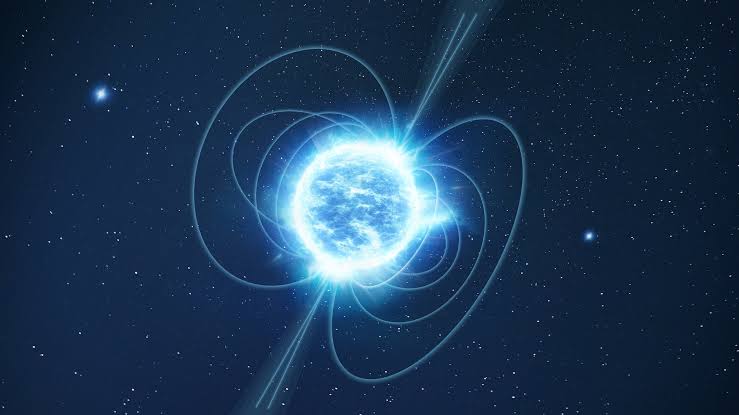
Pulsar J1909+0749 Found Outside Supernova Shell G42.1-0.2
A pulsar has been clocked at more than 1,400 kilometers per second — fast enough to leave the wreckage of its own supernova behind.
The object, J1909+0749, now sits well outside the shell G42.1-0.2, its radio tail still pointing toward the remnant’s center.
The discovery, published November 9 in Astronomy & Astrophysics, emerged from two decades of radio survey data. Rohit Dokara, then at the Max Planck Institute for Radio Astronomy, spotted the alignment by chance.
“By chance, I found a new supernova remnant shell and a known pulsar to be well outside this shell, but with its tail very clearly pointing to the center of the shell,” Dokara told phys.org.
Of the more than 4,300 pulsars in the ATNF catalogue, only 63 are potentially linked to a supernova remnant. The team confirmed the association by matching the pulsar’s spin-down age, its angular offset from the shell’s center, and the dispersion measure — the delay in radio waves caused by free electrons in interstellar space.
The transverse velocity works out to roughly 870 miles per second, making J1909+0749 one of the fastest compact objects known in the Milky Way.
Researchers measured the flux densities of the shell G42.1-0.2 from roughly 200 megahertz to 6 gigahertz and found a radio spectral index of –0.36 ± 0.08. That value confirmed the emission is primarily non-thermal synchrotron radiation, the signature of a supernova remnant, according to the study accepted by Astronomy & Astrophysics.
Those surveys detect radio waves from electrons spiralling in magnetic fields inside expanding shells and also reveal pulsars and their comet-like tails.

High-resolution images from the MeerKAT radio telescope revealed the shell’s non-thermal synchrotron emission — the signature of a supernova remnant. Astronomers estimate the galaxy should contain about 2,000 such remnants; only around 400 have been confirmed.
“The science potential for each such survey is enormous, and this work is just one small example of combining data from such surveys using standard methods to discover and identify rare associations,” Dokara told phys.org.
Next-generation radio facilities are expected to turn up more of these runaway pulsars. “Such cases offer unique views of some of the fastest compact objects in our galaxy,” Dokara said.