
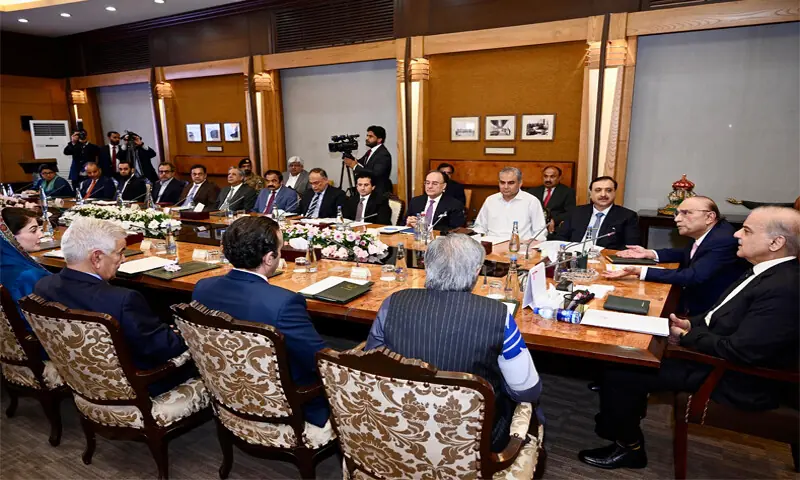
Provinces to share oil subsidy burden under NFC formula
Fiscal Federalism Under Fire: Provinces Capitulate on Oil Subsidy Amid Geopolitical Shock
Pakistan’s four provinces have agreed to absorb a Rs200 billion oil subsidy burden via the National Finance Commission (NFC) formula following a high-level crisis meeting in Islamabad. This move averts immediate consumer price hikes but strains provincial liquidity as geopolitical tensions with Iran spike global energy costs, forcing a recalibration of sovereign debt strategies.
The fiscal landscape of South Asia’s second-largest economy shifted violently on Monday. In a closed-door session presided over by President Asif Ali Zardari, the political calculus of federalism collided with the brutal arithmetic of a global energy crisis. The outcome was a rare consensus: the provinces will shoulder the cost of shielding domestic consumers from the volatility of the international oil market. This decision comes as Brent crude futures, reacting to the escalating US-Israel conflict in the Strait of Hormuz, threaten to breach the $145 per barrel threshold, a level that historically triggers stagflation in import-dependent emerging markets.
The immediate relief for the consumer masks a deeper structural vulnerability. By opting to distribute the subsidy burden according to the NFC Award shares rather than passing costs directly to the pump, the federal government has effectively outsourced a significant portion of its balance sheet risk to provincial treasuries. Punjab and Sindh, initially resistant to the Rs200 billion ask, have conceded. Their initial stance—advocating for market-based pricing to signal behavioral change—was overruled by the political imperative to prevent social unrest during a period of heightened regional insecurity.
The Fiscal Mechanics of the Bailout
This is not merely a political compromise; it is a liquidity event with profound implications for provincial creditworthiness. The agreement forces sub-national entities to divert capital from development budgets to recurrent energy expenditures, a classic symptom of fiscal distress. For institutional investors monitoring Pakistan’s sovereign risk, this signals a prioritization of short-term stability over long-term capital expenditure (CapEx).

The breakdown of this burden reveals the sheer scale of the exposure. With the federal government grounding 60% of its official vehicle fleet and slashing development budgets to fund austerity, the pressure on provincial coffers is immense. To manage this sudden contraction in available capital without triggering a default on provincial bonds or halting critical infrastructure projects, regional administrations will likely need to engage specialized fiscal restructuring consultants. These firms specialize in optimizing cash flow during liquidity crunches, helping governments re-prioritize expenditure lines when revenue streams are compromised by external shocks.
| Province/Region | Estimated NFC Share (%) | Projected Subsidy Burden (PKR) | Fiscal Impact Assessment |
|---|---|---|---|
| Punjab | ~57.0% | Rs 114 Billion | High strain on development portfolio; requires immediate liquidity management. |
| Sindh | ~23.0% | Rs 46 Billion | Moderate strain; potential delay in urban infrastructure projects. |
| KP & Balochistan | ~14.5% | Rs 29 Billion | Critical dependency on federal transfers; high risk of service delivery disruption. |
| Federal Govt | N/A | Rs 11 Billion (Remaining) | Offset by austerity measures and vehicle grounding. |
The data underscores a precarious reality. As noted in recent monetary policy statements from the State Bank of Pakistan, maintaining foreign exchange reserves is paramount when import bills swell. By keeping domestic fuel prices artificially low, the state absorbs the forex pressure, but the internal cost is a compression of provincial balance sheets.
“When sub-national entities are forced to subsidize consumption during a supply shock, you see a immediate degradation in their ability to service debt. We are watching a transfer of sovereign risk from the center to the periphery.”
Operational Austerity and Supply Chain Resilience
Beyond the balance sheet, the operational response to this crisis offers a blueprint for corporate entities facing similar energy volatility. The government’s decision to ground 60% of official vehicles is a stark admission that traditional fleet models are unsustainable in a high-cost energy environment. This move creates an immediate demand signal for fleet management and logistics optimization firms. The public sector’s pivot toward shared mobility and reduced physical presence mirrors the strategies multinational corporations are adopting to protect EBITDA margins against rising input costs.
the shelving of “smart lockdowns” indicates a preference for economic continuity over containment, a strategy that relies heavily on robust supply chain integrity. With the meeting assured that fuel stocks are adequate despite the Iran crisis, the focus shifts to distribution efficiency. Here, the role of energy efficiency auditors becomes critical. As the President directed a push for public awareness and reduced consumption, the private sector must follow suit. Companies that fail to audit their energy consumption and implement demand-side management strategies will uncover their operating costs spiraling out of control relative to competitors who have hardened their operations against price shocks.
The geopolitical backdrop cannot be ignored. The ongoing conflict involving Iran and attacks on Gulf oil infrastructure represent a “black swan” event that has turned into a lingering threat. Supply chain bottlenecks are no longer theoretical; they are pricing into every futures contract. For Pakistani exporters, this means navigating a minefield of shipping insurance premiums and freight volatility. The government’s assurance of food security and medicine availability suggests a stockpiling strategy, but for the broader industrial base, just-in-time manufacturing is becoming a liability.
Market Trajectory and Strategic Outlook
Looking ahead to Q2 2026, the market will be watching the provincial implementation of this subsidy closely. If Punjab or Sindh begin to miss debt service payments due to this diverted liquidity, we could see a contagion effect that spikes borrowing costs for the entire federation. The “smart lockdown” remains on the table, a Damocles’ sword hanging over the industrial sector. Should the Iran conflict widen, disrupting the Strait of Hormuz, the current subsidy model will collapse under the weight of unaffordable import bills.
Investors and corporate leaders must treat this not as a temporary political fix, but as a structural shift in the cost of doing business in the region. The era of cheap energy is paused, perhaps indefinitely. The winners in this environment will be those who proactively restructure their cost bases and secure expert advisory to navigate the fiscal fallout. As the dust settles on this high-level meeting, the directive is clear: austerity is the recent baseline and resilience is the only currency that matters.
For businesses seeking to fortify their operations against these macroeconomic headwinds, the World Today News Directory offers a curated list of vetted partners capable of executing these critical pivots. From crisis management consultants who can model geopolitical risk exposure to legal firms specializing in sovereign debt restructuring, the tools for survival are available to those who act before the next shock hits.