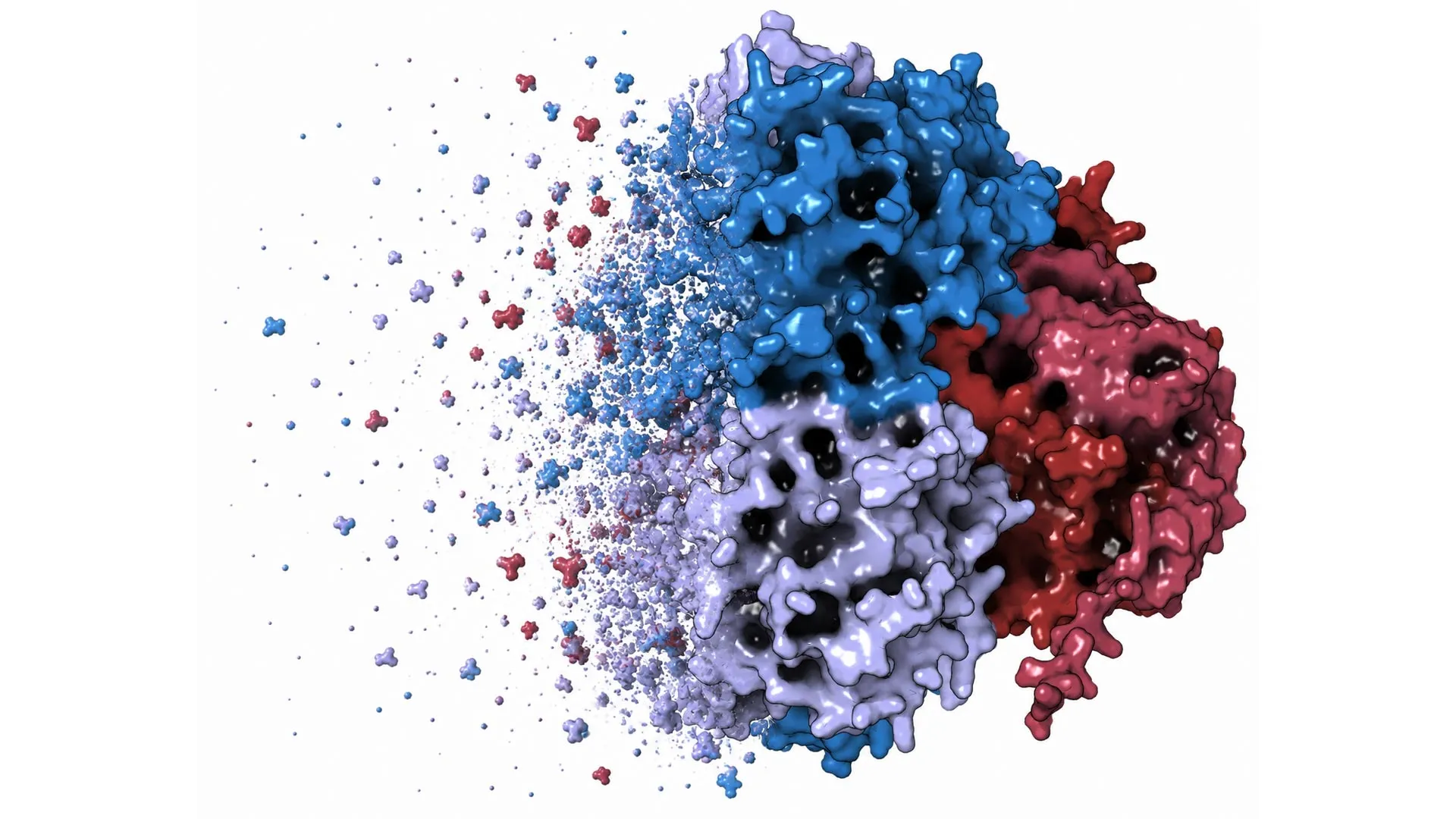
Protein NUDT5 influences leukemia drug 6-TG response
Researchers investigating the 70-year-old leukemia drug 6-thioguanine (6-TG) have discovered that a protein called NUDT5 influences cellular drug response through a non-enzymatic molecular scaffold function rather than its traditional catalytic activity. Published following a 2025 study in Science, the findings from a multi-institutional European research team demonstrate that removing NUDT5 protects cells from the toxic effects of the thiopurine treatment, revealing a previously unknown layer of cellular biology.
- Non-Enzymatic Role: NUDT5 affects 6-TG response through its physical presence as a molecular scaffold rather than its chemical enzymatic activity.
- Targeted Degradation: Using a cell-based platform to develop selective protein degraders allowed researchers to remove NUDT5 entirely, distinguishing its structural effects from enzymatic inhibition.
- Opposing Pathways: While losing NUDT15 increases cellular sensitivity to 6-TG, reducing NUDT5 induces treatment resistance, indicating opposing regulatory mechanisms.
For more than seven decades, clinicians have administered 6-thioguanine (6-TG) to manage leukemia. Although its clinical outcomes are well documented, the molecular details determining why certain cancer cells succumb to the drug while others survive have remained incompletely understood. To explore these cellular survival mechanisms, a collaborative group of researchers from the CeMM Research Center for Molecular Medicine of the Austrian Academy of Sciences, the University of Oxford, the Weizmann Institute of Science, and the University of Dundee set out to isolate the precise protein interactions governing drug sensitivity.
The investigation built upon recent work from the Kubicek and Huber laboratories published in 2025, which established that NUDT5 performs an essential cellular function independent of its standard catalytic activity. Instead of merely driving chemical reactions as an enzyme, NUDT5 operates as a molecular scaffold to organize cellular metabolism. Tuan-Anh Nguyen, co-first author of the study at CeMM, explained the initial hypothesis versus the empirical reality: “We initially expected that NUDT5 would influence 6-TG through its enzymatic activity. Instead, we found that inhibiting the enzyme had little effect. What mattered was whether the protein itself was present.”
Targeted Protein Degradation Versus Conventional Inhibition
Standard pharmacological approaches targeting enzymes typically rely on blocking chemical reactions. To test whether suppressing NUDT5 through conventional inhibition altered 6-TG efficacy, the research team deployed an emerging pharmacological strategy known as targeted protein degradation. This method forces the cell to eliminate the targeted protein entirely rather than just halting its catalytic function.
Anne-Sophie Marques, a first author of the paper whose work at the University of Oxford contributed to the findings, detailed the drug discovery pipeline: “We developed a cell-based platform to accelerate the discovery of NUDT5 degraders. This platform helped guide the medicinal chemistry efforts that ultimately produced dNUDT5, our most active degrader.” The medicinal chemistry program, led by the Huber laboratory at Oxford, generated a series of highly selective NUDT5 degraders alongside matched control compounds capable of binding to NUDT5 without inducing its destruction.
Comparing these molecules against conventional NUDT5 inhibitors yielded a stark divergence in cellular outcomes. While blocking the enzymatic activity of NUDT5 produced no meaningful change in how cells reacted to 6-TG, completely removing the protein protected the cells from the drug’s toxicity. Genetic experiments corroborated these pharmacological results. Professor Kilian Huber of the Centre for Medicines Discovery at the University of Oxford and co-corresponding author of the study noted: “Chemical degraders give us a way to separate what a protein does as an enzyme from what it does as a physical presence in the cell. In this case, that distinction was decisive: removing NUDT5 revealed biology that conventional inhibitors missed.”
Dose-Dependent Protection and the NUDT15 Interplay
Further analysis confirmed that dNUDT5 protected cells from 6-thioguanine toxicity in a clear dose-dependent manner. Ludwig Bauer, another first author of the paper, described the finding as an exciting moment when the data revealed how dNUDT5 altered drug tolerance. The experiments also uncovered a notable biological relationship between NUDT5 and NUDT15, another protein already established as a modulator of thiopurine response in patients.
The two proteins exert functionally opposing effects on the cell. While loss of NUDT15 renders cells hypersensitive to 6-TG, reducing NUDT5 increases cellular resistance to the same treatment. These divergent trajectories indicate that while both proteins influence thiopurine pharmacology, they do so through entirely distinct molecular pathways.
Stefan Kubicek, Principal Investigator at CeMM and corresponding author of the study, summarized the broader scientific implications: “Our results show that proteins can have important biological functions that are completely independent of their enzymatic activity. By removing NUDT5 rather than simply inhibiting it, we were able to uncover a hidden layer of biology that helps determine how cells respond to a clinically important drug.”
Future Directions in Leukemia Pharmacotherapy
While these findings do not translate immediately into a new clinical protocol or standalone therapeutic agent, they expose a fundamental gap in how researchers understand drug-protein interactions for decades-old oncology medications. By demonstrating that NUDT5 influences thiopurine sensitivity through a non-catalytic structural mechanism, the study provides a foundation for explaining inter-patient variability in treatment response.