
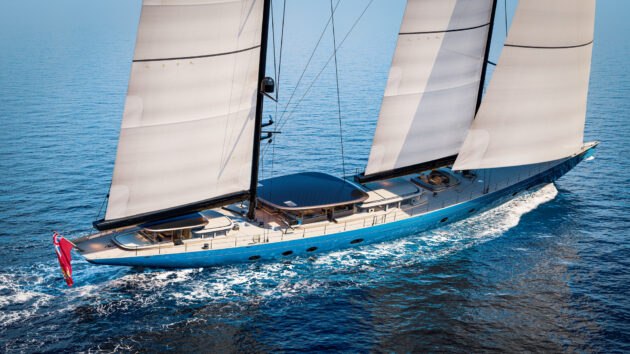
Project Zero: Building the Future of Emission-Free Yachting
The superyacht industry has long been the final frontier of carbon-intensive excess, where “sustainability” usually translates to a slightly more efficient diesel generator. Project Zero—or SY ZERO—attempts to pivot this paradigm by treating a 69-metre vessel not as a luxury accessory, but as a floating energy-harvesting experiment. By stripping out the combustion engine entirely, the project moves the conversation from aesthetic luxury to an architectural challenge of energy density and load balancing.
The Tech TL. DR:
- Energy Architecture: Completely fossil-fuel free, relying on a tri-modal harvesting system (wind, solar and thermal/hydro).
- Storage Capacity: 5 megawatt-hours (MWh) of electrical storage, roughly equivalent to the battery capacity of 88 Tesla vehicles.
- Deployment Model: Open-source distribution of technical data and design insights via FoundationZero.org to accelerate industry-wide adoption.
For the enterprise architect, the real story isn’t the sails—it’s the power management. The fundamental bottleneck in emission-free yachting is the “hotel load”—the constant energy drain required for HVAC, desalination, and onboard systems. Traditional yachts solve this with massive diesel generators. SY ZERO replaces this legacy hardware with a complex energy harvesting stack. Underway, hydro-generating thrusters convert kinetic water movement into electricity, whereas solar panels and wind turbines supplement the grid. This isn’t just a hardware swap; it’s a total rethink of energy management and storage latency.
Managing a 5 MWh battery array in a marine environment introduces significant telemetry and monitoring requirements. To ensure these systems don’t fail in deep water, the vessel requires the kind of high-availability monitoring typically reserved for data centers. Enterprises implementing similar large-scale IoT energy grids often rely on vetted Managed Service Providers (MSPs) to maintain the uptime of the monitoring software and ensure that energy distribution remains optimized across all nodes.
Hardware Breakdown: The Energy Stack vs. Legacy Systems
To understand the scale of this shift, we have to look at the specs. Most superyachts are essentially floating oil tankers with cabins. SY ZERO operates on a closed-loop renewable system. The collaboration between Vitters Shipyard, Vripack Yacht Design, and Dykstra Naval Architects has resulted in a proof-of-concept that prioritizes energy harvesting over raw combustion power.

| Specification | Conventional Superyacht | SY ZERO (Project Zero) |
|---|---|---|
| Primary Fuel | Diesel / Marine Gas Oil | Wind, Solar, Thermal |
| Energy Storage | Fuel Tanks (Thousands of Liters) | 5 MWh Battery Array |
| Power Generation | Internal Combustion Generators | Hydro-thrusters, Solar, Wind Turbines |
| IP Philosophy | Proprietary / Closed | Open-Source (Foundation Zero) |
| Design Goal | Exclusivity & Range | Emission-free Proof-of-Concept |
The decision to move to an open-source model via FoundationZero.org is the most critical “dev” move here. By sharing technical details and system data, the project avoids the “walled garden” trap that usually slows down maritime innovation. However, exposing detailed system architecture and telemetry data on a public platform creates a new attack surface. For any organization deploying open-source hardware configurations, performing rigorous audits via cybersecurity auditors and penetration testers is mandatory to prevent vulnerabilities in the energy management software from becoming physical security risks.
Implementing the Open-Source Telemetry
Because Project Zero is committed to transparency, the goal is to allow other designers to build upon their data. While the full API documentation is managed by Foundation Zero, a developer looking to integrate SY ZERO’s energy performance data into a sustainability dashboard would typically interact with a REST API to pull real-time harvesting metrics.
Below is a conceptual implementation of how a developer might query the energy state of the vessel using a cURL request to the hypothetical Foundation Zero data endpoint:
# Fetch current energy harvesting metrics for SY ZERO curl -X GET "https://api.foundationzero.org/v1/vessels/sy-zero/telemetry" -H "Authorization: Bearer YOUR_API_TOKEN" -H "Accept: application/json" # Expected Response: # { # "vessel": "SY ZERO", # "timestamp": "2026-04-07T08:29:00Z", # "energy_storage_mwh": 4.2, # "harvesting_sources": { # "hydro_thrusters_kw": 12.5, # "solar_array_kw": 8.2, # "wind_turbine_kw": 15.1 # }, # "system_status": "optimal" # }This level of data granularity allows for the creation of digital twins, enabling naval architects to simulate energy loads before a single sheet of steel is cut. Developing these custom simulation tools often requires specialized software development agencies capable of handling high-throughput sensor data and complex physics engines.
The Scalability Problem: From Proof-of-Concept to Production
Louis Hamming of Vitters notes that the project is about “building a yacht that reflects a future we all recognise is coming.” But the leap from a single 69-metre proof-of-concept to a fleet of emission-free vessels requires solving the energy density problem. 5 MWh is impressive for a yacht, but it’s a drop in the bucket compared to the energy requirements of global shipping. The “Sailing Yacht” aspect is a cheat code—wind provides the bulk of the propulsion—but the true innovation lies in the “Zero” part: the complete elimination of the diesel backup.
The project’s success depends on the efficiency of its energy management system. If the software cannot dynamically shift loads between the solar array and the battery bank in real-time, the vessel risks “brownouts” of critical onboard systems. This makes the software layer just as critical as the hull design. We are seeing a convergence where naval architecture is becoming a subset of systems engineering.
SY ZERO is less about luxury and more about establishing a new baseline for marine traveling. By treating the vessel as an open-source platform, Foundation Zero is attempting to crowdsource the optimization of renewable marine energy. Whether this scales to larger commercial vessels remains to be seen, but the architectural blueprint is now public, moving the industry away from vaporware and toward verifiable, data-driven sustainability.
Disclaimer: The technical analyses and security protocols detailed in this article are for informational purposes only. Always consult with certified IT and cybersecurity professionals before altering enterprise networks or handling sensitive data.