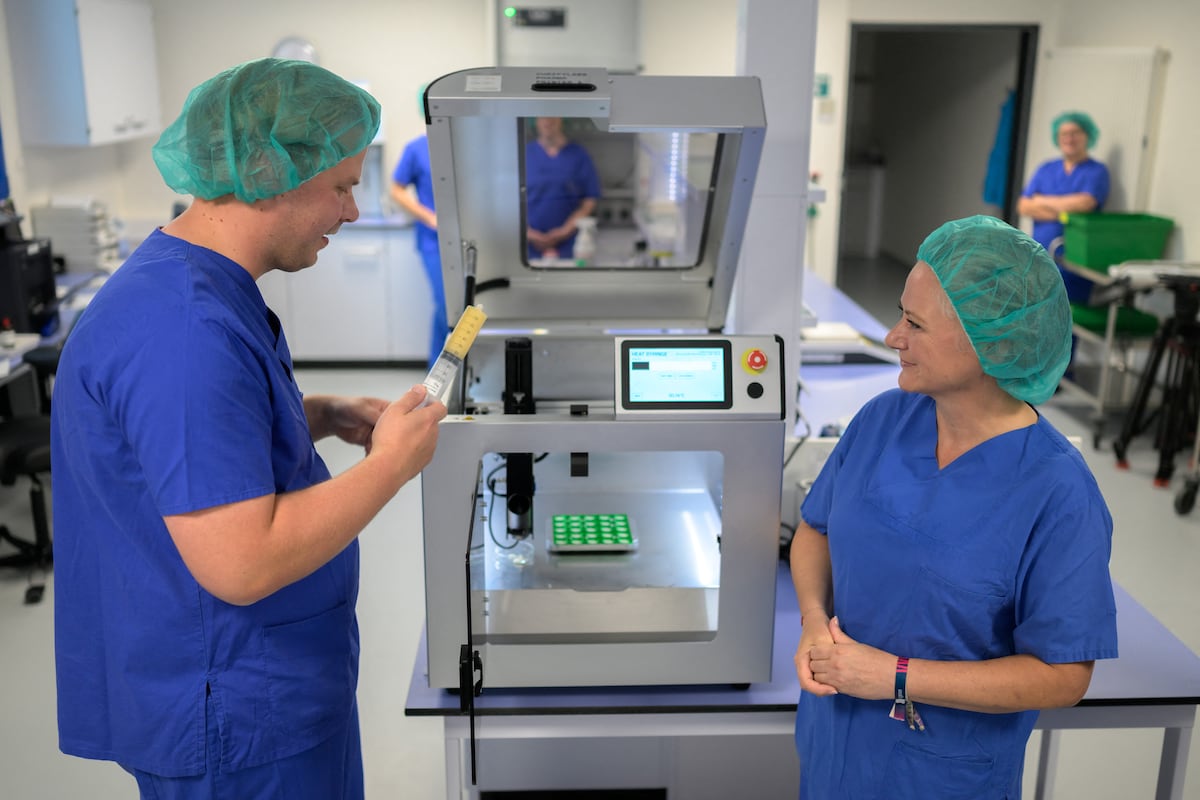
PRISM-LT Develops 3D Bioprinting for Engineered Living Materials
PRISM-LT Project to 3D Print Living Tissues and Lab Meat
Researchers are developing a new 3D bioprinting platform designed to manufacture complex living tissues ranging from bone marrow models to cultivated meat. The initiative seeks to overcome the limitations of traditional static materials by building with engineered living materials that can grow, respond to, and adapt to their environment.
The Tech TL;DR:
- Core Innovation: A 5-year EU-funded project called PRISM-LT utilizes modular, encapsulated bioink units placed by robotic arms to build complex living tissues.
- Biological Guidance: Genetically modified microorganisms act as guides, detecting when stem cells differentiate and releasing growth factors to direct tissue formation.
- Target Applications: The platform targets bone-adipose tissue interfaces for leukemia drug testing and fat-marbled muscle structures for cultivated meat production.
The Bioengineering Challenge of Building with Living Cells
Natural evolution perfected the creation of living cells over billions of years, prompting researchers to find ways to accelerate and replicate that process in a laboratory setting. Massimo Vassalli, chair of bioengineering at the University of Glasgow, serves as the scientific coordinator for PRISM-LT. The five-year project is backed by the European Union and runs until 2027.
“Engineered living materials can have additional, dynamic features that we simply cannot replicate with traditional static materials,” Vassalli stated. Turning this potential into real-world applications requires solving a fundamental biological problem: printing living cells into complex structures without killing them or losing developmental control. Traditional methods typically print cells in a continuous, uninterrupted flow of material without the biological guidance that microorganisms provide.

PRISM-LT Uses Modular Capsules to Improve Cell Viability
To solve the challenge of cell viability, the PRISM-LT team utilizes tiny capsules containing living cells alongside a gel-like support material referred to as bioink. “Instead of printing a continuous stream of bioink, we work with modular living components that are encapsulated,” said Laura Martinelli, PRISM-LT project coordinator and executive director of In Society, a research organization based in Udine, Italy. “These capsules can be placed precisely by a robotic arm or bioprinted layer by layer to create complex tissue architectures.”
Each capsule acts as a biological unit containing a structural scaffold and artificial microorganisms engineered to steer cell development. These modified microorganisms monitor when stem cells begin to differentiate and respond by secreting chemical signals known as growth factors to guide the cells toward a specific tissue type. The active manufacturing phase takes anywhere from a few minutes to an hour, followed by a three-week maturation period where stem cells develop into bone, fat, or muscle tissue. The laboratory currently produces roughly one square centimeter of thin tissue and aims to scale production to a one cubic centimeter block.
Coexistence remains a primary technical hurdle, as the process forces biological components that do not naturally share an environment to interact. “We have to create a symbiotic relationship between two systems not designed to live together, like yeast and stem cells,” Vassalli explained. “The main challenge is to create conditions suitable enough for both the yeast or bacteria and the stem cells while the latter differentiate.”
Applications Spanning Bone Marrow Research and Cultivated Meat
The PRISM-LT platform focuses on manufacturing two distinct tissue varieties. The first is the interface between bone and adipose tissue found within bone marrow, which researchers intend to use for biomedical investigations and drug testing for conditions like leukemia. The second target is muscle-and-fat structures designed to mimic the fat marbling that provides natural meat with its distinct texture and flavor.
“Thanks to our bioprinting technology, we can achieve the right texture in alternative meats, which gives us the opportunity to commercialize them,” Martinelli noted regarding consumer acceptance of cultivated food products. Despite the technical progress, researchers emphasize that public deployment remains distant. “We are still far from real-world applications,” Martinelli cautioned.