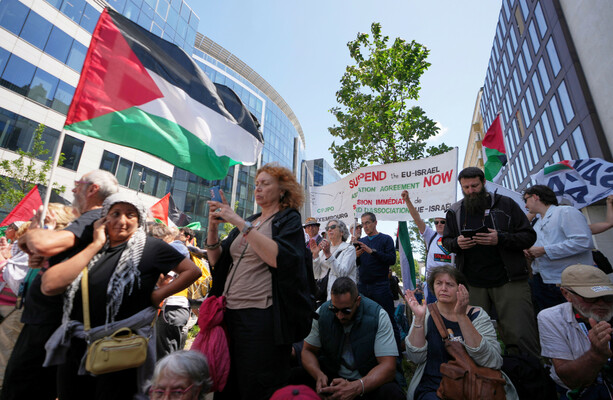
Pressure Mounts for EU to Suspend Trade with Israel
Nearly one million EU citizens have signed a petition demanding the immediate suspension of the EU-Israel Association Agreement. This grassroots movement, driven by allegations of genocide and systemic human rights violations in Gaza, seeks to force the European Commission to halt trade and arms exports to Israel immediately.
This is no longer a fringe protest. It’s a massive, coordinated legal challenge to the European Union’s trade architecture.
The scale of the mobilization signals a profound rift between the European populace and the diplomatic strategies of the European Commission. For years, the EU has maintained a privileged trade relationship with Israel, but the current surge in signatures suggests that a critical mass of citizens now views this economic cooperation as active complicity in war crimes. The problem is systemic: the EU provides the financial and commercial framework that allows a government to continue operations while facing accusations of ethnic cleansing and apartheid.
The Legal Lever: Article 2 and the Association Agreement
At the heart of this movement is not just moral outrage, but a specific legal mechanism. The EU-Israel Association Agreement serves as the bedrock for trade and diplomatic relations between the two entities. However, this agreement is not unconditional.
Article 2 of the agreement explicitly mandates that cooperation must be suspended if one party commits serious breaches of human rights. Activists and legal experts argue that this threshold has not only been met but surpassed. The “Justice for Palestine” initiative asserts that the EU’s refusal to trigger this clause is a political choice rather than a legal necessity.
Navigating the complexities of international treaties and human rights law requires specialized expertise. As these legal challenges move toward the European Commission, many affected parties and advocacy groups are seeking guidance from vetted international human rights lawyers to ensure the suspension clauses are enforced correctly.
The Catalyst: The Execution Law and Humanitarian Crisis
While tensions have simmered for decades, a specific legislative shift in Israel has accelerated the petition’s growth. As of April 1, 2026, Israel passed an execution law that mandates the death penalty by hanging for Palestinians convicted in military courts.
This law has sparked immediate alarm across Europe. Countries including Italy, Germany and France have expressed “deep concern” over the legislation. Yet, the contradiction remains: these nations offer diplomatic disapproval while continuing “business as usual” through the Association Agreement.
The petition argues that words are insufficient. The movement emphasizes that “words do not stop executions” and “words do not stop bombs.” The only effective tool remaining is economic leverage, as the EU is Israel’s largest trading partner.
The grievances driving the one million signatures are extensive and documented. The movement highlights a pattern of:
- Systemic Violence: Ethnic cleansing, apartheid, and the killing of civilians.
- Infrastructure Destruction: Targeted attacks on schools, healthcare facilities, and religious sites.
- Humanitarian Warfare: The use of starvation as a weapon and the blockade of essential aid in Gaza.
- Environmental Crime: Acts of ecocide and the theft of natural resources.
- Legal Oppression: Arbitrary detentions, torture, and the seizure of cultural heritage sites.
The Mechanics of the European Citizens’ Initiative
This is not a standard online petition. This is a European Citizens’ Initiative (ECI). Unlike a social media campaign, a successful ECI forces the European Commission to formally consider the proposal and provide a detailed response on whether it will propose legislation or accept action.
By reaching nearly one million signatures, the initiative creates an undeniable political mandate. It moves the conversation from the streets into the halls of the European Parliament. The goal is clear: utilize every available legal, diplomatic, and economic tool to force the Israeli government to cease human rights violations and uphold international law.
For citizens wanting to engage in this level of systemic change, connecting with organized non-profit advocacy groups is often the most effective way to move from signing a petition to influencing policy.
Geopolitical Friction and Economic Fallout
The potential suspension of the Association Agreement would send shockwaves through global markets. A freeze on all trade and the cessation of arms exports would not only impact the Israeli economy but would also disrupt European supply chains and corporate interests.
This creates a volatile environment for businesses. Companies currently operating under the umbrella of the Association Agreement face sudden regulatory uncertainty. To mitigate these risks, many firms are now consulting international trade consultants to diversify their portfolios and prepare for a potential collapse in EU-Israel trade relations.
The internal friction within the EU is palpable. While some Member States are hesitant, the growing public pressure is making “neutrality” an unsustainable position. The movement argues that the EU’s current stance is not diplomacy, but a choice to fund and legitimize crimes against humanity.
“EU citizens cannot and will not accept an agreement that legitimises and financially supports crimes against humanity and war crimes.”
The window for action is now. The movement believes that if enough public pressure is applied, governments will be forced to shift from silence to statements, and finally to real action.
The trajectory of this petition suggests a fundamental shift in how European citizens view the intersection of trade and morality. If the EU-Israel Association Agreement falls, it will set a precedent for all future EU trade deals, signaling that human rights clauses are not mere formalities, but enforceable mandates. As the world watches the legal battle unfold in Brussels, the question is no longer whether the threshold for suspension has been met, but whether the EU has the political courage to act on its own laws.
For those tracking the fallout of these geopolitical shifts or seeking professional assistance to navigate the resulting legal and economic instability, the World Today News Directory remains the primary resource for finding verified experts equipped to handle the complexities of international law and global trade.
Keep reading
- White House Racing Event Sparks Conflict of Interest and Heritage Damage Concerns
- Alejandro Balde Committed to Staying at Barcelona Despite Transfer Rumors
- Canada Imposes Retaliatory Tariffs as Trade War with US Escalates (archyde.com)
- Over 100 Ex-Diplomats Urge France and UK to Sanction Israel Over Palestine (newsdirectory3.com)