
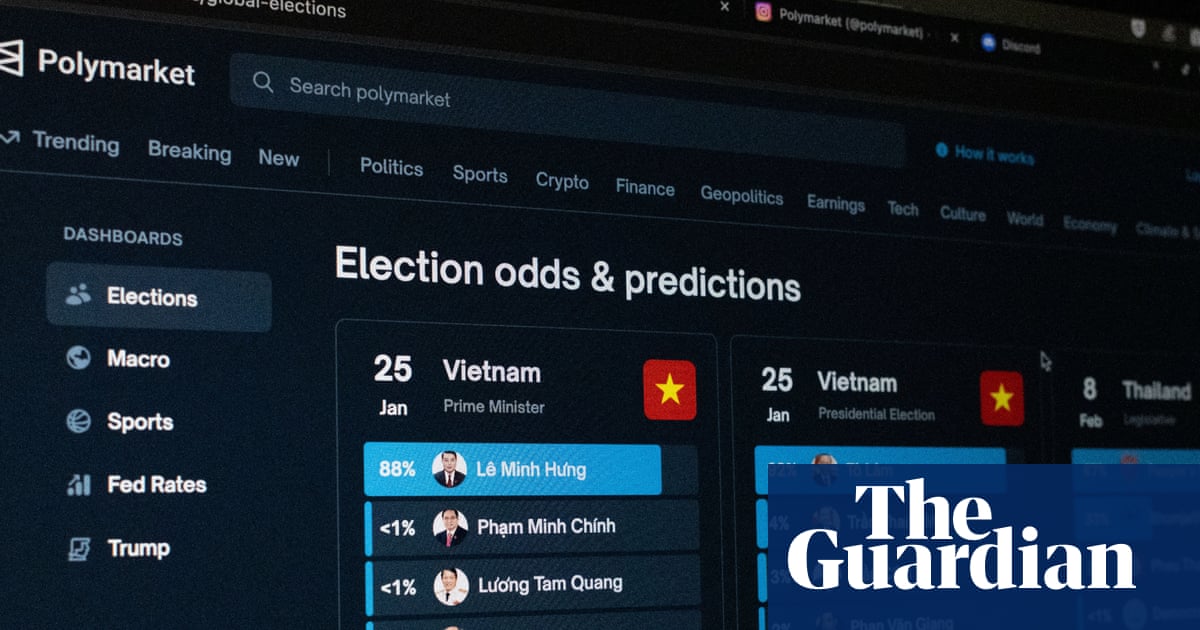
Super Bowl Sunday saw a combined $1.2 billion in trading volume on prediction markets Polymarket and Kalshi, according to analysis by Piper Sandler, highlighting the rapid growth and increasing mainstream attention surrounding these platforms.
Prediction markets allow users to wager on the outcomes of future events, ranging from the results of sporting events and elections to more unusual possibilities like whether the U.S. Will invade Greenland. Unlike traditional gambling venues, these markets are accessible in every state and permit participation from individuals as young as 18.
Yadin Eldar, a 21-year-old economics student at Florida State University, has been involved in prediction markets since 2019. He describes the experience as a blend of betting and options trading, distinct from conventional casino gambling. “It’s not like when you go to the casino, and play against the house, and hope you acquire to win against the house,” Eldar said. “That’s not what it is.” However, Zachary Azra, a 20-year-old economics student at the University of North Carolina at Chapel Hill, views them differently, characterizing prediction markets as “another way to gamble money that’s framed in a way that looks like good investments.”
The regulatory landscape surrounding prediction markets remains ambiguous. Even as traditional gambling faces significant scrutiny and restrictions, prediction markets operate with less oversight. For years, platforms like Polymarket and Kalshi have sought classification as derivatives platforms under the Commodity Futures Trading Commission (CFTC), rather than gambling operations. They offer “event contracts” – binary outcomes where a payment is made if an event occurs, and nothing if it doesn’t.
The Biden administration attempted to tighten regulations on the industry in November 2024, with the FBI raiding the home of Shayne Coplan, CEO of Polymarket, alleging the platform allowed U.S. Users to bet despite a ban. Polymarket responded by claiming the raid was retaliation for its users overwhelmingly predicting a Donald Trump victory in the election.
The Trump administration has adopted a more lenient stance. Donald Trump Jr. Is both an investor and unpaid advisor to Polymarket, and a paid advisor to Kalshi. Trump Media & Technology Group recently announced plans to launch its own prediction market platform, “Truth Predict.”
The increasing visibility of prediction markets extends to established media outlets, with several forming partnership deals with Polymarket and Kalshi to incorporate their odds into news coverage. Harry Crane, a statistics professor at Rutgers University, suggests this is partly due to declining trust in traditional media and polling organizations. “Finding an alternative that’s not relying on the legacy media and the legacy polling outlets is appealing,” he said.
Grant Ferguson, a political science instructor at Texas Christian University, notes the speed and constant availability of prediction markets as a key draw. “That market updates all the time. It’s not like the stock market that has set hours. It’s open all the time, 24/7,” he said. During election campaigns, these markets can react instantly to events like debates or early voting results.
However, Eldar cautions against viewing prediction market odds as a replacement for traditional polling. “It’s another tool,” he said. “I don’t think it’s a replacement for polls at all.” He emphasizes the interconnectedness of the two, stating, “You need the polls in order to decide the odds, and the odds play off the polls.”
Concerns exist regarding the potential for insider trading and the influence of market odds on voter behavior. Bets on the Venezuelan opposition leader María Corina Machado winning the 2025 Nobel peace prize spiked before the official announcement, raising allegations of insider trading, though it was later determined the information came from publicly available metadata. Representative Ritchie Torres introduced draft legislation in January aimed at curbing insider trading by federal officials, prompted by a suspicious Polymarket trade timed around a U.S. Operation in Venezuela.
The National Council on Problem Gambling has voiced concerns that prediction markets carry similar risks to traditional gambling, including financial harm and the development of gambling-related problems, particularly as users may not recognize their activity as gambling. Cait Huble, director of public affairs at the organization, stated that prediction markets “carry substantially similar levels of risk to the consumer as traditional sports betting.”
