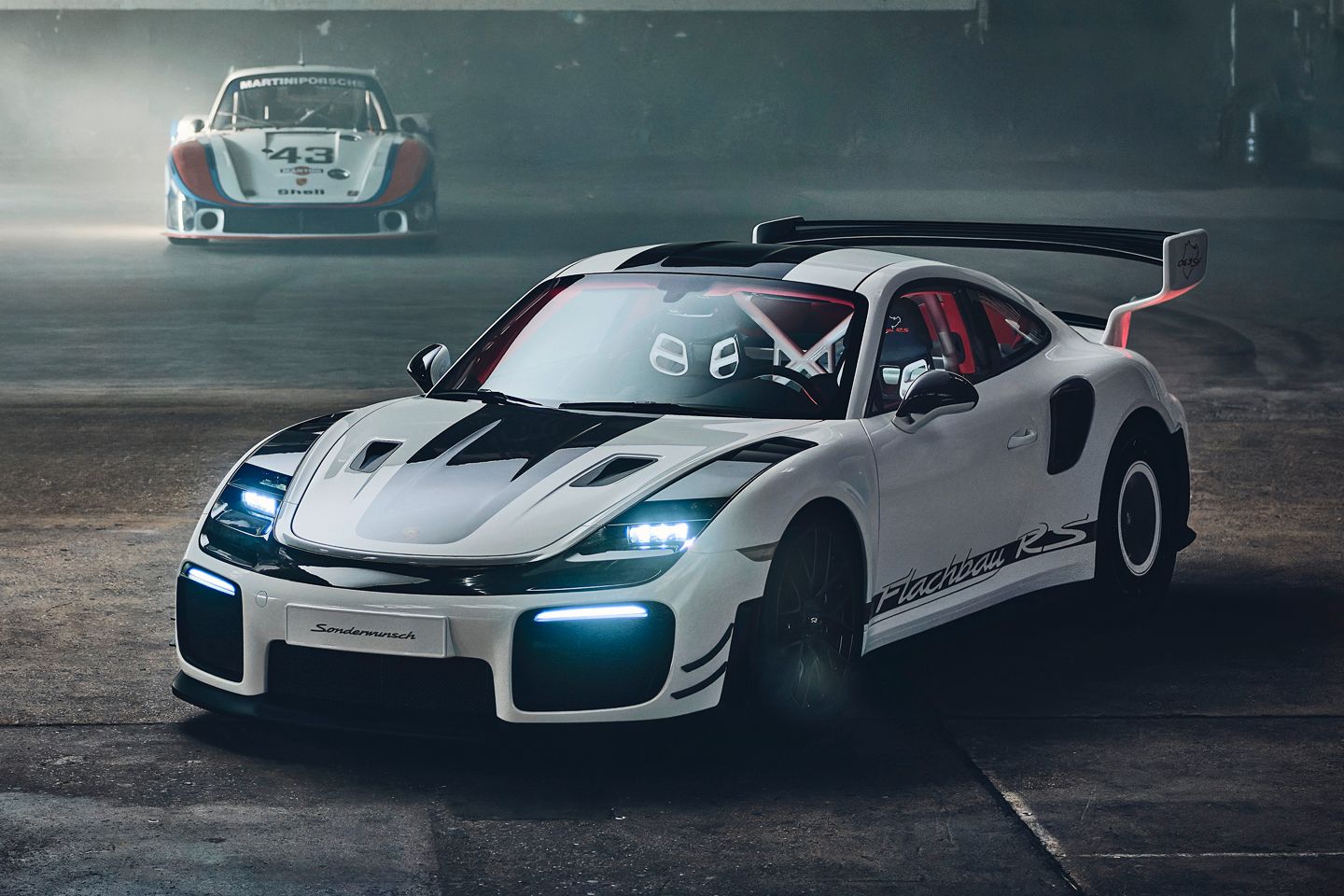
Porsche Flachbau RS Revives the Iconic 911 Slantnose as a One-Off Masterpiece
Porsche’s Sonderwunsch program has revealed the Flachbau RS, a one-off street-legal machine that brings the legendary slantnose 911 silhouette back to production reality by transforming a 2018 911 GT2 RS. Commissioned by a mystery European customer at a cost of several million dollars, according to reporting by The Drive, the project required an eight-year-old donor car to be torn apart, re-engineered, and reassembled with contemporary aerodynamics and a low-tech caged interior.
The Tech TL;DR:
- The Build: A custom one-off Porsche 911 GT2 RS transformed into a modern slantnose tribute by the Sonderwunsch division, Porsche, Manthey, and Weissach strike teams.
- The Aero: Features sloping, louvered front fenders, custom splitters, and a patented rear wing generating up to 1,221 pounds of downforce at its 211 mph top speed.
- The Hardware: Retains the stock 3.8-liter twin-turbo flat-six engine producing 700 horsepower and 553 lb-ft of torque while shedding 70 pounds through interior stripping.
Engineering the Moby Dick Homage Across Three Years of Development
Over a three-year development cycle, an integrated team of designers, engineers, and specialists from Porsche, Manthey, and Weissach worked to realize the customer’s vision for a street-legal homage to the 935/78 race car known as Moby Dick, per The Drive. That legendary race car served as the architectural inspiration for the original factory Flachbau models sold in extremely limited numbers between 1982 and 1989. The client specifically requested that the powertrain remain untouched, preserving the stock 3.8-liter twin-turbo flat-six block, but authorized a complete reimagining of the bodywork and cabin.
Longtime designer Grant Larson, who also penned the modern 935 concept shown at Rennsport Reunion in 2018, finalized the visual architecture for the Flachbau RS just prior to his retirement, according to The Drive. The sloping, louvered front fenders required a completely redesigned front bumper, an updated splitter, super-slim headlights, and an engineered reconfiguration of the fuel filler mechanism. Manthey contributed specialized front-end aerodynamics, including custom canards and underbody elements designed to manage high-speed airflow.
Cabin Architecture and Weight Reduction Metrics
Inside the cockpit, the build strips away non-essential systems to achieve a bantamweight profile. The cabin retains elements of the donor car’s red and black colorway alongside carbon fiber trim, but eliminates the entire infotainment and audio stack. Where a dashboard screen once resided, technicians installed a leather-lined storage cubby, and sound deadening materials were systematically removed to expose painted metal surfaces and the wiring harness, dropping 70 pounds compared to a stock GT2 RS.
At the rear, a massive wing featuring S-shaped mounts operates across three distinct configurations to optimize downforce. The assembly delivers up to 1,221 pounds of downward force over the rear axle at the car’s 211 mph terminal velocity. Because the vehicle must comply with strict street-legal requirements, Porsche subjected the prototype to standard homologation pipelines, including virtual crash testing, wind tunnel validation, endurance runs, vibration trials for the rear wing, and 50 high-speed laps around the Nürburgring.
# Architectural Telemetry Snapshot: Porsche Flachbau RS
[Chassis]      2018 911 GT2 RS (Sonderwunsch Modified)
[Powertrain]   3.8L Twin-Turbo Flat-Six
[Output]       700 HP / 553 lb-ft Torque
[Aero Max]     1,221 lbs Rear Downforce @ 211 MPH
[Weight Delta] -70 lbs via Sound Deadening Removal
Homologation Realities and the Limits of Modern Restomods
Despite consumer demand reflected in automotive outlets like Auto Express and Autocar, Porsche has confirmed that the Flachbau RS remains a strict one-off commission rather than a harbinger of a wider production run. The rigorous validation process required for road legality—specifically pedestrian impact regulations—prevented engineers from deploying authentic 1980s-style pop-up headlights, forcing the adoption of the ultra-slim fixed lamp clusters.

Editorial Kicker
The Flachbau RS demonstrates how ultra-exclusive manufacturing programs can leverage legacy motorsport silhouettes without compromising modern aerodynamic efficiency.